
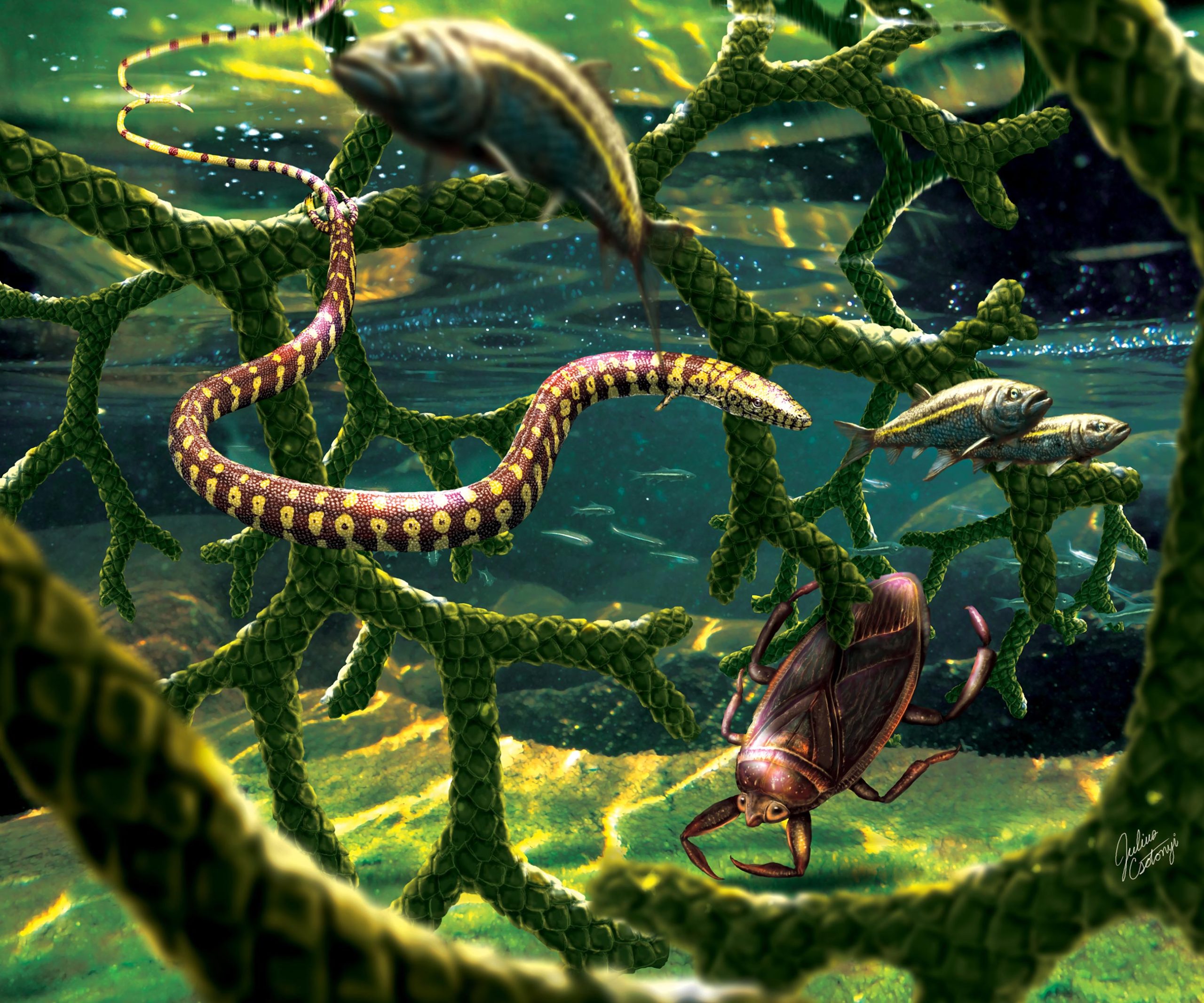
Tetrapodophis, once thought a four-legged snake, is now identified as a bizarre lizard.
More than 120 million years ago in what is now modern Brazil, an ancient waterway was filled with all manner of strange creatures. These included dinosaurs, pterosaurs, sharks, bony fishes, a dizzying array of insects, strange plants and an oddly long and small lizard: Tetrapodophis amplectus.
In 2015, the journal Science published a paper claiming that this elongate lizard was a snake with four legs. The discovery of such a specimen could tell us a great deal about the pattern and process of snake evolution — if it was indeed a snake.
Lizard, Not Snake
Extraordinary claims attract extraordinary attention, and this means such claims require reanalysis — and possibly refutation or corroboration. In scientific research, the data must fit the hypothesis, and if it does not, then the hypothesis is rejected.
In late 2015, two members of our research team traveled to Solnhofen, Germany, to study the specimen and conduct firsthand observation of the anatomy of the fossil. After all, the preserved anatomy is the data upon which all subsequent hypotheses are based.
The results of our team’s detailed anatomical restudy of Tetrapodophis refute the hypothesis that it is a snake. We also challenged the claims in the original article that it possessed both a wide gape for eating large prey and the ability to coil its body and constrict its prey.
Using these corrected data, our analyses of evolutionary relationships found Tetrapodophis to be a dolichosaur, not a snake. Dolichosaurs are an extinct group of elongated, limb-reduced lizards related to mosasaurs. Both are thought to be close relatives of snakes. It is therefore not surprising that there are some anatomical similarities between Tetrapodophis and snakes.
It’s All in the Bones
Many fossils are found by splitting open a slab of rock using a hammer and chisel. The fossil of Tetrapodophis was found this way and is now on two slabs of rock.
The skull slab includes impressions of the skeleton, while the second slab preserves the natural mold of the skull and most of the remaining skeleton. The preserved skull bones are shattered into tiny bits and the ones that remain intact are from the left side of the skull. Only the front part of the left lower jaw is relatively well-preserved and it is similar to that of a dolichosaur, not a snake.
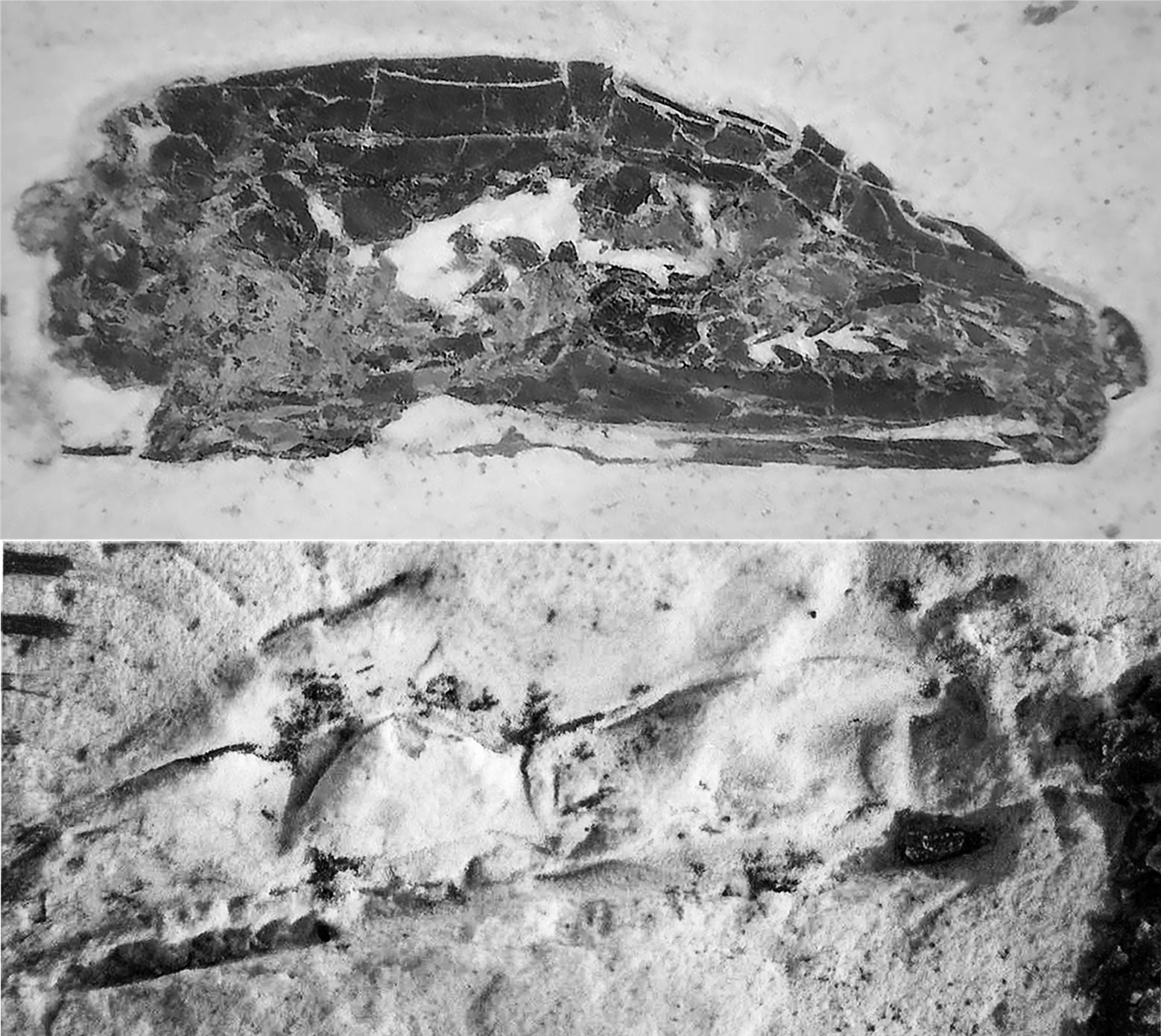
The bones of the right side of the skull are gone, but their impressions are preserved on the other slab and were not described in the first article detailing the find. The bones behind the eye that form a barrier for the jaw closing muscles are complete in Tetrapodophis. But they are absent in all fossil and living snakes.
The quadrate bone, which suspends the lower jaw from the skull in lizards, is also preserved. In Tetrapodophis it is identical to that of a dolichosaur and other mosasaurians, not as in snakes.
Limb reduction and loss are not unique to snakes. Numerous living lizards — for example, skinks, anguids and pygopodid geckos — are legless or limb-reduced. They all evolved leglessness independent of each other — known as convergent evolution — but retained the skull features of their respective lizard kind. The same is true for snakes.
A Bizarre Little Lizard
Tetrapodophis is an amazing and bizarre little lizard even without being interpreted as a four-legged snake. It is very small, yet the body skeleton, from the back of the skull to the tip of the tail, is exceptionally elongated. Unlike any other lizard with limbs, Tetrapodophis has about 148 vertebrae between the front legs and the hips. Also, its tail is very long and has an additional 112 vertebrae.
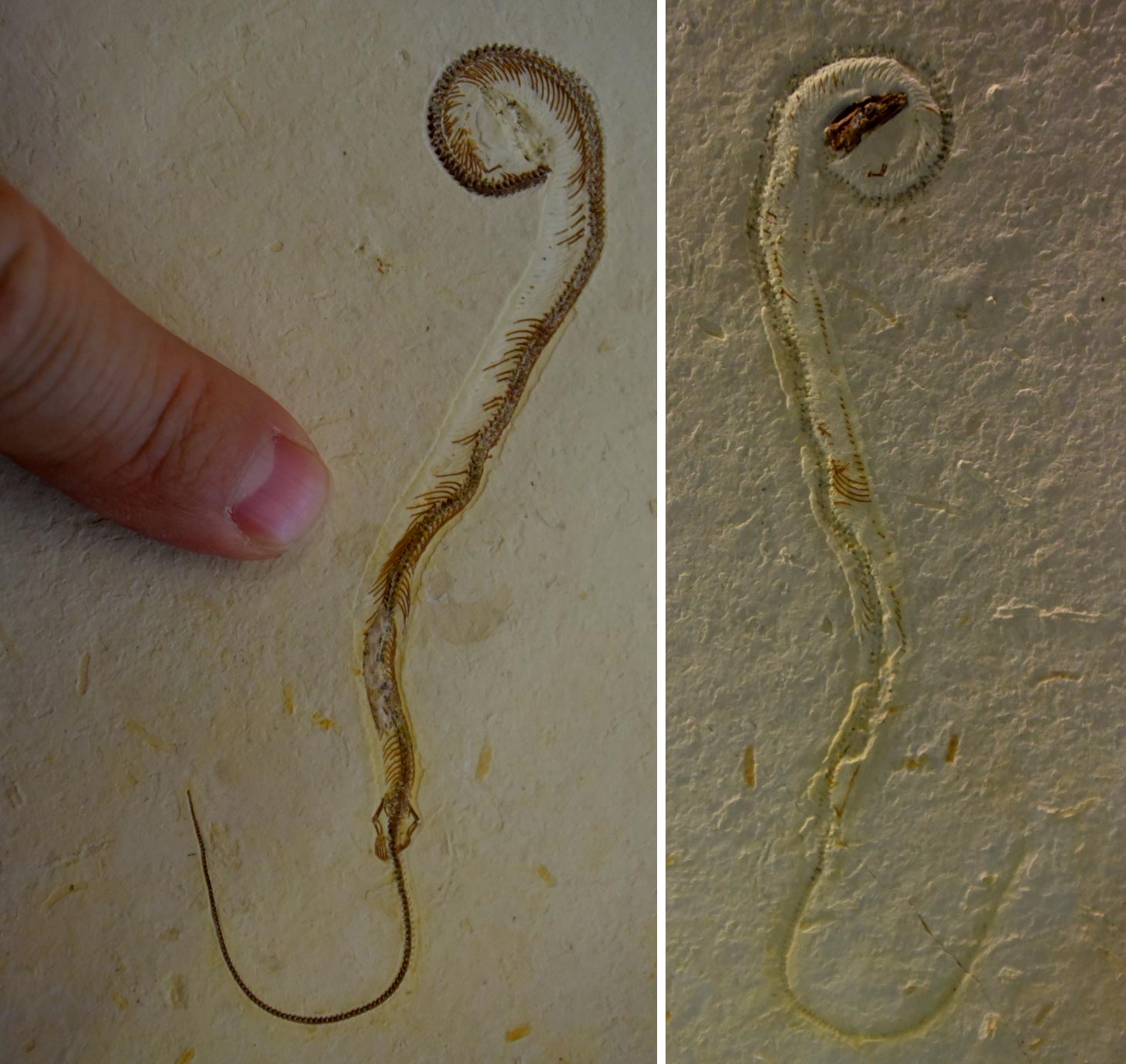
No other lizard with four legs shows this anatomy, and it is not seen or predicted in snakes either. The body is flattened from side to side, which would have helped it swim in the water. The limbs are tiny, with the front legs being almost vestigial, and most of the wrist and ankle elements are not ossified. Clearly, it could not walk on land using its limbs. Nor could it dig or grasp any prey as originally argued.
Fossils and Belonging
Scientific research is not independent from social, political, and economic contexts. Scientific specimens — in paleontology, genetics, archeology or any other field — have a provenance and are intimately linked to people, culture, countries and laws.
Scientific specimens are governed by legislation that outlines how they can be collected and used. This includes countries that in the past suffered from “parachute science” where specimens were removed, legally or illegally, and local scientists were excluded from participating in the research. This practice is now widely condemned as scientists collectively work to decolonize science.
Unfortunately, Tetrapodophis is embroiled in such legal and ethical issues. Since 1942, the law in Brazil has been clear: no fossils can be privately owned. And since 1990, international researchers may only collect in Brazil in partnership with local institutions. The type specimen — the specimen used as a reference point — of any new species must also remain in Brazil.
These legal requirements have been ignored and publicly mocked by one of the authors of the 2015 study.
As of November 2021, the specimen of Tetrapodophis remains in Germany in a private collection, on loan to a private museum: the Bürgermeister-Müller Museum Solnhofen. Its passage from Brazil to that private German collection is unknown.
Ethical Matters
The scientific study of privately owned fossil specimens also runs afoul of ethics policies, such those of the Society of Vertebrate Paleontology. If science is based on the ability to test and retest ideas by re-examining data, then the specimens must always be openly available for study. The concern in paleontology is that private owners of specimens can block that freedom of access and thus unethically limit the science.
Tetrapodophis is proof of this problem. Because of damage to the specimen in 2016 by another research team, and contrary to claims that the specimen would be publicly accessible, the owner blocked access to the specimen.
Some scientists have pronounced that this means Tetrapodophis is dead to science.
We disagree with this conclusion. Despite the controversies, the original paper has not been retracted by Science, and there are also thousands of published references to “Tetrapodophis the four-legged snake.”
We completed our re-examination of the specimen in an effort to correct the record and describe this bizarre fossil lizard for what it is. We also hope that by doing so, we will have reignited the discussion around the specimen with the goal of repatriating it to Brazil.
Written by:
- Michael Caldwell, Professor of Vertebrate Palaeontology, University of Alberta
- Tiago Rodrigues Simoes, Postdoctoral Fellow, Organismic & Evolutionary Biology & Museum of Comparative Zoology, Harvard University
This article was first published in The Conversation.
For more on this research, see Paleontologists Debunk “Snake With Four Legs” Fossil Thought To Be Missing Link.
Never miss a breakthrough: Join the SciTechDaily newsletter.
Follow us on Google and Google News.