
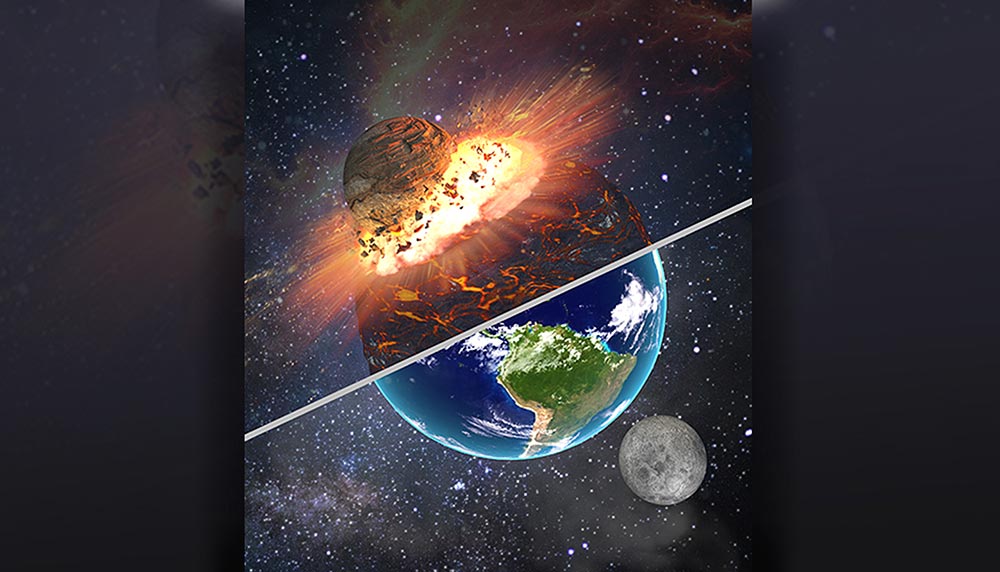
LLNL research shows Earth likely “born with” its water, based on lunar rock isotopic analysis, ruling out meteorites as the source.
Earth’s supply of water is incredibly important for its ability to sustain life, but where did that water come from? Was it present when Earth formed or was it delivered later by meteorites or comets from outer space?
Using the Moon to Unlock Earth’s History
The source of Earth’s water has been a longstanding debate and Lawrence Livermore National Laboratory (LLNL) scientists think they have the answer — and they found it by looking at rocks from the moon.
Since the Earth-moon system formed together from the impact of two large bodies very early in solar system history, their histories are very much linked. And since the moon lacks plate tectonics and weathering, processes that tend to erase or obscure evidence on Earth, the moon is actually a great place to look for clues to the history of Earth’s water.
Even though close to 70 percent of Earth’s surface is covered with water, overall the planet is a relatively dry place compared to many other objects in the solar system. And the moon is even drier. Conventional wisdom was that the lack of volatile species (such as water) on the Earth — and particularly the moon — was due to this violent impact that caused depletions in volatile elements.
Isotopic Clues from Lunar Rocks
But by looking at the isotopic makeup of lunar rocks, the team found that bodies involved in the impact that formed the Earth-moon system had very low levels of volatile elements prior to the impact, not because of it. Specifically, the team used the relative amount of the volatile and radioactive isotope rubidium-87 (87Rb), which is calculated from its daughter isotope strontium-87 (87Sr), to determine the budget of Rb in the Earth-moon system when it formed. The team found that because 87Sr, a proxy for the moon’s long-term volatile budget, was so low the bodies that collided must have both been dry to start with, and not much could have been added since.
“Earth was either born with the water we have, or we were hit by something that was basically pure H2O, with not much else in it. This work eliminates meteorites or asteroids as possible sources of water on Earth and points strongly toward the ‘born with it’ option,” said cosmochemist Greg Brennecka, a co-author of the paper.
The Inner Solar System and the Earth-Moon Collision
In addition to greatly narrowing the potential source of Earth’s water, this work additionally reveals that the large bodies that collided must have both come from the inner Solar System, and the event could not have happened prior to 4.45 billion years ago, greatly reducing the formation window of the moon.
According to Lars Borg, the lead author of the study: “There were only a few types of materials that could have combined to make the Earth and moon, and they were not exotic — they were likely both just large bodies that formed in approximately the same area that happened to run into one another a little more than 100 million years after the solar system formed…but lucky for us, they did just that.”
Reference: “The origin of volatile elements in the Earth–Moon system” by Lars E. Borg, Gregory A. Brennecka and Thomas S. Kruijer, 14 February 2022, Proceedings of the National Academy of Sciences.
DOI: 10.1073/pnas.2115726119
The research appears in the Proceedings of the National Academy of Sciences. LLNL scientist Thomas Kruijer also contributed to the research. The work was funded by NASA and the Laboratory Directed Research and Development program.
Never miss a breakthrough: Join the SciTechDaily newsletter.
Follow us on Google and Google News.
17 Comments
De milliards d’années, la terre avec sa gravité a pu sans doute de capturer la vaporisation de Mercure et de Vénus et pourquoi pas aussi celle de la lune et les hydrogènes aux alontours spacieux y compris des météorites qui contiennent ces précieuses liguides. Déjà que la terre ait plus d’eau imaginable pour maintenir la vie. Sinon, elle devrait s’évaporiser comme la planète Mars.
Suivant ta logique il me semble que la force de gravite des autres planetes etait nul!
ca n’a pas de sens!
“Even though close to 70 percent of Earth’s surface is covered with water, overall the planet is a relatively dry place compared to many other objects in the solar system.” That’s a puzzling statement. What other objects have more than 70% of their surface covered with water? Some of Earth’s water was lost by stratospheric photodissociation leaving oxygen behind. And the oldest rocks on Earth contain evidence of that oxygen, along with evidence of photosynthesis. Earth’s water must have formed very quickly regardless of where it came from.
The Bible states God brought the water to Earth. Now evidence proves that.
Our planet created all the water it possesses exactly like the way a catalytic converter creates water dripping from a tailpipe. The heat from the early Earth heated hydrocarbons to the temperature needed to isolate the water. This happened for 10’s of millions of years.
I Agree, God said it, God did it, Who am I to disagree with the ONE true GOD!!!!!
GOD
Save some money and read the bible and you will see how everything was created.in the beginning God created everything!!!
” . . . the lack of volatile species (such as water) on the Earth . . .”
Water is a “species”? All this time I thought it was a compound. What am I missing?
https://en.wikipedia.org/wiki/Chemical_species
And God said, Let there be a firmament in the midst of the waters, and let it divide the waters from the waters.
And God said, Let the waters under the heaven be gathered together unto one place, and let the dry land appear: and it was so.
And God called the dry land Earth; and the gathering together of the waters called he Seas: and God saw that it was good.
Genesis:1:6-10
If the Scientists can humbly accept the Scripture, they will discover answers to many questions
I got lost at the end. What was the conclusion? Was the earth born with water, or did it collide with another body that had it? If water came about from a collision, why do we think the other body had the water, and not the other way around?
More than half those who responding to this article think it was God who created the water on our planet.
When ignorance replaces curiosity and knowledge like this you know our society could be in trouble.
Humans need to know that everything has a has a cause! There is an intelligent supper power who created everything we know and those we do not know! Why are we questioning about the source of water, while we do not even know our on source! We do not know what life is! We cannot restore life after is lost!
Water,falls from and, because of grace!,” FOR mercy sakes!!”,
AKSHUALLY IT WAS ZARATHUSTRA TEARS THAT MADE THE OCEANS GET REAL ABRAHAMICS