
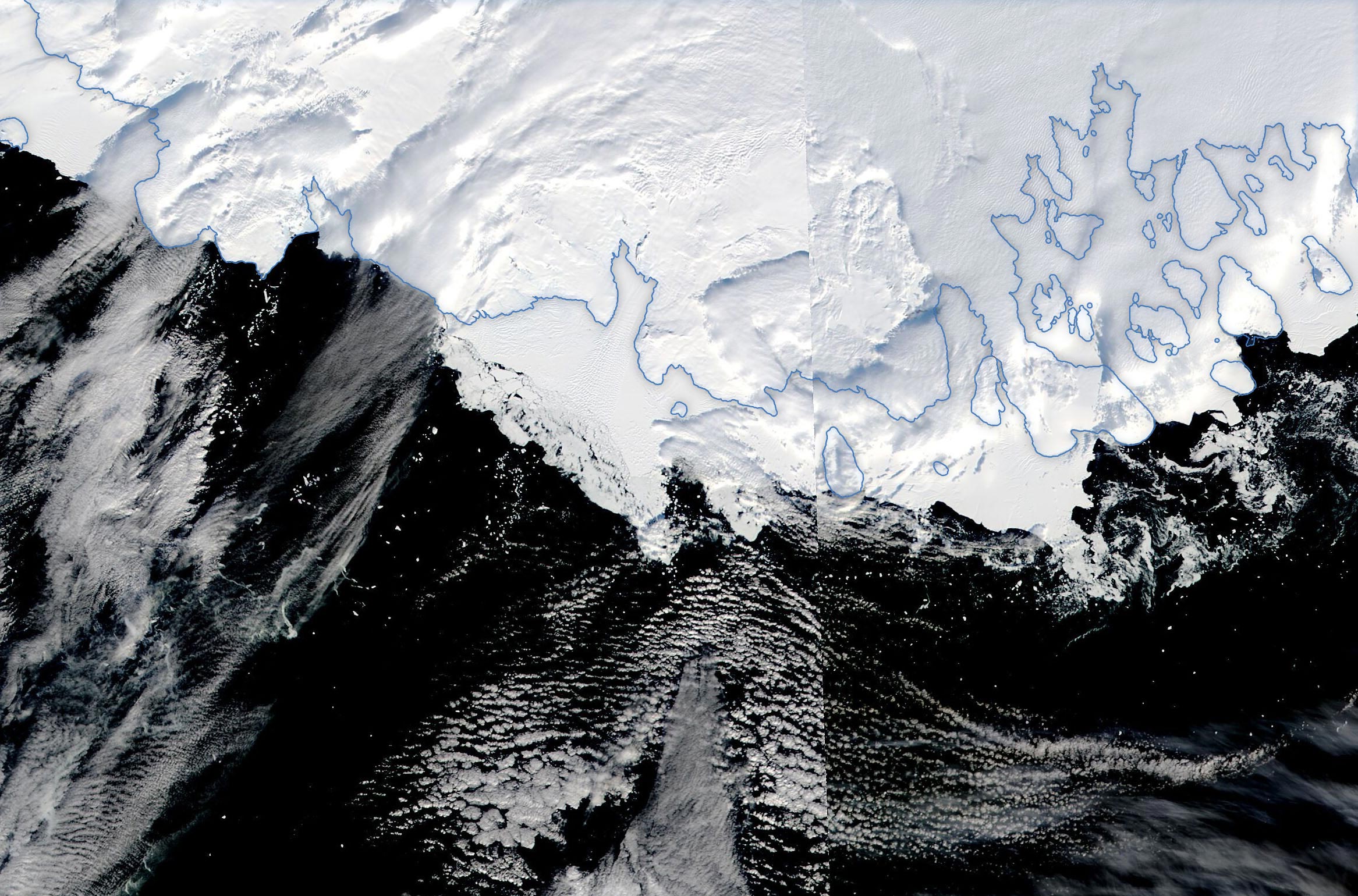
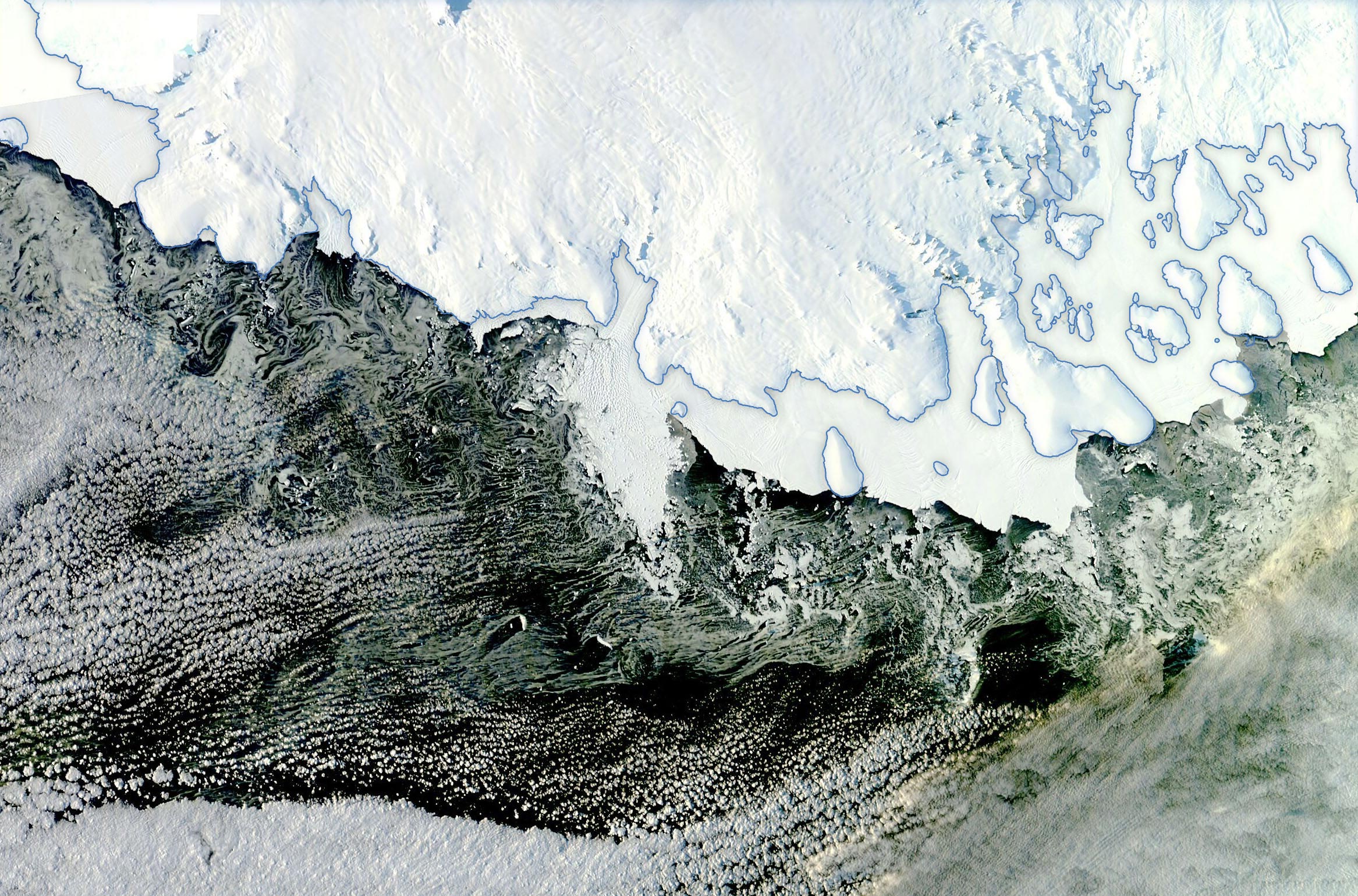
In March 2022, old sea ice crumbled away as new ice formed off the coast of Antarctica’s Marie Byrd Land.
Sea ice around Antarctica started to regrow after reaching the lowest extent ever observed in the satellite record in late February 2022. But on local scales, this transition from melting to freezing can display nuance. For example, near Land Glacier in West Antarctica, an area of old sea ice broke up as new ice formed in March. Around the same time, part of the glacier’s ice tongue crumbled away.
Michael Lowe, an analyst at the U.S. National Ice Center who pointed out the changes, has been closely watching this part of the Antarctic coastline, known as Marie Byrd Land. “I’ve had my eye on that area over the past two months as a large area of very old fast ice began to break apart,” Lowe said. “When comparing two SAR images from consecutive days I saw that the tip of the Land Glacier was starting to break up.”
The changes are also apparent in this pair of natural-color images acquired on February 24 and March 23, 2022, by the Moderate Resolution Imaging Spectroradiometer (MODIS) on NASA’s Terra and Aqua satellites, respectively.
Symbiotic Relationship Between Glaciers, Icebergs, and Fast Ice
The February image displays a vast expanse of sea ice fastened to the edge of the coastline, and to the Land Glacier’s ice tongue and icebergs. Lowe explained that this “fast ice” often has a symbiotic relationship with glaciers and icebergs. “The glaciers and grounded bergs allow sea ice to accumulate and ‘fast’ in a stable fashion,” he said. “This fast ice then helps anchor those bergs and glaciers as it thickens into old ice over years.”
But recent research using satellite observations showed that fast ice around parts of Antarctica, including off the coast of Marie Byrd Land, has been decreasing since MODIS records began around 2000. Still, a substantial patch remained at the time of the February image. By March, much of this old fast ice had broken apart.
According to Frazer Christie, a glacier geophysicist at the Scott Polar Research Institute at the University of Cambridge, the loss of fast ice may have had further consequences. It is possible, he said, that the quick evacuation of fast ice between February and March, in addition to the longer-term losses, may have contributed to the rifting and ultimate calving of Land Glacier’s ice tongue.
Christie points to a similar instance at the fast-flowing Totten Glacier in East Antarctica. There, losses of seasonal fast ice have caused the glacier’s front to speed up by as much as 100 meters per year. “An increasing body of research has begun to show the important role sea ice plays in congealing together and buttressing both ice tongues and ice shelves,” he said.
Iceberg Movements and the Role of the Coastal Current
Notice in the March image that the icebergs appear to be turning west into the direction of the remaining sea ice. Christie explained that the bergs are being carried along with the Antarctic Coastal Current, which flows westward around the continent parallel to the coastline. The Coriolis effect will also influence the bergs’ flow, deflecting them toward the left of their path.
Iceberg calving is a natural process for glaciers that terminate in the ocean. “While Land Glacier has been observed to retreat, thin, and speed up in recent years, there is no evidence to suggest that its recent calving is related to anthropogenically forced climate change,” Christie said. “Instead, its behavior most likely reflects the natural calving lifecycle common to all Antarctic ice shelves and marine terminating glaciers.” The glacier last lost a similar amount of floating ice during the austral winter of 2004.
Another stage in the natural lifecycle of sea ice is visible in the March image: the growth of new sea ice. The smooth streaks and swirls are “nilas”—young ice that often forms thin sheets, generally no more than 10 centimeters thick. (Note that the green-yellow tinge is largely an effect of low light and automatic color corrections.) New ice that appears streaky is lining up with the direction of surface winds; ice that displays a swirling pattern is likely being pushed around by winds and ocean circulation patterns, or “eddies.”
As the next few winter and summer seasons come and go, scientists are curious to see what becomes of the glacier, icebergs, and sea ice off this part of Marie Byrd Land. Lowe added: “We’ll be watching to see if the bergs that broke off the Land Glacier ground and allow a new area of old fast ice to form over the next few years, restabilizing this area.”
NASA Earth Observatory images by Joshua Stevens, using MODIS data from NASA EOSDIS LANCE and GIBS/Worldview. Story by Kathryn Hansen with input from Christopher Shuman (UMBC/GSFC), Michael Lowe (USNIC), and Frazer Christie (U. Cambridge).
Never miss a breakthrough: Join the SciTechDaily newsletter.
Follow us on Google and Google News.
3 Comments
“There, losses of seasonal fast ice have caused the glacier’s front to speed up by as much as 100 meters per year.”
Might it be that he has the cause and effect reversed? That is, the glacier speeding up might have been responsible for shattering the ice.
Just think about this. If mega tons of ice fall into the ocean. In due time it will cause cooling of the many layers of currents. Causing a cool down around the worrlds oceans. Leading to a new beginning of new ice age. Chasing global wsrming away.
Hopefully hydroxychloroquin and ivermectin can help humans survive the impending ice age