
The surface melting of a high-elevation glacier in the Alps has rendered it unusable for scientific research.
Glaciers are natural archives of past climate. In their frozen layers lies evidence of Earth’s changing temperature and atmospheric composition. But as the climate warms, some of the longest records of our changing planet are melting away.
The Shrinking Corbassière Glacier
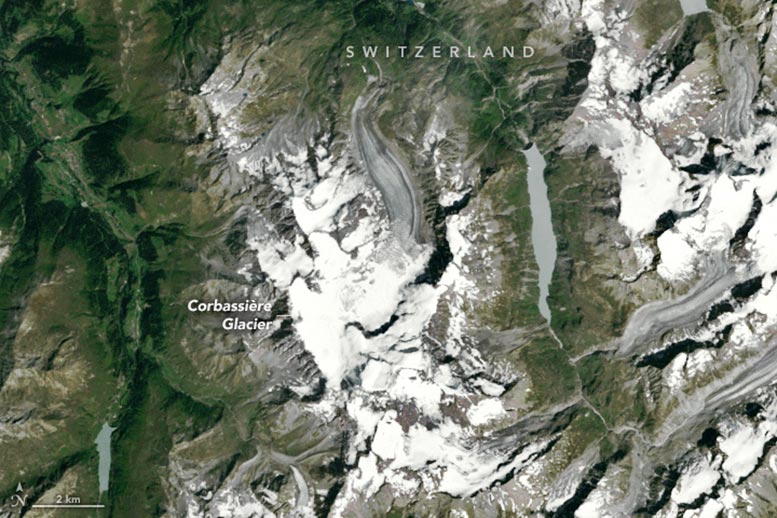
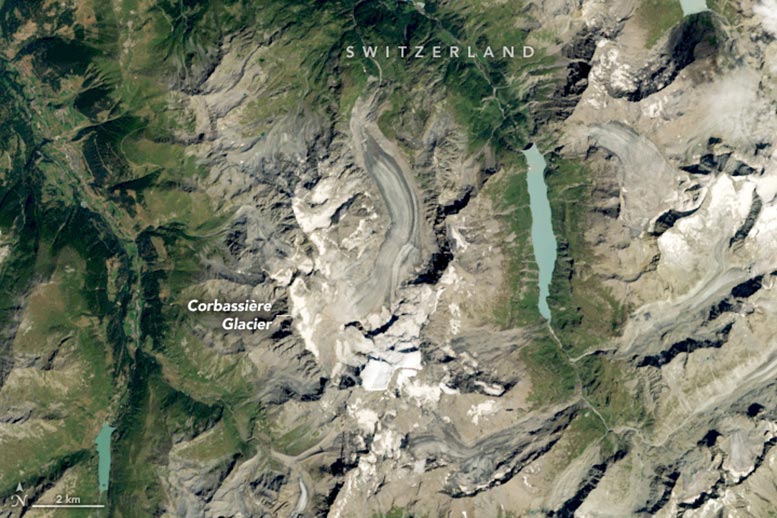
One such archive is the Corbassière glacier in Switzerland. The high-altitude glacier is situated on the flanks of Grand Combin, one of the highest peaks in the western Alps. It has suffered the same fate as many alpine glaciers in Switzerland, which collectively have lost more than half of their volume since the 1930s. Some of the more recent changes at Corbassière glacier are visible in these images, captured in August 2001 (left) and in August 2023 (right). They were acquired by Landsat 5 and Landsat 8, respectively. In just over two decades, Corbassière has shrunk in area and surface mass. The glacier was darker in 2023 due to lack of snow, and the glacier’s tongue had retreated.
Vital Research at Risk
A research team from Switzerland and Italy took cores of ice from Corbassière glacier in 2018 and 2020 to reconstruct past concentrations of the region’s aerosols, or tiny airborne particles that were suspended in the atmosphere and then deposited on the ice. Such information from glaciers around the world can provide clues about past environmental conditions thousands of years ago.
Ice cores contain ammonium, nitrate, and sulfate ions—signatures of aerosols lacing the snow that’s deposited on glaciers year after year. Ion concentrations are lower in winter than in summer because less polluted air can rise from the valley when the air is cold.
The team analyzed a core drilled from the glacier in 2018 and found seasonal fluctuations in the amount of ion deposits throughout the ice core, as expected.
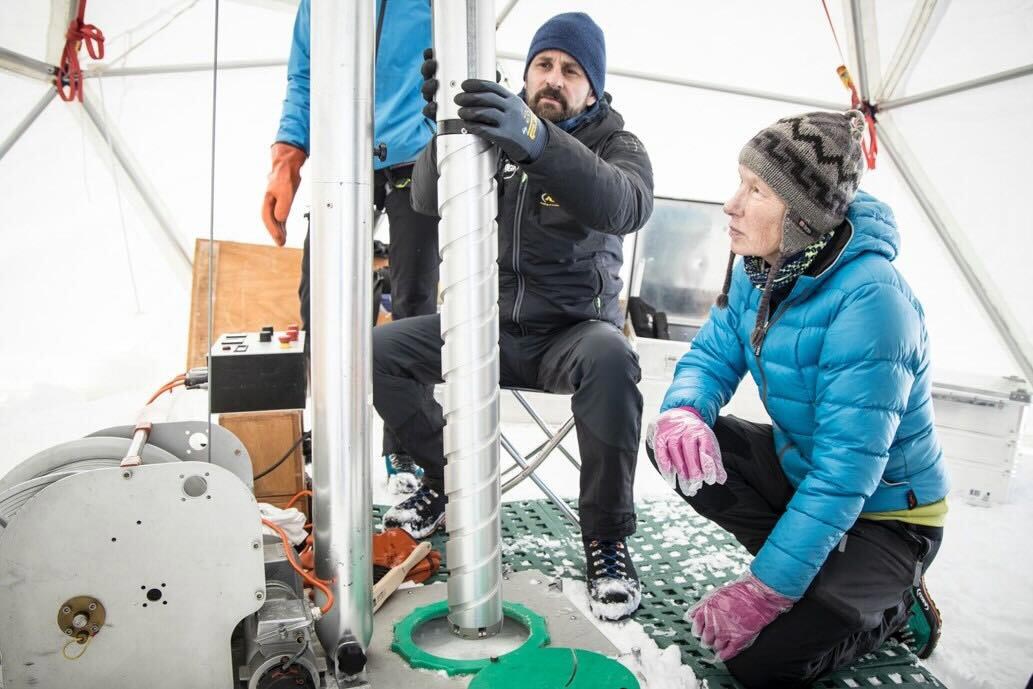
“But when we went to core the glacier in 2020, we noticed melting on the surface right away,” said Margit Schwikowski, who is an environmental chemist at Paul Scherrer Institute in Switzerland. Schwikowski led the team of researchers that analyzed the ice cores with PhD student Carla Huber. In the 2020 core, seasonal fluctuations of ions were only present in the upper three or four annual layers. Deeper in the ice (and farther back in time), the scientists noticed fewer ions overall and that their amounts fluctuated less than expected.
As reported in Nature Geoscience, the team found evidence that previous melting of the glacier’s surface between 2018 and 2020 likely penetrated the glacier layers below and carried away the aerosol ions. This melting rendered the core unusable in the team’s research, and other attempts to core the glacier had the same result. The valuable information stored in the ice was destroyed.
Preserving Our Climate Legacy
Schwikowski and other ice core experts from around the world are part of an effort to preserve cores from the last remaining glaciers. The initiative, led by the Ice Memory Foundation, aims to obtain ice cores from 20 endangered glaciers around the world in 20 years and collect them in a global climate archive.
“Glaciers are retreating worldwide, and we may find similar issues at other sites,” said Schwikowski. Even at the highest altitudes in the Alps, she added, “glaciers are on the verge of becoming unsuitable as natural paleo-archives.”
Reference: “High-altitude glacier archives lost due to climate change-related melting” by C. J. Huber, A. Eichler, E. Mattea, S. Brütsch, T. M. Jenk, J. Gabrieli, C. Barbante and M. Schwikowski, 26 January 2024, Nature Geoscience.
DOI: 10.1038/s41561-023-01366-1
NASA Earth Observatory images by Wanmei Liang, using Landsat data from the U.S. Geological Survey.
Never miss a breakthrough: Join the SciTechDaily newsletter.
Follow us on Google and Google News.
1 Comment
“The surface melting of a high-elevation glacier in the Alps has rendered it unusable for scientific research.”
It depends on the type of scientific research. Archaeology has benefited significantly, particularly in in the Alps and in Norway, from surface melting. One isn’t going to find the likes of The Iceman in a static glacier or ice field.