
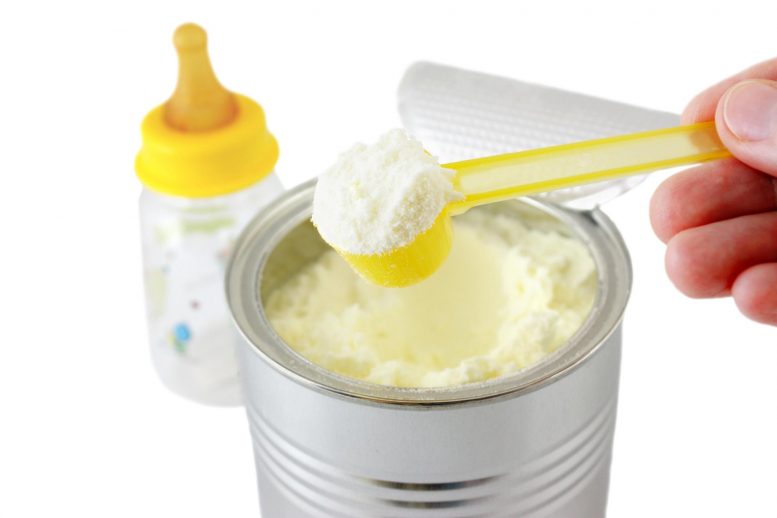
Scientists Are Concerned That Young Children May Be Drinking Too Much Specialized Formula
A study has revealed that the dairy-free trend has started to impact babies.
According to recent research that was published in the journal Clinical and Experimental Allergy, infant formula prescriptions have increased in England, Norway, and Australia in recent years, at rates that are over ten times higher than what would be predicted given the number of children who have milk allergies.
Prescribed amounts of specialized formula for infants rose 2.8-fold in England from 2007–2018, with similar trends in other regions of the United Kingdom. Amounts rose 2.2-fold in Norway from 2009–2020 and 3.2-fold in Australia from 2001–2012.
The results are troubling since specialized formula has increased sugar content, which could promote obesity and tooth decay in young children.
“These data suggest high levels of milk allergy over-diagnosis and mark an important shift in early child nutrition,” the authors wrote.
Reference: “Trends in use of specialized formula for managing cow’s milk allergy in young children” by Shriya Mehta, Hilary I. Allen, Dianne E. Campbell, Karoline Fagerli Arntsen, Melanie Rae Simpson and Robert J. Boyle, 29 May 2022, Clinical & Experimental Allergy.
DOI: 10.1111/cea.14180
Never miss a breakthrough: Join the SciTechDaily newsletter.
Follow us on Google and Google News.
1 Comment
Perhaps increasing production of goat milk, and switching significant parts of formula production to that would be a good first step. The average mother who has read about increased risk of type 1 diabetes in children fed milk based formulas might be easier to convince if goat milk based formula was readily available, so the choices were not either soy or cows milk or truly odd ingredients. Of course, infants with metabolic disorders will always need very specific formulas that eliminate whatever they can not metabolize, unless there’s a major breakthrough.