
Close Menu
    Facebook X (Twitter) Instagram
    SciTechDaily
    • Biology
    • Chemistry
    • Earth
    • Health
    • Physics
    • Science
    • Space
    • Technology
    Facebook X (Twitter) Pinterest YouTube RSS
    SciTechDaily
    Home»Space»CfA Astronomers Shed New Light on Dust Grains
    Space

    CfA Astronomers Shed New Light on Dust Grains

    By Harvard-Smithsonian Center for AstrophysicsJanuary 18, 20131 Comment3 Mins Read
    Facebook Twitter Pinterest Telegram LinkedIn WhatsApp Email Reddit
    Share
    Facebook Twitter LinkedIn Pinterest Telegram Email Reddit
    star-formation
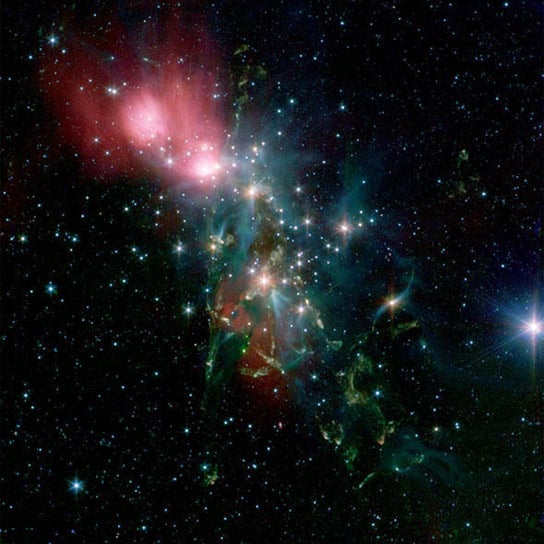
    A region of star formation as seen in a false-color infrared image. The numerous extended greenish filaments are in most cases signs of shock-excited gas produced by jets from young stars in the nebula. New results find that similar fast moving shocks can evaporate water (and most other molecules) frozen onto the surfaces of dust grains in these regions. Credit: NASA and the Spitzer Space Telescope

    A team of astronomers from the Harvard-Smithsonian Center for Astrophysics have completed a series of computations that will shed new light on some of the modern questions in astrochemistry.

    The ubiquitous clouds of gas and dust found between stars provide the natal material for new stars and planets. These clouds are also dynamic factories that produce many complex molecules thanks to their rich environment of stellar radiation, dense gas, and dust grains. The grains (most of which are silicates, analogous to sand) act as miniature chemical laboratories. Atoms and molecules from the gas condense onto their surfaces and then interact with one another to form even more complex species. Water, a particularly abundant species, tends to form a layer of ice on the grain surfaces.

    One of the outstanding set of questions in modern astrochemistry involves the processes that enable newly formed molecules to come off the frozen grains and back into the gas, where they can disperse, radiate, and can be measured with millimeter telescopes. Understanding these processes would also help scientists better characterize the physical conditions in the locations where the molecules are detected.

    New stars host complex environments that include circumstellar disks and dramatic outflows of material in the form of narrow jets. The jets disrupt these environments, and where they collide with the ambient interstellar medium they produce shocks. Astronomers have long known that these shocks, moving at comparatively modest velocities of about ten kilometers per second (about 22,000 miles per hour) can expel surface molecules from grains and prompt the molecules to radiate. In fact, shock velocities are often much faster than this. The shocks can also fracture the grains, thereby injecting silicon oxide molecules (SiO) into the gas. The longstanding problem has been an inability to quantify accurately the shock processes.

    CfA astronomer Sven Van Loo and four colleagues have completed a series of computations that for the first time describe in a self-consistent manner how shocks disrupt grains, and that seems to agree with the observations of gas abundances in many regions. The scientists find that at speeds of 20-25 kilometers (12-16 miles) per second, the grain surfaces are completely vaporized, returning all the ice to the gas as water vapor. Then, once the surface has been completely eroded, the grains begin to release SiO into the gas. Millimeter telescopes have found that SiO gas emission is a ubiquitous signal around young stars. The new research will help scientists determine the kinds of shocks responsible for these regions, in turn shedding light on the jets and young stars that produce them.

    Never miss a breakthrough: Join the SciTechDaily newsletter.
    Follow us on Google and Google News.

    Astronomy Astrophysics Harvard-Smithsonian Center for Astrophysics
    Share. Facebook Twitter Pinterest LinkedIn Email Reddit

    Related Articles

    X-Ray Emission From Mysterious Dark Matter

    Analyzing Dust Storm Sequences on Mars

    Intriguing Remains of a Rare Stellar Explosion Discovered in Milky Way Center

    Puzzling Astrophysics of Quasars in the Early Universe

    Four Exoplanets – Including a Super-Earth Planet – Discovered by High School Students

    Massive Rotating Stars in the Pleiades Cluster

    Astronomers Discover First Cloudless, Jupiter-Like Planet – “Smoking Gun Evidence”

    Chandra X-ray Observatory Studies Extraordinary Magnetar [Video]

    Chandra Studies Extraordinary Magnetar: Fastest Spinning and Possibly the Youngest Magnetar Known

    1 Comment

    1. Michael on June 13, 2013 9:59 am

      That, by any standards, is totally mind blowing information. I am amazed by this universe that we float around in and devour any such data on this and related topics. Every day I learn something new and I am thankful to sites, such as this one, for the information that it provides.

      Reply
    Leave A Reply Cancel Reply

    • Facebook
    • Twitter
    • Pinterest
    • YouTube

    Don't Miss a Discovery

    Subscribe for the Latest in Science & Tech!

    Trending News

    This Copper Drug Clears Alzheimer’s Brain Toxins and Boosts Memory

    Adults Over 65 Lost Massive Amounts of Weight With Ozempic

    How Flocking Birds “Defy” One of Physics’ Most Fundamental Laws

    Physicists Create a New Kind of Schrödinger’s Cat State From Exotic Quantum Building Blocks

    Your Diet Could Be Missing the Key Ingredient for Heart Protection

    Researchers Warn Widely Prescribed Blood Pressure Drugs Could Be Harming Diabetic Kidneys

    James Webb Spots Something Strange Between Day and Night on an Alien Planet

    How Ancient People Moved a 6-Ton Stone 700 Kilometers to Stonehenge

    Follow SciTechDaily
    • Facebook
    • Twitter
    • YouTube
    • Pinterest
    • Newsletter
    • RSS
    SciTech News
    • Biology News
    • Chemistry News
    • Earth News
    • Health News
    • Physics News
    • Science News
    • Space News
    • Technology News
    Recent Posts
    • 2,000-Year-Old Grape Seeds Rewrite the History of Italian Wine
    • Why You Flinch When Someone Else Gets Hurt
    • This Deadly Disease Was Wiping Out Humans 5,500 Years Ago
    • Scientists Uncover Cause of Inflammatory Bowel Disease Solving Decades-Old Mystery
    • The Surprising Reason Swimming Could Be Better for Your Heart Than Running
    Copyright © 1998 - 2026 SciTechDaily. All Rights Reserved.
    • Science News
    • About
    • Contact
    • Editorial Board
    • Privacy Policy
    • Terms of Use

    Type above and press Enter to search. Press Esc to cancel.