
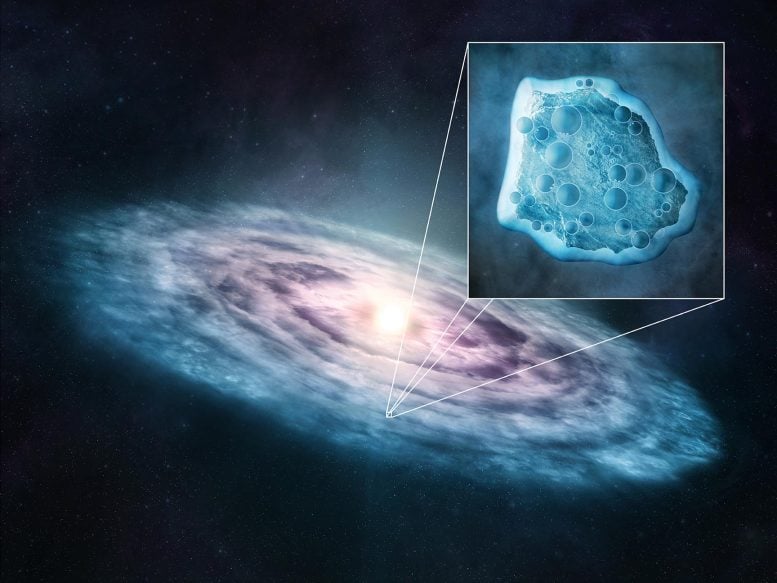
A new model reveals that carbon monoxide in planetary disks has turned into ice, explaining previous discrepancies in its detection and altering our understanding of planetary formation.
Astronomers frequently observe carbon monoxide (CO) in planetary nurseries. Because the compound is ultra-bright and extremely common in protoplanetary disks — regions of dust and gas where planets form around young stars — it is a prime target for scientists.
However, something hasn’t been adding up when it comes to carbon monoxide observations for the last decade or so, according to Diana Powell, a NASA Hubble Fellow at the Center for Astrophysics | Harvard & Smithsonian.
“This may be one of the biggest unsolved problems in planet-forming disks.” Diana Powell
If astronomers’ current predictions of its abundance are correct, a huge chunk of carbon monoxide is missing in all observations of disks.
New Model Sheds Light on Carbon Monoxide Discrepancy
Now, a new model — validated by observations with ALMA — has solved the mystery. It uncovered that carbon monoxide has been hiding in ice formations within the disks. The findings are described on August 22, 2022, in the journal Nature Astronomy.
“This may be one of the biggest unsolved problems in planet-forming disks,” says Powell, who led the study. “Depending on the system observed, carbon monoxide is three to 100 times less than it should be; it’s off by a really huge amount.”
It’s really important too, as carbon monoxide inaccuracies could have huge implications for the field of astrochemistry.
“Carbon monoxide is essentially used to trace everything we know about disks — like mass, composition, and temperature,” Powell explains. “This could mean many of our results for disks have been biased and uncertain because we don’t understand the compound well enough.”
Powell was intrigued by the mystery, so she put on her detective hat and leaned on her expertise in the physics behind phase changes. This is when matter morphs from one state to another, like a gas changing into a solid.
Ice Formations as the Key to the Mystery
On a hunch, Powell made modifications to an astrophysical model that’s currently used to study clouds on exoplanets, or planets beyond our solar system.
“What’s really special about this model is that it has detailed physics for how ice forms on particles,” she explains. “So how ice nucleates onto small particles and then how it condenses. The model carefully tracks where ice is, on what particle it’s located on, how big the particles are, how small they are and then how they move around.”
Hoping to generate an in-depth understanding of how carbon monoxide evolves over time in planetary nurseries, Powell applied the adapted model to planetary disks. To test the model’s validity, Powell then compared its output to real ALMA observations of carbon monoxide in four well-studied disks — TW Hya, HD 163296, DM Tau, and IM Lup.
According to Powell, the results and models worked really well.
The new model lined up extremely well with each of the observations. It showed that the four disks weren’t actually missing carbon monoxide at all — it had just transformed into ice, which is currently undetectable with a telescope.
Radio observatories like ALMA allow astronomers to view carbon monoxide in space in its gas phase, but ice is much harder to detect with current technology. This is especially true for large formations of ice, Powell says.
The model shows that, unlike previous thinking, carbon monoxide is forming on large particles of ice — especially after one million years. Prior to a million years, gaseous carbon monoxide is abundant and detectable in disks.
“This changes how we thought ice and gas were distributed in disks,” Powell says. “It also shows that detailed modeling like this is important to understand the fundamentals of these environments.”
Powell hopes her model can be further validated using observations with NASA’s Webb Telescope. It may be powerful enough to finally detect ice in disks, although that remains to be seen.
Powell, who loves phase changes and the complicated processes behind them, says she is in awe of their influence. “Small-scale ice formation physics influences disk formation and evolution — now that’s really cool.”
Reference: “Depletion of gaseous CO in protoplanetary disks by surface-energy-regulated ice formation” by Diana Powell, Peter Gao, Ruth Murray-Clay and Xi Zhang, 22 August 2022, Nature Astronomy.
DOI: 10.1038/s41550-022-01741-9
Never miss a breakthrough: Join the SciTechDaily newsletter.
Follow us on Google and Google News.