
South American Mummies Were Brutally Murdered, According to Scientific “Detective Work.”
How often did prehistoric human societies engage in violence? Investigating the presence of trauma in early human remains is one way to assess this. For instance, a recent analysis of pre-Columbian remains revealed that 21% of the men had signs of violence-related trauma. The majority of research of this kind has currently concentrated on skulls and other parts of the skeleton, but mummies, with their preserved soft tissues, could be a richer source of information.
In a recent study published in Frontiers in Medicine, researchers examined three pre-Columbian South American mummies that have been preserved in European museums since the late 19th century using 3D computed tomography (3D CT).
“Here we show lethal trauma in two out of three South American mummies that we investigated with 3D CT. The types of trauma we found would not have been detectable if these human remains had been mere skeletons,” said Dr. Andreas G Nerlich, a professor at the Department of Pathology of Munich Clinic Bogenhausen in Germany, the study’s corresponding author.
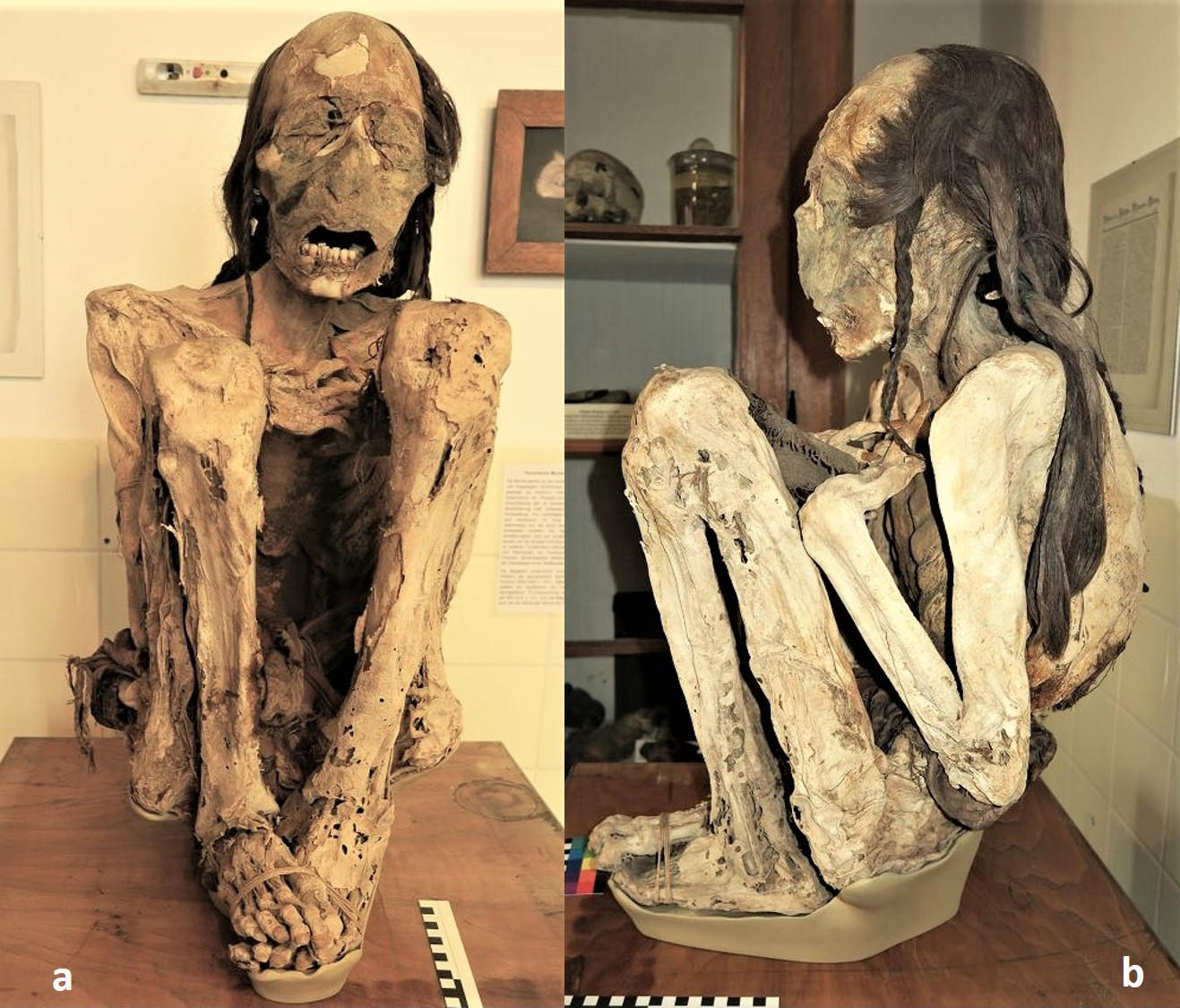
Nerlich and colleagues examined a male mummy at the Philipps University Marburg’s “Museum Anatomicum,” as well as a female and a male mummy at the Delémont Art and History Museum in Switzerland. Mummies may form naturally in dry environments, such as deserts, when a decaying body’s fluids are absorbed quicker than decomposition can occur. These circumstances are common in the southern regions of South America.
Died Between 740 and 1120 Years Ago
The Marburg mummy belonged to the Arica civilization in today’s northern Chile, and based on the burial goods discovered with him, he likely resided in a fishing community. He was buried squatting, with well-preserved but misaligned teeth and some abrasions, as is typical of pre-Columbian individuals who ate maize as a staple food. Scars from past severe tuberculosis were observed in his lungs. The investigators estimated his age to be between 20 and 25 years old and 1.72 meters (68 inches) tall based on the features of the bones. According to radiocarbon dating, he died between 996 and 1147 CE.
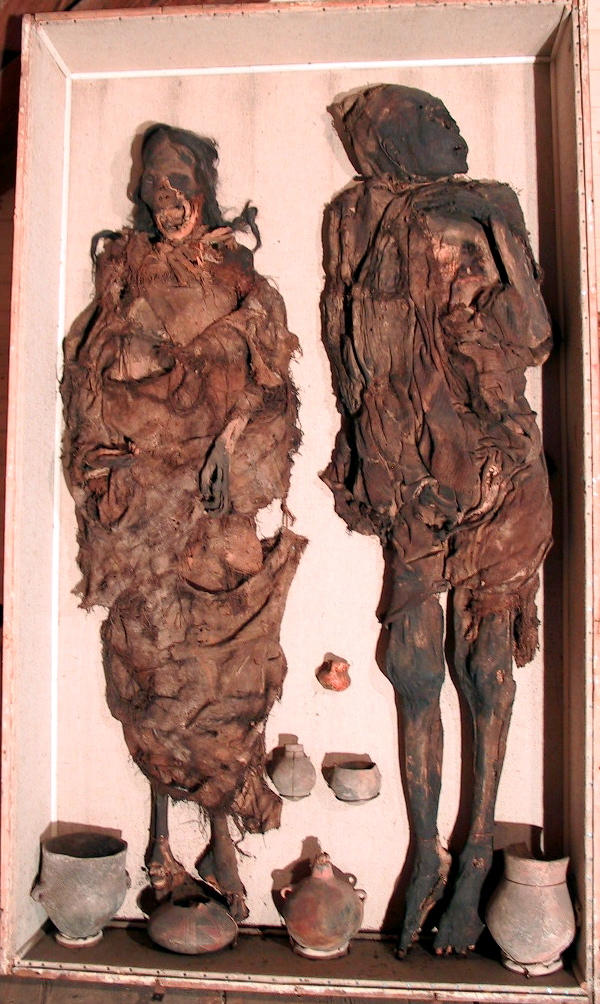
The Delémont mummies probably came from the region of Arequipa in today’s southwestern Peru, based on the ceramics among the grave goods. Both were buried lying face up, which is unusual for mummies from the highlands of South America. Radiocarbon data showed that the man died between 902 and 994 CE, and the woman between 1224 and 1282 CE. They wore textiles woven from cotton and hairs of llamas or alpacas as well as vizcachas, rodents related to chinchillas. The state of the aorta and large arteries showed that the man suffered from calcifying arteriosclerosis in life.
Two Murder Victims
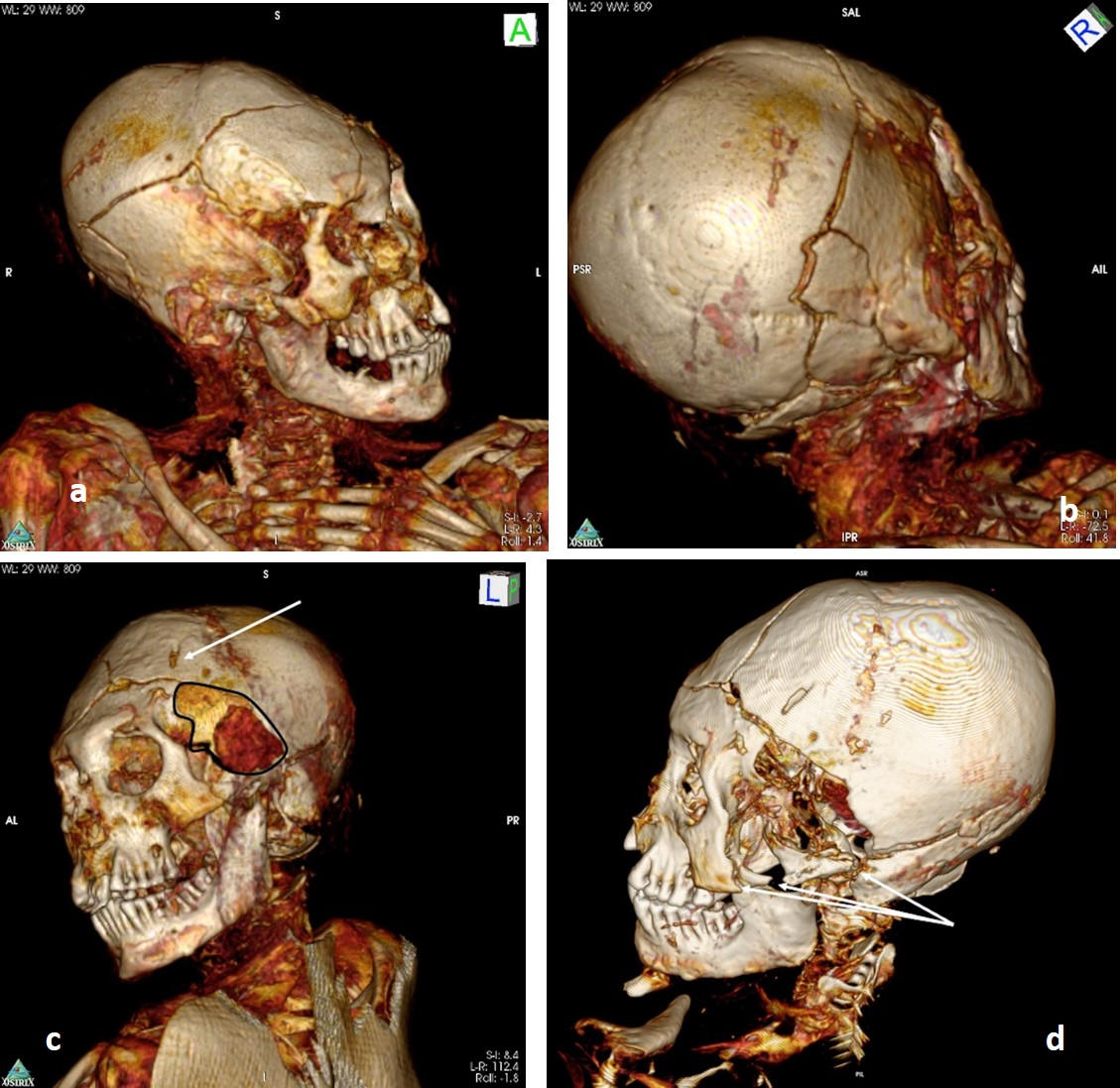
The results show that both male mummies had died on the spot from extreme intentional violence. The authors reconstructed that the Marburg mummy had died because either “one assaulter hit the victim with full force on the head and [a] second assaulter stab[bed] the victim (who still was standing or kneeing) in the back. Alternatively, the same or another assaulter standing on the right side of the victim struck the head and then turned to the back of the victim and stabbed him.”
Similarly, the male mummy from Delémont showed “massive trauma against the cervical spine which represents most likely the cause of death. The significant dislocation of the two cervical vertebral bodies itself is lethal and may have led to immediate death.”
Only the female mummy had died of natural causes. She also showed extensive damage to the skeleton, but this occurred after death, probably during burial and not on purpose.
Nerlich said: “The availability of modern CT scans with the opportunity for 3D reconstructions offers unique insight into bodies that would otherwise not have been detected. Previous studies would have either destroyed the mummy, while X-rays or older CT scans without three-dimensional reconstruction functions could not have detected the diagnostic key features we found here.”
“Importantly, the study of human mummified material can reveal a much higher rate of trauma, especially intentional trauma, than the study of skeletons. There are dozens of South American mummies which might profit from a similar investigation as done here we did here.”
Reference: “Trauma of bone and soft tissues in South American mummies—New cases provide further insight into violence and lethal outcome” by Anna-Maria Begerock, Robert Loynes, Oliver K. Peschel, John Verano, Raffaella Bianucci, Isabel Martinez Armijo, Mercedes González and Andreas G. Nerlich, 9 September 2022, Frontiers in Medicine.
DOI: 10.3389/fmed.2022.962793
Never miss a breakthrough: Join the SciTechDaily newsletter.
Follow us on Google and Google News.
1 Comment
A discovery that will perhaps lead to more knowledge about Ötzi’s death? Btw, I sawx his plastifued body of Ötzi. that’s displayed in Bolzano’s museum. It is stunning