
Close Menu
    Facebook X (Twitter) Instagram
    SciTechDaily
    • Biology
    • Chemistry
    • Earth
    • Health
    • Physics
    • Science
    • Space
    • Technology
    Facebook X (Twitter) Pinterest YouTube RSS
    SciTechDaily
    Home»Space»Astronomers Investigate the Links between Supernova Remnants and Cosmic Rays
    Space

    Astronomers Investigate the Links between Supernova Remnants and Cosmic Rays

    By Harvard-Smithsonian Center for AstrophysicsApril 22, 2013No Comments3 Mins Read
    Facebook Twitter Pinterest Telegram LinkedIn WhatsApp Email Reddit
    Share
    Facebook Twitter LinkedIn Pinterest Telegram Email Reddit
    The Links between Supernova Remnants and Cosmic Rays
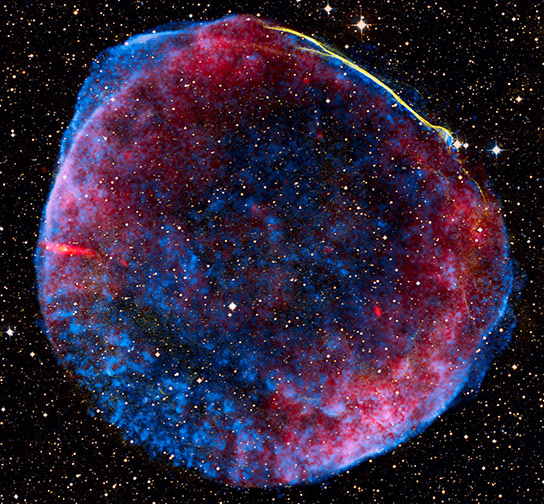
    A false-color, multi-wavelength image of the remnant material from supernova SN1006, an explosion so bright when it occurred in the year 1006 that it reportedly cast shadows at night. New research on SN1006 argues that supernova remnants like this one are likely sources for cosmic rays, the extremely high energy particles that bombard Earth. Credit: NASA Chandra X-ray Observatory

    In a newly published study, astronomers investigate the links between supernova remnants and cosmic rays. Using a new optical spectrometer to analyze the shock activity at the outer edge of supernova SN1006, the astronomers report finding gas motions of over five thousand kilometers per second and evidence for the presence of fast-moving protons and electrons.

    In the spring of the year 1006, one thousand and seven years ago this April, observers in China, Egypt, Iraq, Japan, Switzerland (and perhaps North America) reported seeing what might be the brightest stellar event in recorded history: a supernova (“SN1006”) that was relatively close to Earth, only about seven thousand light-years away. It was reportedly so bright that it cast shadows at night. In 1965, radio astronomers identified the residue of this event, a so-called supernovae remnant, in the form of a sixty-light-year diameter shell of glowing gas. Current models of the cataclysm find that it resulted when two white dwarf stars (each being a late stage of a star’s life) merged together.

    Supernovae are critical to life in the universe. They and their progenitor stars create most of the elements in the universe, and their explosive deaths disburse them into interstellar space where they can later be incorporated into new stars and planets. Supernovae are also active research topics because their bright emission enables them to be used as probes of the very distant universe. Not least, supernovae are astrophysical laboratories for the study of very high-velocity shocks and the physics of particles under extreme conditions.

    CfA astronomer John Raymond and seven colleagues, writing in the latest issue of Science magazine, investigate the links between supernova remnants and cosmic rays – the very rapidly moving nuclear particles that impact the earth from space. Cosmic rays can have energies millions of times larger than the most energetic particles produced in man-made particle accelerators, but astronomers are not sure where they come from or how they are accelerated to such fantastic energies.

    Supernovae have been a likely suspect for over fifty years because their powerful shocks were thought to be capable of accelerating subatomic particles to high energies. In their new paper, the scientists used a new optical spectrometer to analyze in detail the shock activity at the outer edge of SN1006. They report finding gas motions of over five thousand kilometers per second and evidence for the presence of fast-moving protons (as well as for fast-moving but much less massive electrons). The team suggests that such protons may be the seed particles for cosmic rays once they are further accelerated by the shocks.

    The study with its new techniques offers powerful new evidence towards clarifying the role of supernova remnants in the production of the mystery cosmic rays.

    Reference: “An Integral View of Fast Shocks Around Supernova 1006” by Sladjana Nikolić, Glenn van de Ven, Kevin Heng, Daniel Kupko, Bernd Husemann, John C. Raymond, John P. Hughes and Jesús Falcón-Barroso, 14 February 2013, Science.
    DOI: 10.1126/science.1228297

    Never miss a breakthrough: Join the SciTechDaily newsletter.
    Follow us on Google and Google News.

    Astronomy Astrophysics Harvard-Smithsonian Center for Astrophysics Supernova
    Share. Facebook Twitter Pinterest LinkedIn Email Reddit

    Related Articles

    Extreme Weight Loss: Shocking Supernova Discovery Challenges the Standard Theory of Stellar Evolution

    Fragments of Titanium Found Blasting Out of a Famous Supernova

    How Do the Most Massive Stars Explode? Bubbles With Titanium Trigger Titanic Explosions

    Intriguing Remains of a Rare Stellar Explosion Discovered in Milky Way Center

    Cloud of Hydrogen and Helium Plunging Toward the Galactic Center

    Video and Sound Help Turn Astronomical Data Into Art

    Scientists Use Light From an Exploding Star to Study Distant Galaxy

    Supernova Shock Wave Breaks Through a Cocoon of Gas

    Origins of Type Ia Supernovae

    Leave A Reply Cancel Reply

    • Facebook
    • Twitter
    • Pinterest
    • YouTube

    Don't Miss a Discovery

    Subscribe for the Latest in Science & Tech!

    Trending News

    “Crawzilla” – Scientists Just Found North America’s Biggest Known Crayfish

    Scientist Reveals 7 of the Strangest Things Coffee Does to Your Body

    Great News From Enceladus: Saturn’s Icy Moon Just Became Even More Promising for Life

    Scientists Just Built the World’s Most Accurate Clock

    Scientists Find a “Pain Switch” That Could Shut Down Arthritis Pain

    Scientists Reveal What Could Happen if Yellowstone Erupted Now

    Scientists Discover a Molecular “Memory” That Could Make Lost Weight Come Back

    This Strange Planet Is Going Backwards – and Scientists Don’t Know Why

    Follow SciTechDaily
    • Facebook
    • Twitter
    • YouTube
    • Pinterest
    • Newsletter
    • RSS
    SciTech News
    • Biology News
    • Chemistry News
    • Earth News
    • Health News
    • Physics News
    • Science News
    • Space News
    • Technology News
    Recent Posts
    • The Hidden Mathematics of Alzheimer’s Plaques Could Reveal New Treatment Strategies
    • Copper Could Be a Secret Weapon Against Antibiotic-Resistant UTIs
    • The More Ultra-Processed Food People Ate, the Higher Their Risk of Disease and Death
    • NASA’s SpaceX Crew-13 Could Reach the ISS in Record Time – Watch Live
    • Researchers Uncover a Hidden Molecular Machine Parasites Need To Survive
    Copyright © 1998 - 2026 SciTechDaily. All Rights Reserved.
    • Science News
    • About
    • Contact
    • Editorial Board
    • Privacy Policy
    • Terms of Use

    Type above and press Enter to search. Press Esc to cancel.