
Uncovering the Secret Behind Stradivarius Violins
Stradivarius violins are highly prized collector’s items. According to some musicians, they produce elegant music with a level of clarity that is unparalleled by modern instruments. And it’s the finishing touches — mysterious treatments applied hundreds of years ago by Antonio Stradivari — that contribute to their unique look and sound. In a step toward unraveling the secret, researchers report on nanometer-scale imaging of two of Stradivari’s violins, revealing a protein-based layer between the wood and varnish. The study was published on October 17 in ACS’ Analytical Chemistry.
A Stradivarius is one of the violins, violas, cellos and other string instruments crafted by members of the Italian family Stradivari, particularly Antonio Stradivari, during the 17th and 18th centuries. They are highly prized as extremely valuable collectors items and commonly regarded as some of the finest instruments ever constructed.
Investigating the Mysterious Layer Beneath the Varnish
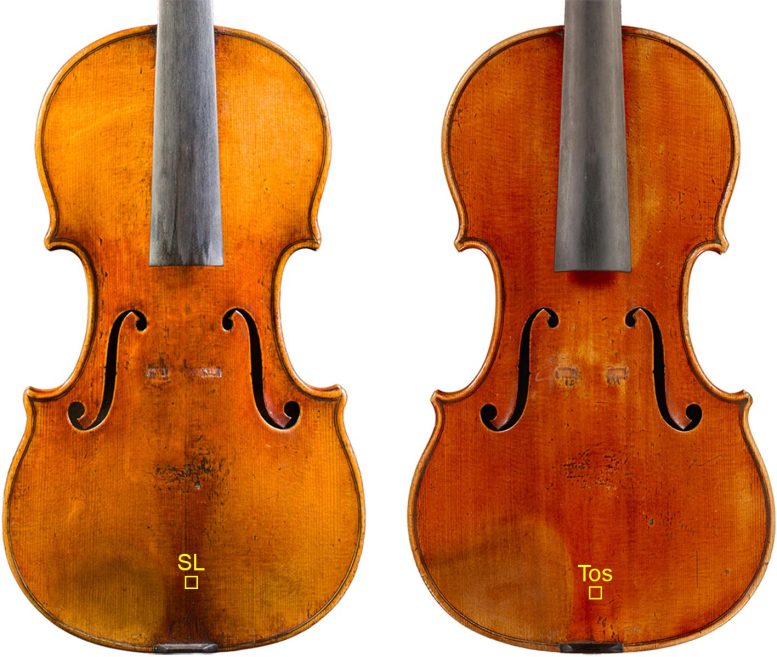
It was reported in previous studies that some stringed instruments built by Stradivari have a hidden coating underneath the shiny varnish. By filling in and smoothing out the wood, this coating would influence the wood’s resonance and the sound that’s produced. Knowing the components of this film could be key to replicating the historic instruments in modern times. So, Lisa Vaccari, Marco Malagodi, and colleagues wanted to find a technique that would determine the composition of the layer between the wood and varnish of two precious violins — the San Lorenzo 1718 and the Toscano 1690.
Using synchrotron radiation Fourier-transform infrared spectromicroscopy, a technique previously used on historic violins, the research team discovered that both samples had an intermediary layer. However, this method couldn’t differentiate the layer’s composition from the adjacent wood.
A Protein-Based Layer Beneath the Varnish
Next, they turned to infrared scattering-type scanning near field microscopy (IR s-SNOM) to analyze the samples. The IR s-SNOM apparatus includes a microscope that collects images tens of nanometers wide and measures the infrared light scattered from the coating layer and the wood to collect information about their chemical composition. The results of the new method revealed that the layer between the wood and varnish of both instruments contained protein-based compounds, congregating in nano-sized patches.
Because IR s-SNOM provided a detailed 3D picture of the types of substances on the violin’s surface, the scientists say that it could be used in future studies to identify compounds in complex multi-layer cultural heritage samples.
Reference: “A Nanofocused Light on Stradivari Violins: Infrared s-SNOM Reveals New Clues Behind Craftsmanship Mastery” by Chiaramaria Stani, Claudia Invernizzi, Giovanni Birarda, Patrizia Davit, Lisa Vaccari, Marco Malagodi, Monica Gulmini and Giacomo Fiocco, 17 October 2022, Analytical Chemistry.
DOI: 10.1021/acs.analchem.2c02965
The authors acknowledge CERIC-ERIC and Elettra Sincrotrone Trieste for access to experimental facilities and financial support.
Never miss a breakthrough: Join the SciTechDaily newsletter.
Follow us on Google and Google News.
14 Comments
Egg whites? A standard pore filler for wood at the time. Probably has little to nothing to do with the sound quality. Just accept the wood selection and craftsmanship at the time was high due to the fact luthiers did not have clickbait like this to waste their valuable time.
What a HOOT it would be to find that the “protein” is of greasy fingers from Stradivarius eating his meals without washing up afterwards!!😂
Headline led me to expect an answer to “why.” But the intermediate layer that was discovered thanks to tech wunderkraft may well do nothing at all. Clickbait on this site, once again.
Modern fiddles are the way to go.
Interesting, but would be more significant if the unparalleled excellence of the Strads hadn’t been exposed as a myth. In double-blind studies, it turns out that the best modern luthiers produce violins that equal or exceed the Strad — and generally cost in the tens of thousands, not millions.
Exactly. Of course it’s a myth. It’s perpetuated also by prominent violinists too because many of them play on them, enhancing their own renown. The superiority of Strads and Ds is a myth that is long overdue to be put to rest.
Parts of this article ripped straight from Wikipedia.
I’m with the egg white theory. That and an excellent of wood and instrument making. Certainly there are better violins, I simply love Del Gesu every bit as much if not more. Won’t it be interesting what modern fiddles reveal in three hundred years, which are prized, which despised?!
Stradivarius violins are to violin players just like the late 1950s Gibson Les Paul Standard “Bursts” are. To be frank, many of the bursts are heavy guitars and many don’t sound as good as they are marketed. It was a sales failure. Modern guitars and instruments in general are far better and cheaper. When you buy the Stradivarius or the bursts you buy the hype and it is essentially meant to sit in a closet where you can “play” modern instruments.
Sigh. More clickbait about Strads.
The violins Stradivari made are not the violins now played. He made baroque violins with a low neck angle, short inlaid fruitwood fingerboards, low bridges, three-nail neck attachment, and short fruitwood tailpieces.
The strads we see played today have been converted to modern violin specs – re-angled or entI rely replaced necks, grafted peg heads, dovetailed neck joints, taller bridges longer ebony fingerboards and tailpieces, and often radical regraduation of the plates either for repair or sonic reasons.
Sure, a lot of them are great. But so are new ones by Paul Schuback, Joseph Curtin, and a host of other violin makers……and in blind tests, the listener can’t tell.
Hide glue used to assemble violins is protein based, specifically collagen. Could a thin wash of hide glue be the “mystery” layer under the varnish, perhaps as a sealer?
So no one is thinking virgin blood?
Cringe
For many years prior to these violins being built, the earth went through a lengthy low temperature cycle. This caused slower tree growth resulting in tighter woodgrain. I know from experience with acoustic guitars that tight grain gives more resonance and more string energy.