
A Breakthrough Tool for Solar Material Characterization
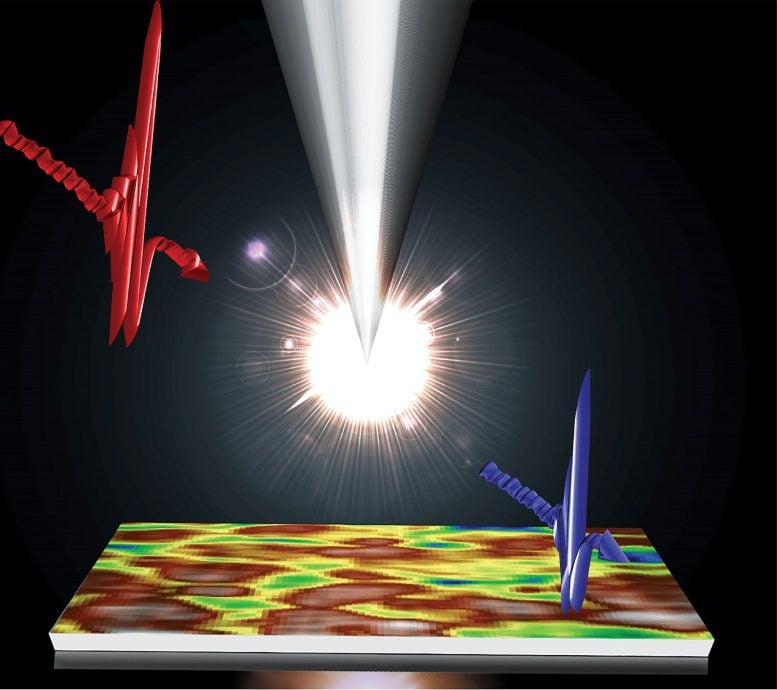
A new characterization tool was developed by a team of scientists, allowing them to gain unique insight into a possible alternative material for solar cells. They developed a microscope that uses terahertz waves to collect data on material samples. The team, from the Department of Energy’s Ames National Laboratory, working under the leadership of senior scientist Jigang Wang, then used their microscope to explore Methylammonium Lead Iodide (MAPbI3) perovskite, a material that could potentially replace silicon in solar cells.
Richard Kim, a scientist from Ames Lab, explained the two features that make the new scanning probe microscope unique. First, the microscope uses the terahertz range of electromagnetic frequencies to collect data on materials. This range is far below the visible light spectrum, falling between the infrared and microwave frequencies. Secondly, the terahertz light is shined through a sharp metallic tip that enhances the microscope’s capabilities toward nanometer-length scales.
“Normally if you have a light wave, you cannot see things smaller than the wavelength of the light you’re using. And for this terahertz light, the wavelength is about a millimeter, so it’s quite large,” explained Kim. “But here we used this sharp metallic tip with an apex that is sharpened to a 20-nanometer radius curvature, and this acts as our antenna to see things smaller than the wavelength that we were using.”
Using this new microscope, the team investigated a perovskite material, MAPbI3, that has recently become of interest to scientists as an alternative to silicon in solar cells. Perovskites are a special type of semiconductor that transports an electric charge when it is exposed to visible light. The main challenge to using MAPbI3 in solar cells is that it degrades easily when exposed to elements like heat and moisture.
Unexpected Insights into Material Behavior
According to Wang and Kim, the team expected MAPbI3 to behave like an insulator when they exposed it to the terahertz light. Since the data collected on a sample is a reading of how the light scatters when the material is exposed to the terahertz waves, they expected a consistent low-level of light scatter throughout the material. What they found, however, was that there was a lot of variation in light scattering along the boundary between the grains.
Kim explained that conductive materials, like metals, would have a high level of light scattering while less-conductive materials, like insulators, would not have as much. The wide variation of light scattering detected along the grain boundaries in MAPbI3 sheds light on the material’s degradation problem.
Visualizing Degradation Over Time
Over the course of a week, the team continued to collect data on the material, and data collected in that time showed the degradation process through changes in the levels of light scatterings. This information can be useful for improving and manipulating the material in the future.
“We believe that the present study demonstrates a powerful microscopy tool to visualize, understand, and potentially mitigate grain boundary degradation, defect traps, and materials degradation,” said Wang. “Better understanding of these issues may enable developing highly efficient perovskite-based photovoltaic devices for many years to come.”
The samples of MAPbI3 were provided by the University of Toledo. This research is further discussed in the paper “Terahertz Nanoimaging of Perovskite Solar Cell Materials,” written by Richard H. J. Kim, Zhaoyu Liu, Chuankun Huang, Joong-Mok Park, Samuel J. Haeuser, Zhaoning Song, Yanfa Yan, Yongxin Yao, Liang Luo, and Jigang Wang, and published in the ACS Photonics.
Reference: “Terahertz Nanoimaging of Perovskite Solar Cell Materials” by Richard H. J. Kim, Zhaoyu Liu, Chuankun Huang, Joong-Mok Park, Samuel J. Haeuser, Zhaoning Song, Yanfa Yan, Yongxin Yao, Liang Luo and Jigang Wang, 17 October 2022, ACS Photonics.
DOI: 10.1021/acsphotonics.2c00861
Never miss a breakthrough: Join the SciTechDaily newsletter.
Follow us on Google and Google News.
1 Comment
What do you believe is the greatest material for a greenhouse or hot house?
Twin-wall polycarbonate sheet should be used to construct a greenhouse. It is a lot more durable and offers up to 60% more thermal insulation than greenhouse glass or PVC film. It’s an affordable and simple replacement for glass that won’t break the bank. If your plants receive more light, they will develop more quickly.