
Close Menu
    Facebook X (Twitter) Instagram
    SciTechDaily
    • Biology
    • Chemistry
    • Earth
    • Health
    • Physics
    • Science
    • Space
    • Technology
    Facebook X (Twitter) Pinterest YouTube RSS
    SciTechDaily
    Home»Space»Cosmic Contortions – Hubble Views Massive Galaxy Cluster Warped by Gargantuan Magnifying Glass
    Space

    Cosmic Contortions – Hubble Views Massive Galaxy Cluster Warped by Gargantuan Magnifying Glass

    By ESA/HubbleFebruary 20, 2023No Comments2 Mins Read
    Facebook Twitter Pinterest Telegram LinkedIn WhatsApp Email Reddit
    Share
    Facebook Twitter LinkedIn Pinterest Telegram Email Reddit
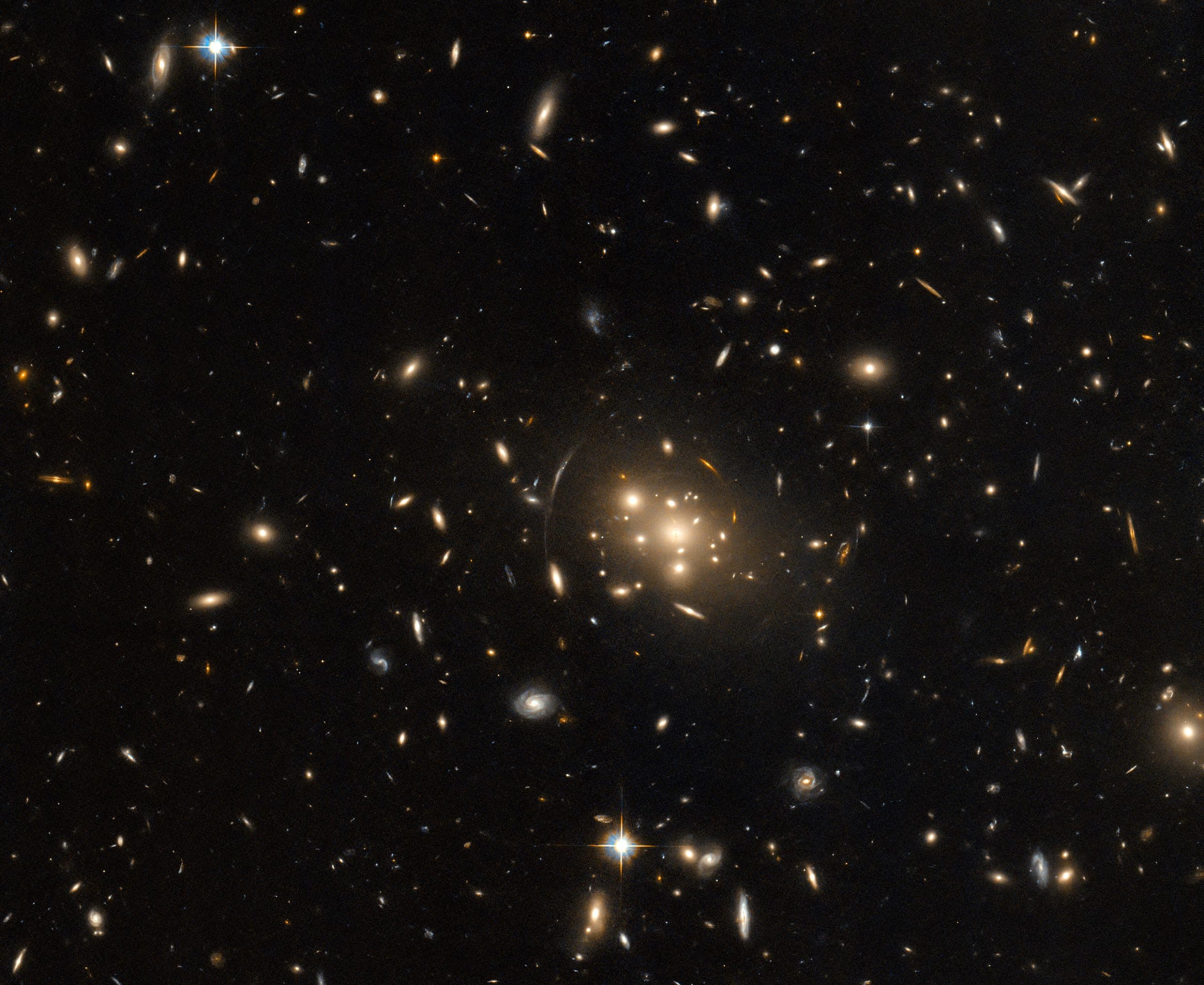
    Hubble Massive Galaxy Cluster in Cetus Constellation
    Hubble Space Telescope features a massive galaxy cluster named SPT-CL J0019-2026 in the constellation Cetus that is warped by gravitational lensing. Credit: ESA/Hubble & NASA, H. Ebeling

    This image from the Hubble Space Telescope is populated with a serene collection of elliptical and spiral galaxies, with the center dominated by a massive galaxy cluster in the constellation Cetus. The galaxies surrounding the central cluster — which is named SPT-CL J0019-2026 — appear stretched into bright arcs, as if distorted by a gargantuan magnifying glass. This cosmic contortion is called gravitational lensing, and it occurs when a massive object like a galaxy cluster has a sufficiently powerful gravitational field to distort and magnify the light from background objects. Gravitational lenses magnify light from objects that would usually be too distant and faint to observe, and so these lenses can extend Hubble’s view even deeper into the Universe.

    This observation is part of an ongoing project to fill short gaps in Hubble’s observing schedule by systematically exploring the most massive galaxy clusters in the distant Universe, in the hopes of identifying promising targets for further study with both Hubble and the NASA/ESA/CSA James Webb Space Telescope. This particular galaxy cluster lies at a vast distance of 4.6 billion light-years from Earth.

    Each year, the Space Telescope Science Institute is inundated with observing proposals for Hubble, in which astronomers suggest targets for observation. Even after selecting only the very best proposals, scheduling observations of all of Hubble’s targets for a year is a formidable task. There is sometimes a small fraction of observing time left unused in Hubble’s schedule, so in its ‘spare time’ the telescope has a collection of objects to explore — including the lensing galaxy cluster shown in this image.

    Never miss a breakthrough: Join the SciTechDaily newsletter.
    Follow us on Google and Google News.

    Astronomy European Space Agency Hubble Space Telescope
    Share. Facebook Twitter Pinterest LinkedIn Email Reddit

    Related Articles

    A Diamond Necklace of Cosmic Proportions

    Hubble Snaps a Stunning Close-Up of a Magnificent Spiral Galaxy

    Extraordinary Hubble Image: Light Bends From the Beyond

    Hubble Space Telescope Sees Volcanic Activity Reforming the Atmosphere on a Rocky Exoplanet

    Hubble Spies a Luminous Heart With Dark Tendrils

    Spectacular Return to the Veil Nebula

    Hubble Spots a Peculiar Sight: Unusual Spiral Galaxy With a Heavy Arm

    A Flash of Life: Hubble Spies an Unusual Planetary Nebula

    Through the Cosmic Clouds: Hubble Spots a Beautiful Stellar Nursery

    Leave A Reply Cancel Reply

    • Facebook
    • Twitter
    • Pinterest
    • YouTube

    Don't Miss a Discovery

    Subscribe for the Latest in Science & Tech!

    Trending News

    These Toads Are Surviving a Deadly Fungus – Scientists May Finally Know Why

    These Brain Cells May Explain Why We Eventually Have To Sleep

    Tomatoes Contain an Invisible Ingredient With Surprising Effects on Liver Health

    World’s First Heat-Powered Cooling System Turns Waste Heat Into Cold

    Antarctica Gained a Record 695 Billion Tons of Ice in Just Two Years

    Don’t Miss: A Brilliant Venus and Glowing Harvest Moon Light Up the Sky

    New Twist on the Einstein Problem Reveals Unexpected Physics

    JWST Captures Stunning Evidence of How Supermassive Black Holes Feed

    Follow SciTechDaily
    • Facebook
    • Twitter
    • YouTube
    • Pinterest
    • Newsletter
    • RSS
    SciTech News
    • Biology News
    • Chemistry News
    • Earth News
    • Health News
    • Physics News
    • Science News
    • Space News
    • Technology News
    Recent Posts
    • Cardiac Breakthrough Could Offer Lifesaving Treatment to More Patients
    • Scientists Uncover New Clues Behind the “Suicide Headache” Mystery
    • Depression in Later Life May Be an Early Warning Sign of Alzheimer’s
    • Physicists Find Useful Energy Hiding in Quantum “Waste Heat”
    • Largest-Ever Physics Survey Raises New Doubts About Our Model of the Universe
    Copyright © 1998 - 2026 SciTechDaily. All Rights Reserved.
    • Science News
    • About
    • Contact
    • Editorial Board
    • Privacy Policy
    • Terms of Use

    Type above and press Enter to search. Press Esc to cancel.