
Close Menu
    Facebook X (Twitter) Instagram
    SciTechDaily
    • Biology
    • Chemistry
    • Earth
    • Health
    • Physics
    • Science
    • Space
    • Technology
    Facebook X (Twitter) Pinterest YouTube RSS
    SciTechDaily
    Home»Physics»“Stretching” Time To Improve Molecular Vibration Information Detection
    Physics

    “Stretching” Time To Improve Molecular Vibration Information Detection

    By University of TokyoMarch 4, 20231 Comment3 Mins Read
    Facebook Twitter Pinterest Telegram LinkedIn WhatsApp Email Reddit
    Share
    Facebook Twitter LinkedIn Pinterest Telegram Email Reddit
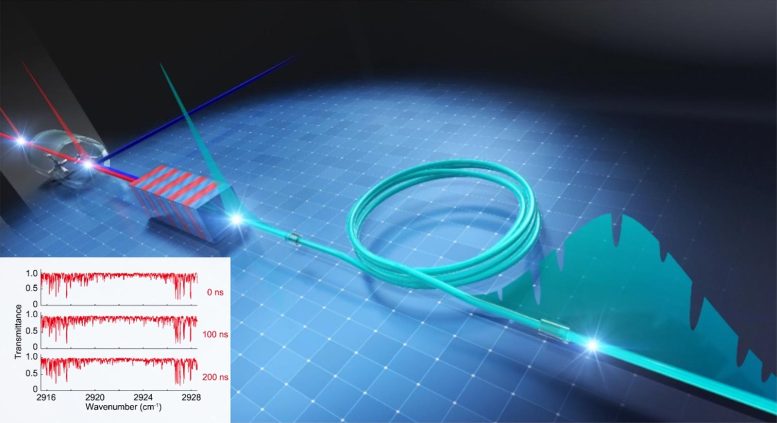
    Upconversion Time-Stretch Infrared Spectroscopy Schematic
    First, the sample is illuminated with infrared light. After the light interacts with the sample, the resulting wavelengths are ‘upconverted’ from low-energy infrared to high-energy near-infrared wavelength. The near-infrared pulses then travel through an optical fiber which essentially “stretches” the pulse in time. A near-infrared photodetector detects the pulses. The inset in the bottom left corner shows the transmittance spectra of gaseous CH4 molecules at three consecutive time points. Credit: Hashimoto et. al. 2023

    This ultrafast infrared spectroscopy method would fulfill many unmet needs in experimental molecular science, revealing various high-speed phenomena in detail.

    Infrared spectroscopy is a non-invasive tool to identify unknown samples and known chemical substances. It is based on how different molecules interact with infrared light. You may have seen this tool at airports, where they screen for illicit drugs. The technique has many applications: liquid biopsy, environmental gas monitoring, contaminant detection, forensic analyses, exoplanet search, etc. But the traditional infrared spectroscopy methods provide low (temporal) resolution data. They are usually only applied for static samples because spectral data acquisition is a slow process.

    Detecting fast-changing phenomena requires multiple quick measurements. Thanks to Prof. Ideguchi and his team at the University of Tokyo, it is now possible to obtain high-speed and high-resolution spectral data. The team discovered the upconversion time-stretch infrared spectroscopy (UC-TSIR) that can measure infrared spectra with 1000 spectral elements at a rate of 10 million spectra per second.

    Atoms in a molecule are bound together—like spheres with stiff springs connecting them. Shine infrared light (2-20 µm wavelength) on the substance; it absorbs infrared energy, and the “springs” vibrate. The range of vibrational motions depends on the structure of the molecule. So, we can identify and infer the properties of the substance by detecting the range of wavelengths absorbed by the substance—its absorption spectra.

    “With recent improvements in the capability of analyzing spectra using machine learning and other techniques, it is essential for infrared spectroscopy methods to acquire a large amount of molecular vibration information rapidly. We wanted to develop the infrared spectroscopy method to achieve that,” said Prof. Ideguchi, explaining the motivation of the research team.

    Overcoming Infrared Spectroscopy’s Limitations

    Conventional time-stretch infrared spectroscopy data has fewer measurable spectral elements (~30) because the instruments work in the infrared region, where optical technology is currently limited. “UC-TSIR breaks the limit by converting infrared pulses containing molecular vibration information into near-infrared pulses with wavelength conversion techniques (upconversion) and temporally stretching and detecting the pulses in the near-infrared region,” said Dr. Hashimoto. Compared to conventional methods, UC-TSIR provides over 30-fold more spectral elements and 400 times better spectral resolution. The UC-TSIR can trace high-speed phenomena such as the combustion of gaseous molecules and irreversible chemical reactions of biomolecules at a high temporal resolution.

    In theory, the concept sounds simple and easy to implement; but it was far from that. “We carefully selected optical elements and adjusted the parameters through trial and error. Even after building the setup, we dealt with various spectral distortions caused by unwanted nonlinear optical effects and insufficient time stretching. We were overjoyed when we finally saw clear infrared absorption spectra after dealing with those issues,” said Dr. Hashimoto. “Nanosecond- or microsecond-scale ultra-fast continuous infrared spectral measurements by UC-TSIR can solve problems unresolved by conventional spectroscopy methods.”

    Reference: “Upconversion time-stretch infrared spectroscopy” by Kazuki Hashimoto, Takuma Nakamura, Takahiro Kageyama, Venkata Ramaiah Badarla, Hiroyuki Shimada, Ryoich Horisaki and Takuro Ideguchi, 4 March 2023, Light: Science & Applications.
    DOI: 10.1038/s41377-023-01096-4

    Never miss a breakthrough: Join the SciTechDaily newsletter.
    Follow us on Google and Google News.

    Spectroscopy University of Tokyo
    Share. Facebook Twitter Pinterest LinkedIn Email Reddit

    Related Articles

    Can You Hear a Virus? Scientists Use Light To Listen to the Sounds of Life

    Molecular “Fingerprinting” Now 100 Times Faster With Raman Spectroscopy

    Strange Bird-Like Behavior in Atoms: Researchers Unveil New Magnetic Properties in Quantum Systems

    Molecules in Motion: Advanced Spectroscopy Captures Molecular Dynamics in Real-Time

    Decades in the Making: Laser Excites Atomic Nucleus in Groundbreaking Discovery

    Precision Spectroscopy Now Possible Under Starved-Light Conditions

    Powerful New Tool Ushers In New Era of Quantum Materials Research

    Light-Matter Particle Breakthrough Could Change Displays Forever

    Redefining Quantum Communication: Researchers Have Solved a Foundational Problem in Transmitting Quantum Information

    1 Comment

    1. Jimmy Bilodeau on April 1, 2023 3:30 am

      Magic Frequence Univers

      Reply
    Leave A Reply Cancel Reply

    • Facebook
    • Twitter
    • Pinterest
    • YouTube

    Don't Miss a Discovery

    Subscribe for the Latest in Science & Tech!

    Trending News

    First-of-Its-Kind Discovery: Homer’s Iliad Found Embedded in a 1,600-Year-Old Egyptian Mummy

    Beyond Inflammation: Scientists Uncover New Cause of Persistent Rheumatoid Arthritis

    A Simple Molecule Could Unlock Safer, Easier Weight Loss

    Scientists Just Built a Quantum Battery That Charges Almost Instantly

    Researchers Unveil Groundbreaking Sustainable Solution to Vitamin B12 Deficiency

    Millions of People Have Osteopenia Without Realizing It – Here’s What You Need To Know

    Researchers Discover Boosting a Single Protein Helps the Brain Fight Alzheimer’s

    World-First Study Reveals Human Hearts Can Regenerate After a Heart Attack

    Follow SciTechDaily
    • Facebook
    • Twitter
    • YouTube
    • Pinterest
    • Newsletter
    • RSS
    SciTech News
    • Biology News
    • Chemistry News
    • Earth News
    • Health News
    • Physics News
    • Science News
    • Space News
    • Technology News
    Recent Posts
    • Scientists Flip Immune System “Switch,” Uncover Surprising Path To Stop Gut Inflammation
    • Magnesium Magic: New Drug Melts Fat Even on a High-Fat, High-Sugar Diet
    • Weight-Loss Drugs Like Ozempic May Come With an Unexpected Cost
    • After Decades, MIT Researchers Capture the First 3D Atomic View of a Mysterious Material
    • Your Favorite Fishing Spot Is Turning Brown – and the Fish Are Changing
    Copyright © 1998 - 2026 SciTechDaily. All Rights Reserved.
    • Science News
    • About
    • Contact
    • Editorial Board
    • Privacy Policy
    • Terms of Use

    Type above and press Enter to search. Press Esc to cancel.