
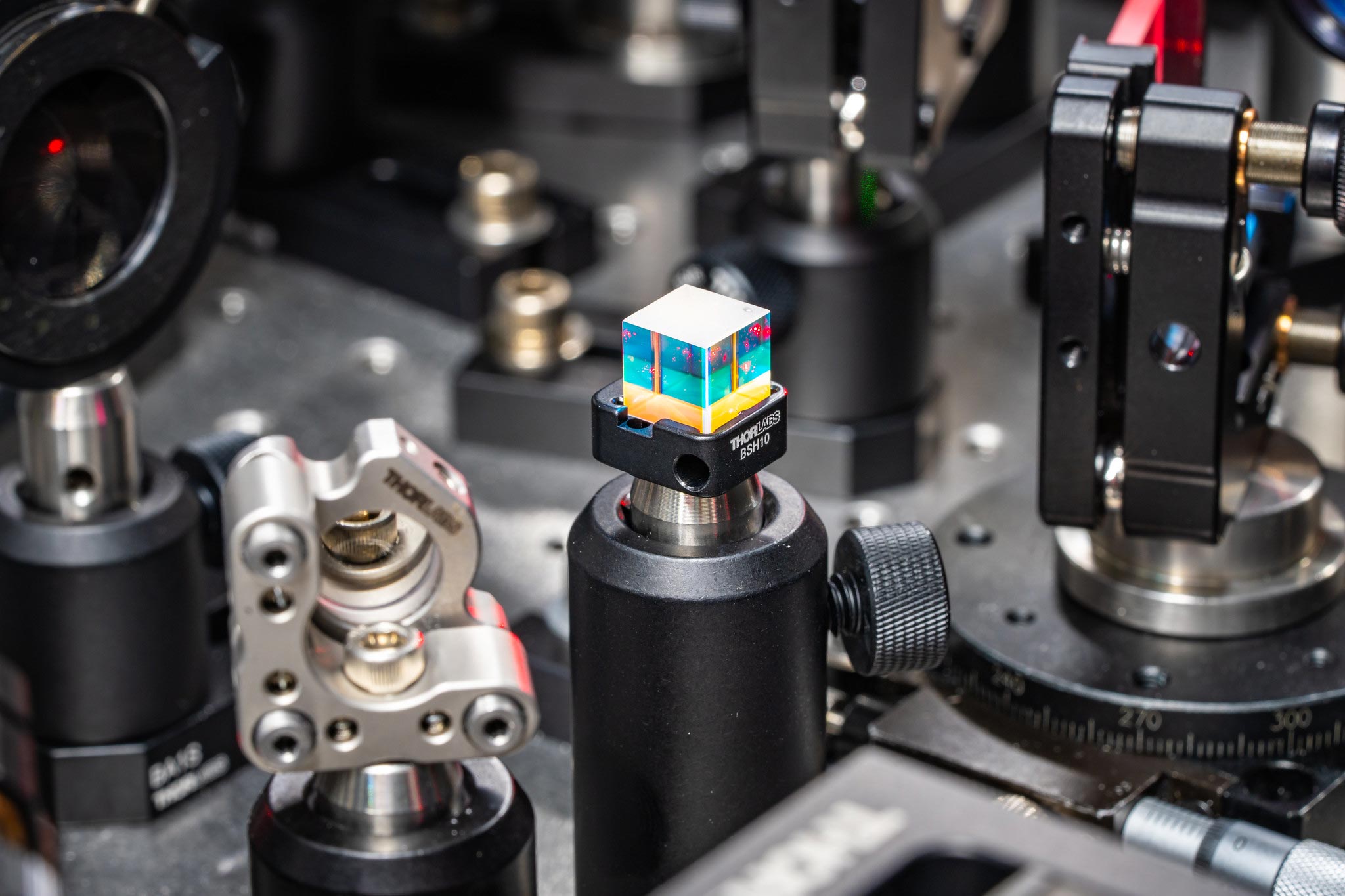
New research at MSU uses light to reveal viruses’ unique vibrations, opening new doors for biological imaging and antiviral research.
Elad Harel is used to shining a light on the mysteries of the natural world.
Working at the cutting edge of ultrafast spectroscopy—the use of short laser pulses to analyze molecular dynamics—the Michigan State University associate professor seeks to uncover how microscopic phenomena impact large complex systems.
One promising frontier Harel has been working on is the development of new methods of microscopy that will allow researchers to observe molecular and atomic landscapes in motion rather than through static imagery. Such work has earned Harel MSU’s 2023 Innovation of the Year award, as well as MSU’s first-ever grant from the W.M. Keck Foundation.
Now, in a new publication appearing in the Proceedings of the National Academy of Sciences, Harel and his Spartan collaborators report using light to observe and study the “sound” of a virus — an auditory breakthrough that provides a glimpse into elusive, real-time biology.
Harel’s lab worked closely with Dohun Pyeon, a professor in MSU’s Department of Microbiology, Genetics and Immunology, or MGI, who lent his group’s expertise in providing virus targets.
“Teamwork really matters in this challenging and exciting project, and it’s fascinating to experimentally observe the nanoscale motion of these tiny virus particles — they are actually ‘breathing’ under laser illumination,” said Yaqing Zhang, a postdoctoral researcher in the Harel lab and first author of the study.
“I am confident that this technique can be widely utilized for millions of viruses and other biological samples and will acquire more invaluable information from them. The more we know them, the better we can prepare for the next pandemic,” Zhang added.
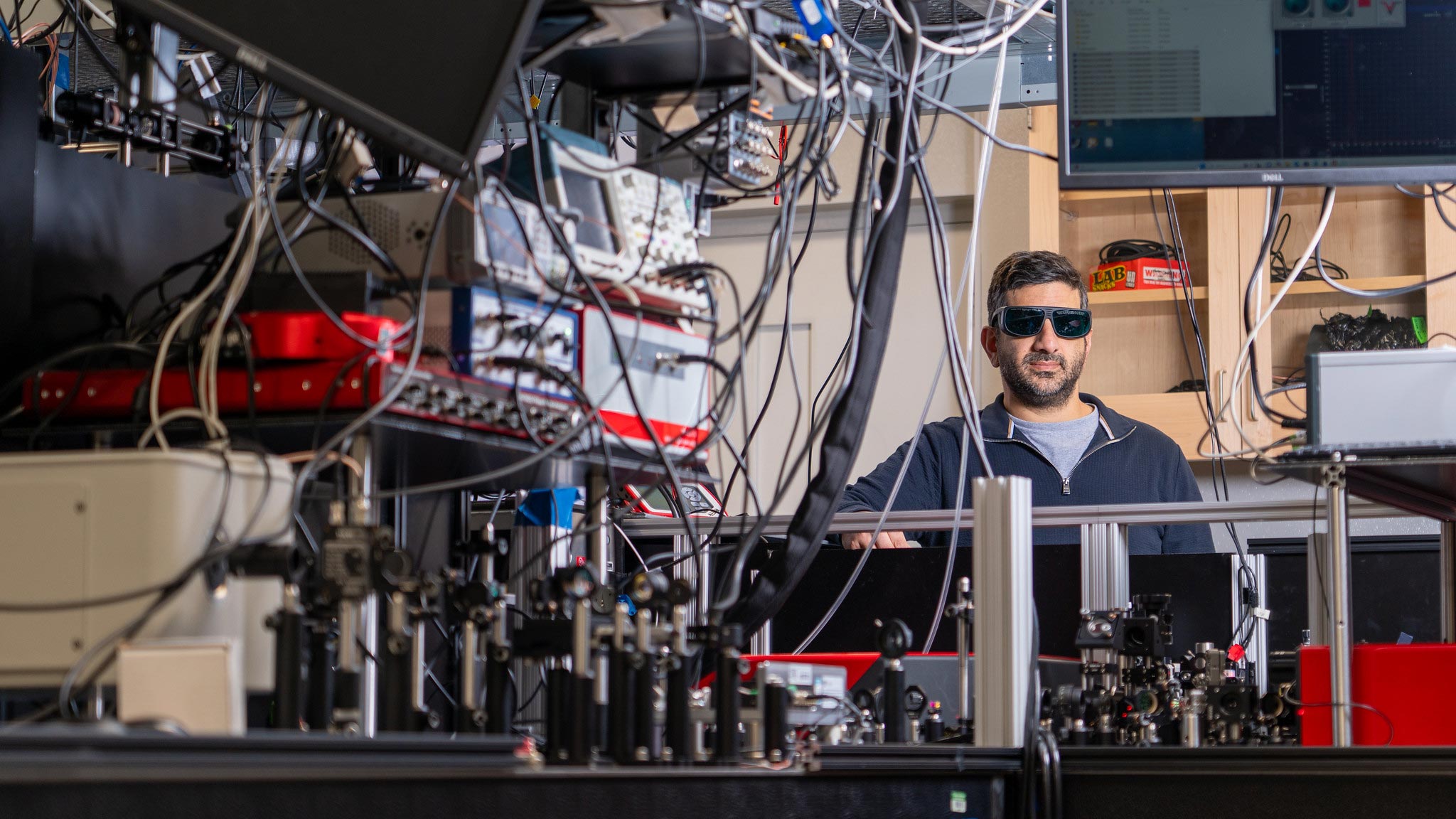
The College of Natural Science caught up with Harel to learn more about this discovery and a process he calls BioSonic spectroscopy.
This conversation has been edited for length and clarity.
Not many people would string together the words “virus,” “light” and “listen” in a sentence. Could you talk a bit about the fundamental science behind this discovery?
Every type of system has a natural vibrational frequency, whether it’s a star or a biological entity like a virus. You can think of it as the sound the material has, whereby all the atoms vibrate together like balls connected by a complex network of springs.
The arrangement of atoms and their interactions is why when I bang on a table, it sounds different than if I bang on a wall. Of course, sound can be much more complex and contain important information: If you hear a familiar voice across the room, you can immediately identify who it is coming from. Sound, therefore, is a powerful means of identification.
Researchers have been looking at ultrasonic vibrations of metal nanoparticles for several years, but we wanted to ask the question, ‘Do biological systems produce a sound when experiencing some force?’
To initiate the sound, we use short pulses of light that generate coherent motion in the system. We then use a second pulse of light to probe that motion at different moments in time. By stringing together all the snapshots in time, we can produce a molecular movie that captures the vibrational motion of the object.
This was a kind of far-out idea, and there wasn’t really any precedent for it, and we discovered that viruses do have a unique sound, which opens a whole new way of thinking about biology.
Whether it’s a virus, a protein, bacteria, or the nucleus of a cell — each one will have this unique signature we can detect.
Why did “listening” to a biological system seem like an effective approach compared to other methods of analysis?
We were trying to tackle a fundamental problem in biology, which was also the focus of our Keck Foundation grant — to get the resolution of electron microscopy, but for living systems.
Electron microscopy, or EM, itself is very powerful, but you’re really taking snapshots of life, and you’re doing it in an environment that’s quite different than what you find in living organisms. EM is done in vacuum, and with cryo-EM, it is done at very low temperatures where life cannot be sustained. The goal of the Keck grant was to develop microscopy methods that can visualize and track biology in the hot and wet environment where living things operate.
We spent several years developing more and more sensitive techniques that can measure acoustic vibrations, especially at the single particle level. This was in collaboration with the Pyeon lab in MGI, which helped us gain access to different viruses.
The bigger picture was also thinking of how this acoustic approach could be used as a powerful imaging probe without the need for labeling. This is the process in which a marker is attached to a molecule, allowing researchers to track and study its behaviors and interactions. While extremely useful and specific, the labeling process can be slow and intensive.
One of our goals is to show that this new methodology could use a virus’s or molecule’s natural labeling — basically, the sound of its own materials that distinguishes it from everything else in a system.
So, what did these viruses end up sounding like? Do they ever change their tune?
It turned out the vibrations occur in the gigahertz region. This is a very, very low frequency from the point of optical transitions. For instance, visible light is in the hundreds of terahertz, so these are thousands to millions of times lower energy than what we typically think of in terms of optical spectroscopy.
In this paper, we showed that we can track single viruses and even listen to a virus rupture. As the virus begins to break open and weaken, its acoustics start to change, going lower — almost like a deflating balloon.
What does the future look like for these discoveries?
What we want to do next is show that we could actually dynamically track how a virus is moving. If we want to watch a virus go into a cell now, the process is very, very challenging and slow via electron microscopy or utilizing complex fluorescence labeling.
For example, we have a grant with the Defense Threat Reduction Agency that is interested in biological and chemical detection. One of the things they do is develop drugs, or antivirals, for combating viral infections.
The thinking is: Can we use this kind of technique to speed up that development process — because we could potentially watch a virus’s life cycle from start to finish and better understand the influence of antivirals or drugs in disrupting that process.
Reference: “Nanoscopic acoustic vibrational dynamics of a single virus captured by ultrafast spectroscopy” by Yaqing Zhang, Rihan Wu, Md Shahjahan, Canchai Yang, Dohun Pyeon and Elad Harel, 21 January 2025, Proceedings of the National Academy of Sciences.
DOI: 10.1073/pnas.2420428122
Never miss a breakthrough: Join the SciTechDaily newsletter.
Follow us on Google and Google News.
2 Comments
Why did “listening” to a biological system seem like an effective approach compared to other methods of analysis?
VERY GOOD!
Ask the researchers:
1. Is’ The Blind and the Elephant ‘just a fable?
2. Is the elephant you see the same as the elephant you touch?
3. Is the elephant you touch the same as the elephant you smell?
4. Is Proceedings of the National Academy of Sciences a publication that respects science?
Scientific research guided by correct theories can enable researchers to think more.
A topological vortex is a concept in physics that describes the natural gravitational field or the fluid-body coupled system. A topological vortex is formed by the interaction and balance of vortex and anti-vortex field pairs, which can be set into resonance by the body motion and interaction.
Topological Vortex Theory (TVT) treats space as an ideal fluid, posits that the topological vortex gravitational field is fundamental to the structure of the universe, and emphasizes the importance of topological phase transitions in understanding mass, inertia, and energy.
According to the Topological Vortex Theory (TVT), spins create everything, spins shape the world. There are substantial distinctions between Topological Vortex Theory (TVT) and traditional physical theories. Grounded in the inviscid, incompressible, and isotropic spaces, TVT introduces the concept of topological phase transitions and employs topological principles to elucidate the formation and evolution of matter in the universe, as well as the impact of interactions between topological vortices and anti-vortices on spacetime dynamics and thermodynamics.
Within TVT, low-dimensional spacetime matter serves as the foundation for high-dimensional spacetime matter, and the hierarchical structure of matter and its interaction mechanisms challenge conventional macroscopic and microscopic interpretations. The conflict between Quantum Physics and Classical Physics can be attributed to their differing focuses: Quantum Physics emphasizes low-dimensional spacetime matter, whereas Classical Physics centers on high-dimensional spacetime matter.
Subatomic particles in the quantum world often defy the familiar rules of the physical world. The fact repeatedly suggests that the familiar rules of the physical world are pseudoscience. In the familiar rules of the physical world, two sets of cobalt-60 can form the mirror image of each other by rotating in opposite directions, and should receive the Nobel Prize for physics.
Please witness the grand performance of some so-called peer review publications (including PRL, PNAS, Nature, Science, etc.). https://scitechdaily.com/microscope-spacecrafts-most-precise-test-of-key-component-of-the-theory-of-general-relativity/#comment-854286. Some so-called academic publications (including PRL, PNAS, Nature, Science, etc.) are addicted to their own small circles and have deviated from science for a long time.
As the background of various material interactions and movements, space exhibits inviscid, absolutely incompressible and isotropic physical characteristics. It may form various forms of spacetime vortices through topological phase transitions. Hence, vortex phenomena are ubiquitous in cosmic space, from vortices of quantum particles and living cells to tornados and black holes. Stars and radioactive elements are one of the most active topological nodes in spacetime. Utilizing them is more valuable and meaningful than simulating them. Small or micro power topology intelligent batteries may be the direction of future energy research and development for human society.
Under the topological vortex architecture, science and pseudoscience are clear at a glance. Topological Vortex Theory (TVT) can play a crucial role in elucidating the foundations of physics, establishing its principles, and combating pseudoscience. Therefore, TVT has been strongly opposed and boycotted by traditional so-called peer review publications (such as PRL, PNAS, Nature, Science, etc.).
These so-called peer review publications (including PRL, PNAS, Nature, Science, etc.) mislead the direction of science and are known for their various absurdities and wonders. They collude together, reference each other, and use so-called Impact Factor (IF) or the Nobel Prize to deceive people around.
Ask the so-called peer review publications (including PRL, PNAS, Nature, Science, etc.):
1. What are your criteria for distinguishing science from pseudoscience?
2. Is your Impact Factor (IF) the standard for distinguishing science from pseudoscience?
3. Is the Nobel Prize the standard for distinguishing science from pseudoscience?
4. What is the most important aspect of academic publications?
5. Is the most important aspect of academic publications being flashy and impractical articles?
Pseudo academic publications (including PRL, PNAS, Nature, Science, etc.) are neither inclusivity nor openness, nor transparency and fairness, and have already had a serious negative impact on the progress of science and technology. Some so-called peer review publications (including PRL, PNAS, Nature, Science, etc.) are addicted to their own small circle and no longer know what science is. They hardly know what is dirty and ugly.
Publications that mislead the public under the guise of scholarship are more reprehensible than ordinary publications. The field of physics faces an ongoing challenge in maintaining scientific rigor and integrity in the face of pervasive pseudoscientific claims. Fighting against rampant pseudoscience, physics still has a long way to go.
While my comments may be lengthy, they are necessary to combat the proliferation of rampant pseudoscience and to promote the advancement of science and technology, and also is all I can do.
Appreciate the SciTechDaily for its inclusivity, openness, transparency, and fairness. If the researchers are truly interested in cosmic matter, please read: A Brief History of the Evolution of Cosmic Matter (https://scitechdaily.com/microscope-spacecrafts-most-precise-test-of-key-component-of-the-theory-of-general-relativity/#comment-873523).
Topological Vortex Theory (TVT) is based on topology and fluid dynamics, which have solid mathematical and physical foundations. Under the topological vortex architecture, science and pseudoscience are clear at a glance. Topological Vortex Theory (TVT) can play a crucial role in elucidating the foundations of physics, establishing its principles, and combating pseudoscience.
However, some individuals, some AI (https://zhuanlan.zhihu.com/p/23079945169), and some so-called peer review publications (including PRL, PNAS, Nature, Science, etc.) stubbornly believe that two sets of cobalt-60 can form the mirror image of each other by rotating in opposite directions (https://scitechdaily.com/microscope-spacecrafts-most-precise-test-of-key-component-of-the-theory-of-general-relativity/#comment-854286), and stubbornly believe that the Topological Vortex Theory (TVT) currently lacks validation. This is because they have been misled by pseudoscientific information.
Vortex phenomena are ubiquitous in cosmic space, from vortices of quantum particles and living cells to tornados and black holes. The inviscid and incompressible spaces have been widely used in engineering simulation (https://scitechdaily.com/microscope-spacecrafts-most-precise-test-of-key-component-of-the-theory-of-general-relativity/#comment-870077). These all are the most powerful verification and validation.
Ask some so-called peer review publications (including PRL, PNAS, Nature, Science, etc.) again:
1. Does space not exist?
2. Does time not exist?
3. Does the ideal fluid not exist?
4. Do scientific experiments require time and space?
5. Do certain engineering simulations require ideal fluids?
6. If non-existent things are applied to scientific experiments and engineering simulations, and good results can be achieved. So, what is the difference between the non-existent thing and God?
Some individuals and some so-called peer review publications (including PRL, PNAS, Nature, Science, etc.) have been misleading the public with confusing concepts (https://pic2.zhimg.com/v2-4127b0b58fe8b88feb27c189fb705029_1440w.jpg?source=172ae18b), unscientific logic and reasoning, and self righteous Impact Factor (IF), hindering the progress of science and technology.
Fighting against rampant pseudoscience, physics still has a long way to go. Let us continue to witness the dirtiest and ugliest era in the history of science and humanities with facts.