
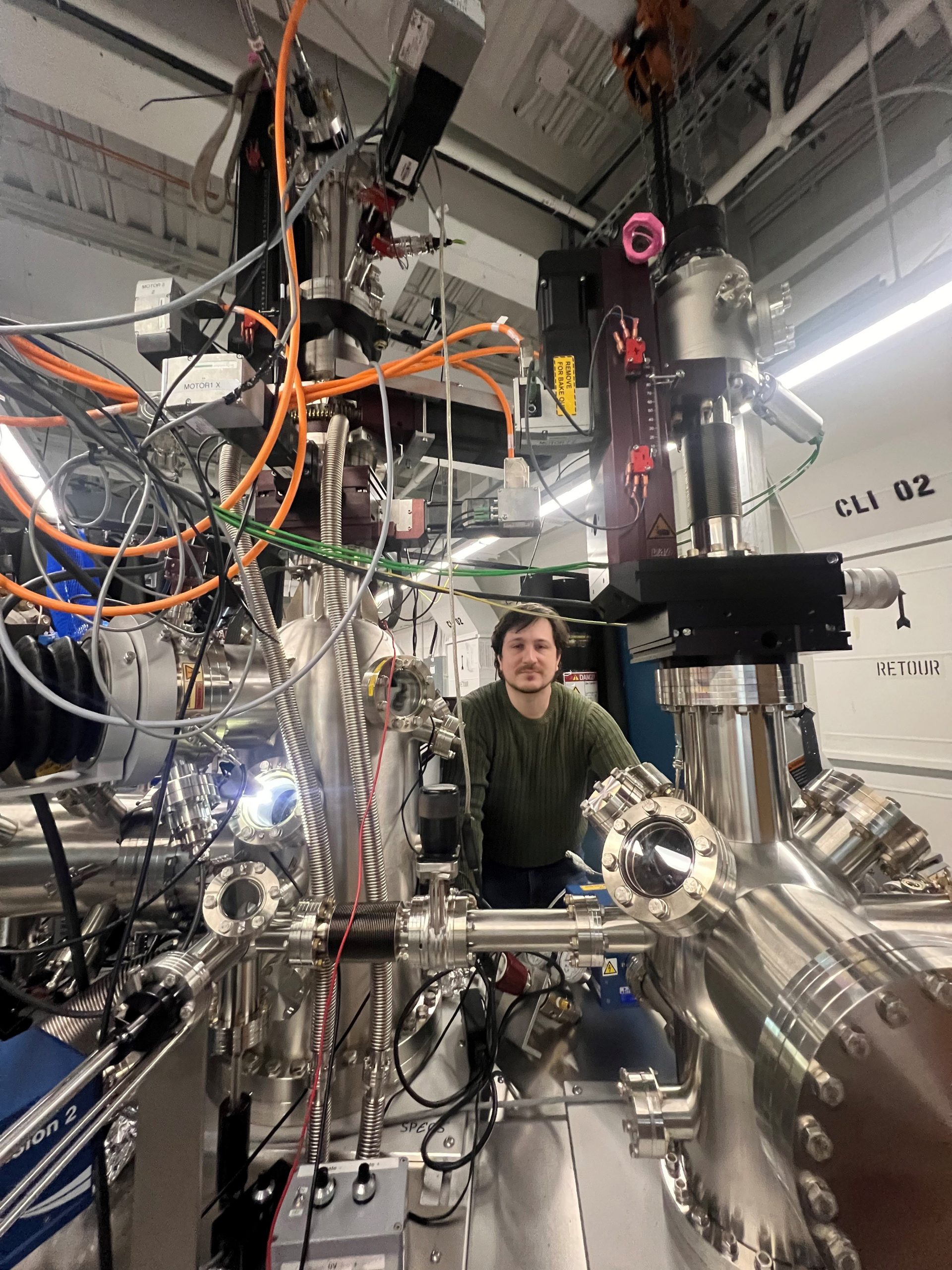
Professor Fabio Boschini and his team at QMI-UBC have highlighted the TR-ARPES photoemission technique.
Research into quantum materials is leading to revolutionary breakthroughs and is set to propel technological progress that will transform industries such as mining, energy, transportation, and medical technology.
A technique called time- and angle-resolved photoemission spectroscopy (TR-ARPES) has emerged as a powerful tool, allowing researchers to explore the equilibrium and dynamical properties of quantum materials via light-matter interaction.
Published in the world’s premier physics review journal, Reviews of Modern Physics, a recent review paper by Professor Fabio Boschini from the Institut national de la recherche scientifique (INRS), along with colleagues Marta Zonno from Canadian Light Source (CLS) and Andrea Damascelli from UBC’s Stewart Blusson Quantum Matter Institute (Blusson QMI), illustrates that TR-ARPES has rapidly matured into a powerful technique over the last two decades.

“TR-ARPES is an effective technique not only for fundamental studies, but also for characterizing out-of-equilibrium properties of quantum materials for future applications,” says Professor Boschini who specializes in ultrafast spectroscopies of condensed matter, at the Énergie Matériaux Télécommunications Research Centre.
A revolutionary tool for quantum materials research
The new paper provides a comprehensive review of research using TR-ARPES and its evolving significance in exploring light-induced electron dynamics and phase transitions in a wide range of quantum materials.
“The scientific community is currently investigating new ‘tuning knobs’ to control the electronic, transport, and magnetic properties of quantum materials on demand. One of these ‘tuning knobs’ is the light-matter interaction, which promises to provide fine control the properties of quantum materials on ultrafast timescales,” says Professor Boschini, who is also a QMI affiliate investigator. “TR-ARPES is the ideal technique for this purpose, since it provides direct insight into how light excitation modifies electronic states with time, energy, and momentum resolution.”
“TR-ARPES has ushered in a new era of quantum materials research, allowing us to ‘knock on the system’ and observe how it responds, and pushing the materials out of equilibrium to uncover their hidden properties,” adds Blusson QMI Scientific Director Andrea Damascelli.
Collaboration at the heart of TR ARPES’ success
TR-ARPES combines condensed matter spectroscopy (ARPES) with ultrafast lasers (photonics), bringing together research groups from both fields. The technique owes much of its success to significant advancements in developing new laser sources capable of producing light with precise characteristics.
Boschini is working closely on the subject with Professor François Légaré, a full professor at INRS and an expert in ultrafast laser science and technology. Together, Boschini’s and Légaré’s groups built and are operating a state-of-the-art TR-ARPES endstation with unique intense long-wavelength excitation capabilities at the Advanced Laser Light Source (ALLS) laboratory.
“Thanks to the support from the Canada Foundation for Innovation (CFI), the governments of Québec (MEIE) and Canada, and LaserNetUS, as well as the recent CFI Major Science Initiatives program, we are now in the privileged position to open the TR-ARPES endstation at ALLS to national and international users,” states Professor Légaré, Director of the Énergie Matériaux Télécommunications Research Centre at INRS and Scientific Head of ALLS.
According to Professor Boschini, TR-ARPES is now a mature technique with a proven impact on various branches of physics and chemistry. “Further experimental and theoretical developments, similar to what we are doing at ALLS, suggest that even more exciting times lie ahead,” he concludes.
Reference: “Time-resolved ARPES studies of quantum materials” by Fabio Boschini, Marta Zonno and Andrea Damascelli, 27 February 2024, Reviews of Modern Physics.
DOI: 10.1103/RevModPhys.96.015003
Funding: Canada Foundation for Innovation, Natural Sciences and Engineering Research Council of Canada, Fonds de recherche du Québec – Nature et technologies
Never miss a breakthrough: Join the SciTechDaily newsletter.
Follow us on Google and Google News.