

New research on C. elegans worms identifies the nervous system protein NPR-8 as a regulator of collagen production, influencing longevity.
For a long time, scientists have observed that many creatures tend to have lengthier lifespans in cooler environments compared to warmer ones. Recent studies on C. elegans, a type of nematode worm, indicate that this longevity might be linked to a specific protein in the nervous system that regulates the production of collagens, the primary component of skin, bone, and connective tissue in a variety of animals.
Given that the protein found in C. elegans closely resembles nervous system receptor proteins found in other species, including humans, this revelation could potentially bring us a step closer to finding methods to manipulate collagen production in order to slow human aging and enhance lifespan, particularly in the context of rising global temperatures. The research, led by a team from Washington State University, was published in the journal Aging Cell.
“Based on animal studies, scientists anticipate that human lifespan will go down in the future as climate change drives up the ambient temperature,” said senior author Yiyong (Ben) Liu, an assistant professor in the WSU Elson S. Floyd College of Medicine and director of the university’s Genomics Service Center. “We have found that warm temperatures leading to short lifespan is not a passive, thermodynamic process as previously thought, but a regulated process controlled by the nervous system. Our findings mean that down the road, it may be possible to intervene in that process to extend human lifespan as temperatures rise.”
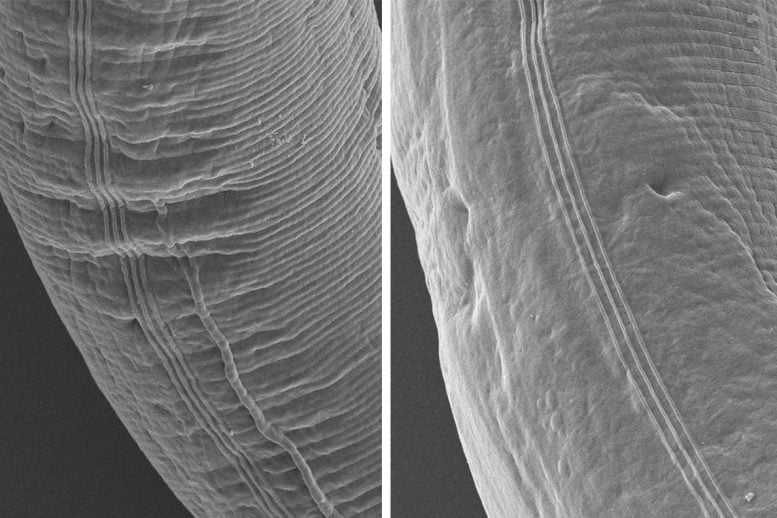
The researchers looked at a nervous system protein known as NPR-8 in the tiny soil-dwelling worm Caenorhabditis elegans (C. elegans), a commonly used model organism in aging research. During their study, they observed that worms lacking NPR-8 had fewer skin wrinkles as they aged. They also made the unexpected discovery that mutant worms kept at a warm temperature of 25 C (77 F) had increased collagen expression and lived longer than wild-type worms, which did not happen when the worms were kept at 20 C or 15 C (68 F and 59 F, respectively). To determine whether the neural regulation of collagens may play a role in aging and longevity, they conducted a series of additional experiments and analyses.
Collagen’s Link to Stress Resistance and Longevity
“What we saw was that the absence of NPR-8 caused an increase in collagen expression, which increased the worms’ stress resistance and lifespan and made them look younger than wild-type worms that were the same biological age,” said co-first author Durai Sellegounder, a former postdoctoral research associate in the WSU Elson S. Floyd College of Medicine who is now a scientist at the Buck Institute for Research on Aging.

In one experiment, the researchers reintroduced NPR-8 in mutant worms kept at 25 C (77 F) and saw that this reverted the worms’ skin from smooth to wrinkled and significantly reduced the animals’ extended lifespan. Next, they showed that the extended lifespan of npr-8 mutant worms also held up under heat stress conditions, with mutant worms surviving significantly longer than wild-type worms when moved into a 35 C (95 F) environment. Additional experiments identified specific neurons responsible for regulating lifespan in response to warm temperatures and pointed to increased expression of collagens as a driver of the improved lifespan at warm temperatures.
Challenging Traditional Theories on Heat and Lifespan
The phenomenon of heat shortening lifespan has traditionally been explained by the rate of living theory, which suggests that heat speeds up an organism’s metabolism, causing it to use up its finite store of metabolic energy more quickly. While the researchers still found limited evidence supporting this idea, their study findings indicate that the nervous system also plays an active role in this process.
Given earlier findings that showed that worms lacking NPR-8 were more resistant to infection and oxidative stress, the researchers believe that the NPR-8-controlled increase in collagen expression boosts the animals’ resistance to stressful conditions such as excessive heat. Their next step is to delve deeper into the underlying mechanisms of how increased collagen production enhances stress resistance.
Reference: “The longevity response to warm temperature is neurally controlled via the regulation of collagen genes” by Sankara Naynar Palani, Durai Sellegounder, Phillip Wibisono and Yiyong Liu, 9 March 2023, Aging Cell.
DOI: 10.1111/acel.13815
In addition to Liu and Sellegounder, co-authors on the current study include co-first author and postdoctoral research associate Sankara Naynar Palani and postdoctoral research associate Phillip Wibisono, both of the WSU Elson S. Floyd College of Medicine.
Never miss a breakthrough: Join the SciTechDaily newsletter.
Follow us on Google and Google News.
1 Comment
Woken science. Fire the inept bastrds.