
Close Menu
    Facebook X (Twitter) Instagram
    SciTechDaily
    • Biology
    • Chemistry
    • Earth
    • Health
    • Physics
    • Science
    • Space
    • Technology
    Facebook X (Twitter) Pinterest YouTube RSS
    SciTechDaily
    Home»Health»Beware the Splice of Life: This Killer Protein Causes Pancreatic Cancer
    Health

    Beware the Splice of Life: This Killer Protein Causes Pancreatic Cancer

    By Cold Spring Harbor LaboratoryJune 4, 2023No Comments4 Mins Read
    Facebook Twitter Pinterest Telegram LinkedIn WhatsApp Email Reddit
    Share
    Facebook Twitter LinkedIn Pinterest Telegram Email Reddit
    Mouse Pancreas
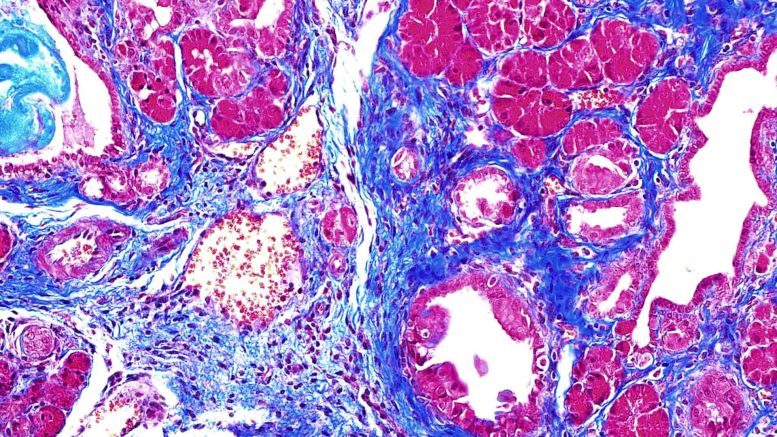
    Mouse pancreas cells with high levels of the protein SRSF1; CSHL Professor Adrian Krainer found that mice with high levels of SRFS1 tend to exhibit intraepithelial neoplasia—a known precursor to the most common form of pancreatic cancer. Credit: Krainer lab/Cold Spring Harbor Laboratory

    Researchers at the Cold Spring Harbor Laboratory found that the protein SRSF1, which regulates RNA splicing, plays a critical role in the development of pancreatic ductal adenocarcinoma (PDAC), a deadly form of pancreatic cancer. Elevated levels of SRSF1 lead to inflammation and stimulate tumor growth, while restoring normal levels halts the disease’s progress. This discovery could pave the way for new diagnostic methods and treatments for PDAC.

    Pancreatic ductal adenocarcinoma (PDAC) is the most common form of pancreatic cancer. It’s also one of the deadliest. More than 90% of PDAC patients die within five years of diagnosis. Usually, by the time the cancer is identified, it has already spread.

    “PDAC is often found too late for treatments like chemotherapy and surgery to be very effective,” Cold Spring Harbor Laboratory (CSHL) Professor Adrian Krainer says. “But if we can clearly understand the underlying genetic mechanisms of PDAC, this might lead to earlier diagnoses and new types of therapies.”

    Krainer and CSHL Postdoc Ledong Wan partnered with CSHL Professor David Tuveson to explore the role of a genetic process called RNA splicing in pancreatic cancer. RNA splicing helps DNA deliver instructions to cells for protein production. The team zeroed in on a splicing-regulator protein called SRSF1. They found that high levels of SRSF1 cause inflammation, or pancreatitis. This jumpstarts PDAC tumor development.
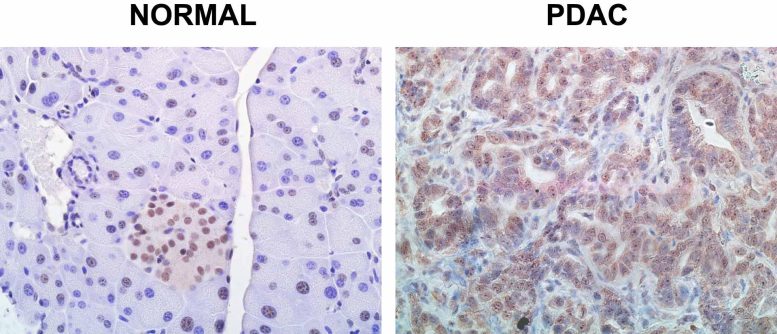
    Normal PDAC Pancreas Cells
    Normal healthy pancreas cells maintain a constant level of SRSF1 (stained red), but in PDAC, those levels grow out of control. Credit: Krainer lab/Cold Spring Harbor Laboratory

    “Cells have several processes to keep SRSF1 levels constant,” says Krainer. “But cancer tends to find a way to overcome these checks and balances.”

    Several genes, RNAs, and proteins work together in cells to keep SRSF1 levels steady. But sometimes, the process gets disrupted. In the pancreas, this triggers pancreatitis and accelerates PDAC.

    “It’s a very pronounced effect,” Krainer explains. “We could see that patients whose tumors express higher levels of SRSF1 have worse outcomes. So, we set out to explore to what extent SRSF1 contributes to PDAC.”

    The Role of SRSF1 in Tumor Growth

    The team found that higher levels of SRSF1 are essential for PDAC growth in mice and organoids—small versions of tumors. Furthermore, when SRSF1 returned to normal levels, the organoids stopped growing. SRSF1 is important in healthy tissue, so it may not be an ideal drug target by itself. However, some of the splicing changes it promotes could be targeted instead. Krainer says there is still more work to be done.

    “We’re excited by these developments,” he says. “But PDAC is a difficult and complicated malignancy. We’re hoping to provide actionable information for future treatments. This work spearheaded by Ledong is just the tip of the iceberg.”

    Krainer and Wan’s collaboration with the Tuveson lab is part of a broader effort to explore pancreas and breast cancer. The initiative also includes CSHL Professors David Spector and Christopher Vakoc.

    “The Krainer lab’s paradigm-shifting work has led to a deeper understanding of many types of cancer,” says Tuveson, director of the CSHL Cancer Center. “Dr. Wan’s research reveals an exciting new avenue to understand pancreatic cancer. It reaffirms the importance of basic biological research for the improvement of human health.”

    Reference: “Splicing Factor SRSF1 Promotes Pancreatitis and KRASG12D-Mediated Pancreatic Cancer” by Ledong Wan, Kuang-Ting Lin, Mohammad Alinoor. Rahman, Yuma Ishigami, Zhikai Wang, Mads A. Jensen, John E. Wilkinson, Youngkyu Park, David A. Tuveson and Adrian R. Krainer, 26 April 2023, Cancer Discovery.
    DOI: 10.1158/2159-8290.CD-22-1013

    Never miss a breakthrough: Join the SciTechDaily newsletter.
    Follow us on Google and Google News.

    Cancer Cold Spring Harbor Laboratory Popular Protein
    Share. Facebook Twitter Pinterest LinkedIn Email Reddit

    Related Articles

    Scientists Crack Cancer’s Hidden Defense With a Breakthrough Protein Discovery

    Scientists Have Discovered a Simple Supplement That Causes Prostate Cancer Cells To Self-Destruct

    “Shocking” Findings – Scientists Discover How Stress Triggers Cancer’s Spread

    Unlocking the Secret: How One Protein Can Halt Lung Cancer Spread

    Scientists Uncover How Proteins Drive Cancer Growth

    Surprising Finding: Scientists Discover New, Unexpected Mechanism of Cancer Cell Spread

    Keto Diet: The Dark Side of a Promising Cancer Weapon

    Scientists Develop a New, Powerful Cancer-Fighting Weapon

    How a Certain Protein Can Cause Deadly Cancers

    Leave A Reply Cancel Reply

    • Facebook
    • Twitter
    • Pinterest
    • YouTube

    Don't Miss a Discovery

    Subscribe for the Latest in Science & Tech!

    Trending News

    Mezcal “Worm” in a Bottle Mystery: DNA Testing Reveals a Surprise

    New Research Reveals That Your Morning Coffee Activates an Ancient Longevity Switch

    This Is What Makes You Irresistible to Mosquitoes

    Shockingly Powerful Giant Octopuses Ruled the Seas 100 Million Years Ago

    Scientists Stunned by New Organic Molecules Found on Mars

    Rewriting Dinosaur Evolution: Scientists Unearth Remarkable 150-Million-Year-Old Stegosaur Skull

    Omega-3 Supplements Linked to Cognitive Decline in Surprising New Study

    First-of-Its-Kind Discovery: Homer’s Iliad Found Embedded in a 1,600-Year-Old Egyptian Mummy

    Follow SciTechDaily
    • Facebook
    • Twitter
    • YouTube
    • Pinterest
    • Newsletter
    • RSS
    SciTech News
    • Biology News
    • Chemistry News
    • Earth News
    • Health News
    • Physics News
    • Science News
    • Space News
    • Technology News
    Recent Posts
    • Male Birth Control Breakthrough: Scientists Find Way To Turn Sperm Production Off and Back On
    • A Common Vitamin Could Hold the Key to Treating Fatty Liver Disease
    • New Research Shows Vitamin B12 May Hold the Key to Healthy Aging
    • Scientists Map Thousands of Brain Connections With RNA Barcodes
    • This Gene Tweak Turns Strawberries Into Healthier, Tastier Superfruit
    Copyright © 1998 - 2026 SciTechDaily. All Rights Reserved.
    • Science News
    • About
    • Contact
    • Editorial Board
    • Privacy Policy
    • Terms of Use

    Type above and press Enter to search. Press Esc to cancel.