
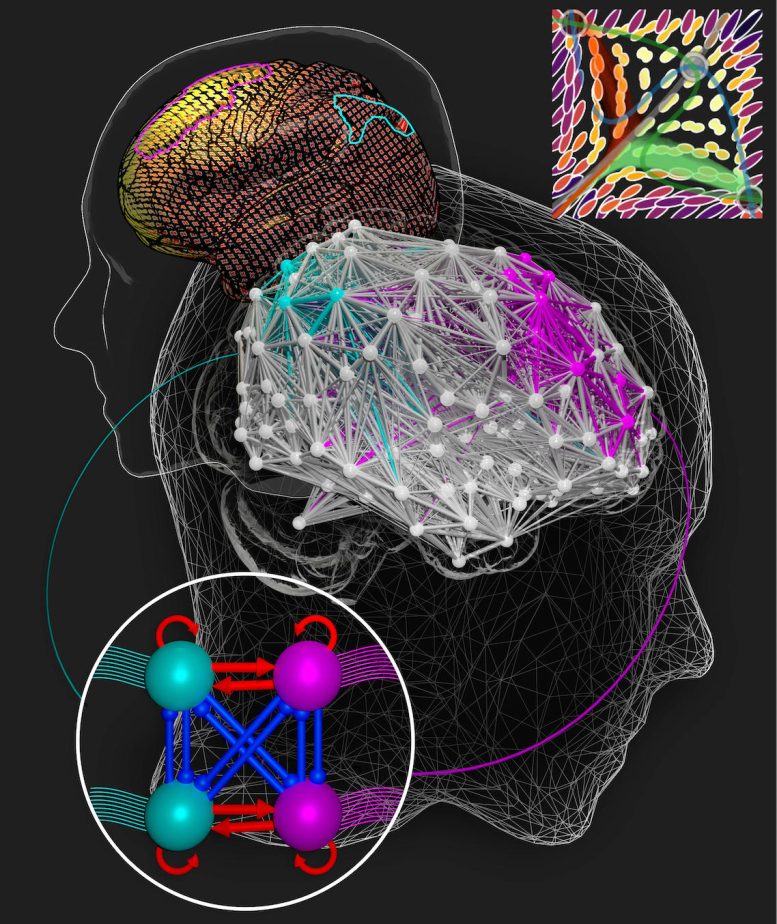
A study using brain simulations reveals that highly intelligent individuals take longer to solve complex problems, as better brain synchronization allows for deeper reasoning.
Do intelligent people think faster than others when solving problems? New findings by researchers from the Human Brain Project at Charité University Berlin and their partner at University Pompeu Fabra in Barcelona question this deeply ingrained belief in the field of intelligence research.
The results of their research were recently published in the journal Nature Communications.
Taking a biologically inspired approach, they constructed 650 personalized brain network models (BNMs). These were created using data gathered from the Human Connectome Project and enabled the team to simulate the processes the brain undergoes during problem-solving.
Observations from the brain simulations were compared to empirical data of the 650 participants taking the so-called Penn Matrix Reasoning Test (PMAT), consisting of a series of increasingly difficult pattern-matching tasks. The results of these were quantified into participants’ fluid intelligence (FI), which could roughly be described as the ability to take difficult decisions in new situations.
Higher Intelligence Linked to Slower, More Thoughtful Processing
“We found that people scoring higher on fluid intelligence (FI) took more time to solve the more difficult tasks compared to people with lower FI. They were only quicker when responding to simple questions,” explains Petra Ritter of Charité University, senior author of the study. “We first observed this in our simulations, and then only afterward we saw that the empirical data of participants taking the intelligence tests corresponded to this trend.” Ritter’s lab and many other research groups at HBP use brain simulation to complement observational data, in order to develop a theoretical framework of how the brain works.
In this case, brain simulation has been employed to determine the link between functional and structural connectivity in the brain and cognitive performance. A more synchronized brain is better at solving problems, but not necessarily faster. “As synchronization is reduced, decision-making circuits in the brain jump faster to conclusions, while higher synchronization between brain regions allows for better integration of evidence and more robust working memory,” says Ritter. “Intuitively this is not so surprising: if you have more time and consider more evidence, you invest more in problem-solving and come up with better solutions. Here we not only show this empirically, but we demonstrate how the observed performance differences are a consequence of the dynamic principles in personalized brain network models. We thus present new evidence that challenges a common notion about human intelligence.”
Challenging Traditional Views on Intelligence
Previously established local circuit models of working memory (WM) and decision-making (DM), both important for intelligence, were plugged into The Virtual Brain (TVB), of which the latter provided a simulation at the whole-brain level.
The simulations were run using a multi-scale brain modeling approach; brain imaging data were processed with automated containerized pipelines. The processing of the highly sensitive brain data took place within a secure Virtual Research Environment of EBRAINS Health Data Cloud. These technologies are accessible through EBRAINS to the global research community.
The ultimate goal of the study is not to find out how fast you should think but rather to understand how biological networks determine decision-making for the development of bio-inspired tools and robotic applications. Modeling brain dynamics of intelligent decision-making is therefore a promising approach to building smart applications. “We think that biologically more realistic models may outperform classical A.I. in the future,” says Ritter.
Reference: “Learning how network structure shapes decision-making for bio-inspired computing” by Michael Schirner, Gustavo Deco, and Petra Ritter, 23 May 2023, Nature Communications.
DOI: 10.1038/s41467-023-38626-y
Never miss a breakthrough: Join the SciTechDaily newsletter.
Follow us on Google and Google News.
1 Comment
“Intuitively this is not so surprising: if you have more time and consider more evidence, you invest more in problem-solving and come up with better solutions.”
Maybe! The potential is there for solutions that might not be options for those making snap decisions. However, it doesn’t mean that the solutions will always be better. Part of the definition of intelligence should be answers that are correct more frequently or somehow better than other solutions. I didn’t see that being considered.
Is there a correlation between simple reaction times and intelligence? Was that considered?