

Close Menu
    Facebook X (Twitter) Instagram
    SciTechDaily
    • Biology
    • Chemistry
    • Earth
    • Health
    • Physics
    • Science
    • Space
    • Technology
    Facebook X (Twitter) Pinterest YouTube RSS
    SciTechDaily
    Home»Earth»Rewriting Earth’s Early History: Scientists Discover High Iron Oxidation in Primordial Magma
    Earth

    Rewriting Earth’s Early History: Scientists Discover High Iron Oxidation in Primordial Magma

    By Ehime UniversityAugust 6, 2023No Comments3 Mins Read
    Facebook Twitter Pinterest Telegram LinkedIn WhatsApp Email Reddit
    Share
    Facebook Twitter LinkedIn Pinterest Telegram Email Reddit
    Early Earth Illustration
    A new study shows that early Earth’s magma ocean was significantly more oxidized, leading to an atmosphere rich in CO2 and SO2. This could have hindered the formation of biomolecules, suggesting late accretion of reducing materials was crucial for habitability.

    New Study Sheds Light on the Composition of the Earth’s Earliest Atmosphere

    Understanding the atmospheric and surface conditions of early Earth, especially before life originated, is crucial to comprehend Earth’s ability to support life. The atmosphere of terrestial planets is believed to have been created by the release of volatile substances from the planet’s interior and its composition is mainly controlled by the oxidation state of the mantle.

    To understand the mantle oxidation state, the abundance of ferrous (Fe2+) and ferric (Fe3+) iron in the mantle are key because the mantle oxidation state varies with the relative abundance of these two iron oxides.

    Ehime University has led an experimental study showing that the formation efficiency of Fe3+ via redox disproportionation of Fe2+ in metal-saturated magma under high pressures corresponding to the depth of the lower mantle is higher than previously thought. In this reaction, Fe3+ and metallic iron (Fe0) are formed from 2Fe2+, and the segregation of Fe0 into the core increases the content of Fe3+ in the residual magma and its oxidation state.
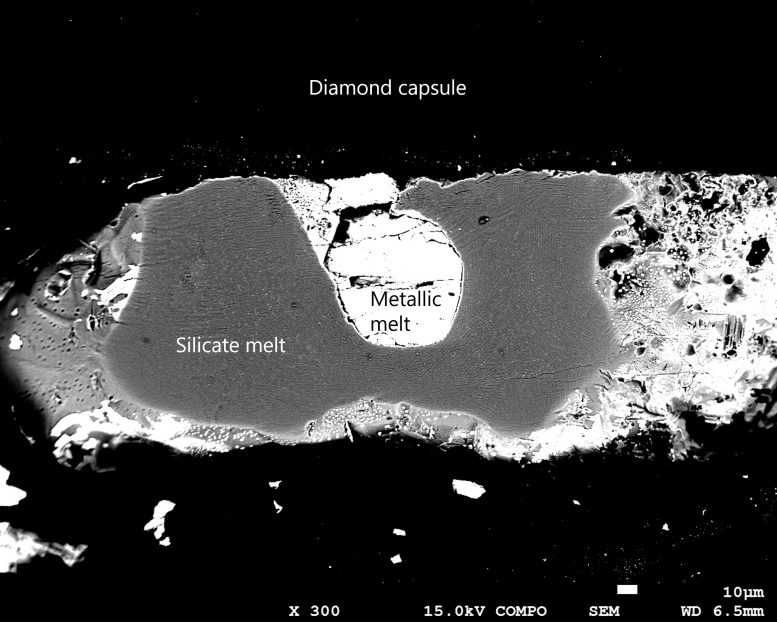
    Quenched Texture of the Recovered Sample
    The bright area at the center of the image shows quenched metallic melt and the surrounding grey area indicates quenched silicate melt. The sample was encapsulated into a graphite capsule, which is transformed into diamond during heating experiments. Credit: Geodynamics Research Center, Ehime University

    The experimental results indicate that the Fe3+ content of the Earth’s magma ocean during core formation was about one order of magnitude higher than the present upper mantle. This suggests that the magma ocean was much more oxidizing than the present Earth’s mantle after the core formation, and the atmosphere formed by the degassing of volatiles from such a highly oxidizing magma would have been rich in CO2 and SO2.

    In addition, the authors found that the estimated oxidation state of the Earth’s magma ocean can explain that of Hadean magmas of more than 4 billion years ago by inference from geological records.

    Because the formation efficiency of biomolecules in a CO2-rich atmosphere is quite low, the authors speculated that the late accretion of reducing materials after the formation of the Earth played an important role in supplying biologically available organic molecules and the formation of a habitable environment.

    Reference: “Hadean mantle oxidation inferred from melting of peridotite under lower-mantle conditions” by Hideharu Kuwahara, Ryoichi Nakada, Shintaro Kadoya, Takashi Yoshino and Tetsuo Irifune, 4 May 2023, Nature Geoscience.
    DOI: 10.1038/s41561-023-01169-4

    The study was funded by the Japan Society for the Promotion of Science.

    Never miss a breakthrough: Join the SciTechDaily newsletter.
    Follow us on Google and Google News.

    Earth Science Ehime University Geoscience Planetary Science
    Share. Facebook Twitter Pinterest LinkedIn Email Reddit

    Related Articles

    Cosmic Hide-and-Seek: Scientists Solve a 4.6-Billion-Year-Old Nitrogen Mystery

    Impact Simulations Show How Massive Collisions Delivered Metal to Early Earth

    New Research Sheds Light on the Evolutionary Path That Enabled Life on Earth

    Geoscientists Building Whole-Earth Model to Study Long-Term Climate Evolution

    First Definitive Proof of a Comet Striking Earth Millions of Years Ago

    Scientists Link Earth’s Westward Drift of Magnetic Field and Superrotation of Inner Core

    Tamu Massif Confirmed as Largest Single Volcano on Earth

    Earthquake Doublets Reveal Changing Speed of the Earth’s Inner Core

    Using a Fifth Force of Nature to Probe Earth’s Deep Interior

    Leave A Reply Cancel Reply

    • Facebook
    • Twitter
    • Pinterest
    • YouTube

    Don't Miss a Discovery

    Subscribe for the Latest in Science & Tech!

    Trending News

    Don’t Miss: A Brilliant Venus and Glowing Harvest Moon Light Up the Sky

    New Twist on the Einstein Problem Reveals Unexpected Physics

    JWST Captures Stunning Evidence of How Supermassive Black Holes Feed

    Early Exercise May Permanently Change How Much Energy the Body Uses To Move

    New Molecule Wipes Out Aggressive Lymphoma Tumors in Mice in Just 11 Days

    The Human Family Tree May Need a Major Rewrite

    Scientists Find a Surprising Cancer-Fighting Effect in Dark Sweet Cherries

    New AI Detects Hidden Warning Signs of Solar Eruptions Hours Before They Emerge

    Follow SciTechDaily
    • Facebook
    • Twitter
    • YouTube
    • Pinterest
    • Newsletter
    • RSS
    SciTech News
    • Biology News
    • Chemistry News
    • Earth News
    • Health News
    • Physics News
    • Science News
    • Space News
    • Technology News
    Recent Posts
    • Africa’s Giant Herbivores Were Disappearing Millions of Years Before Humans Could Hunt Them
    • This Utah Mountain Is Hiding Enough Ice To Fill 600 Olympic Pools
    • Vagus Nerve Stimulation Could Unlock the Brain’s Hidden Learning Potential
    • Your Mother’s Age May Leave a Biological Mark That Lasts for Generations
    • Women Who Ate More Antioxidants Had Strikingly Lower Rates of Cervical Cancer
    Copyright © 1998 - 2026 SciTechDaily. All Rights Reserved.
    • Science News
    • About
    • Contact
    • Editorial Board
    • Privacy Policy
    • Terms of Use

    Type above and press Enter to search. Press Esc to cancel.