
Close Menu
    Facebook X (Twitter) Instagram
    SciTechDaily
    • Biology
    • Chemistry
    • Earth
    • Health
    • Physics
    • Science
    • Space
    • Technology
    Facebook X (Twitter) Pinterest YouTube RSS
    SciTechDaily
    Home»Earth»Impact Simulations Show How Massive Collisions Delivered Metal to Early Earth
    Earth

    Impact Simulations Show How Massive Collisions Delivered Metal to Early Earth

    By Kimberly Minafra, Ames Research CenterDecember 6, 20171 Comment3 Mins Read
    Facebook Twitter Pinterest Telegram LinkedIn WhatsApp Email Reddit
    Share
    Facebook Twitter LinkedIn Pinterest Telegram Email Reddit
    Simulations Show How Massive Collisions Delivered Metal to Early Earth
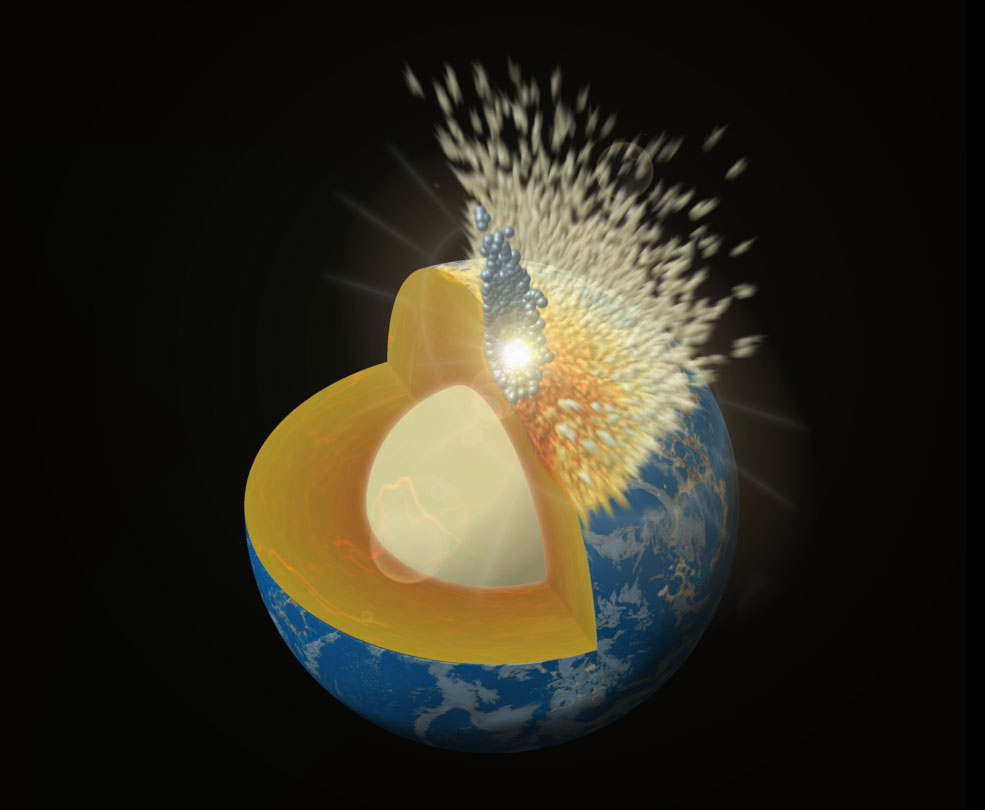
    Artist concept shows the collision of a large moon-sized planetary body penetrating all the way down to the Earth’s core, with some particles ricocheting back into space. Credit: Southwest Research Institute/Simone Marchi

    Planetary collisions are at the core of our solar system’s formation. Scientists have long believed that after the Moon’s formation, the early Earth experienced a long period of bombardment that diminished about 3.8 billion years ago.

    During this period, called “late accretion,” collisions with moon-sized planetary bodies, known as planetesimals, embedded extensive amounts of metal and rock-forming minerals into the Earth’s mantle and crust. It is estimated that approximately 0.5 percent of Earth’s present mass was delivered during this stage of planetary evolution.

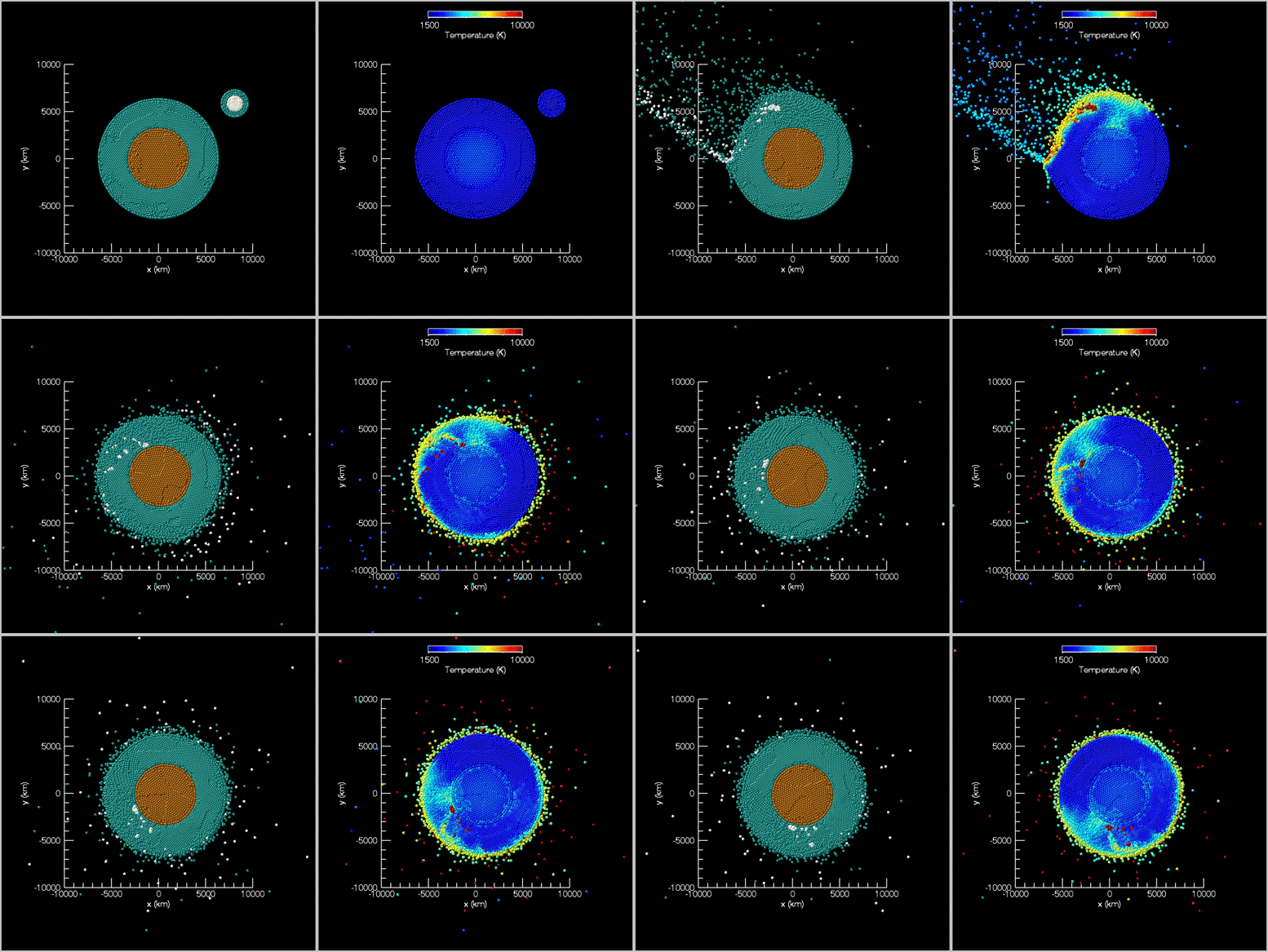
    With the support from a NASA Exobiology grant and NASA’s Solar System Exploration Research Virtual Institute, or SSERVI, researchers at the Southwest Research Institute, or SwRI, and University of Maryland have created high-resolution impact simulations that show significant portions of a large planetesimal’s core could penetrate all the way down to merge with Earth’s core—or ricochet back into space and escape the planet entirely.
    NASA Simulations Show How Massive Collisions Delivered Metal to Early Earth
    The simulations show significant portions of a large moon-sized planetary body penetrating all the way down to the Earth’s core, and ricocheting back into space. On the right, particles are color coded with temperature, indicated in Kelvin. Credit: Southwest Research Institute/Simone Marchi

    For a recently published paper in Nature Geoscience about the topic, Simone Marchi and his colleagues found evidence of more massive accretion onto the Earth than previously thought after the Moon’s formation. The mantle abundances of certain trace elements such as platinum, iridium, and gold, which tend to bond chemically with metallic iron, are much higher than what would be expected to result from core formation. This discrepancy can most easily be explained by late accretion after core formation was complete. The team determined the total amount of material delivered to Earth may have been 2-5 times greater than previously thought, and the impacts altered Earth in a profound way while depositing familiar elements like gold.

    “These results have far-reaching implications for Moon-forming theories and beyond,” said Marchi. “Interestingly, our findings elucidate the role of large collisions in delivering precious metals like gold and platinum found here on Earth.”

    Reference: “Heterogeneous delivery of silicate and metal to the Earth by large planetesimals” by S. Marchi, R. M. Canup and R. J. Walker, 4 December 2017, Nature Geoscience.
    DOI: 10.1038/s41561-017-0022-3

    Researchers at SwRI and the University of Maryland are part of 13 teams within SSERVI, based and managed at NASA’s Ames Research Center in California’s Silicon Valley. SSERVI is funded by the Science Mission Directorate and Human Exploration and Operations Mission Directorate at NASA Headquarters in Washington.

    Never miss a breakthrough: Join the SciTechDaily newsletter.
    Follow us on Google and Google News.

    Earth Science Geoscience Planetary Science
    Share. Facebook Twitter Pinterest LinkedIn Email Reddit

    Related Articles

    Rewriting Earth’s Early History: Scientists Discover High Iron Oxidation in Primordial Magma

    New Research Sheds Light on the Evolutionary Path That Enabled Life on Earth

    Research Reveals New Man-Made Ozone-Depleting Gases in the Atmosphere

    Geoscientists Building Whole-Earth Model to Study Long-Term Climate Evolution

    First Definitive Proof of a Comet Striking Earth Millions of Years Ago

    Scientists Link Earth’s Westward Drift of Magnetic Field and Superrotation of Inner Core

    Tamu Massif Confirmed as Largest Single Volcano on Earth

    Earthquake Doublets Reveal Changing Speed of the Earth’s Inner Core

    Using a Fifth Force of Nature to Probe Earth’s Deep Interior

    1 Comment

    1. thomas on December 7, 2017 10:26 am

      Very cool to know.

      Reply
    Leave A Reply Cancel Reply

    • Facebook
    • Twitter
    • Pinterest
    • YouTube

    Don't Miss a Discovery

    Subscribe for the Latest in Science & Tech!

    Trending News

    New Study Reveals Why Ozempic Works Better for Some People Than Others

    Climate Change Is Altering a Key Greenhouse Gas in a Way Scientists Didn’t Expect

    New Study Suggests Gravitational Waves May Have Created Dark Matter

    Scientists Discover Why the Brain Gets Stuck in Schizophrenia

    Scientists Engineer “Tumor-Eating” Bacteria That Devour Cancer From Within

    Even “Failed” Diets May Deliver Long-Term Health Gains, Study Finds

    NIH Scientists Discover Powerful New Opioid That Relieves Pain Without Dangerous Side Effects

    Collapsing Plasma May Hold the Key to Cosmic Magnetism

    Follow SciTechDaily
    • Facebook
    • Twitter
    • YouTube
    • Pinterest
    • Newsletter
    • RSS
    SciTech News
    • Biology News
    • Chemistry News
    • Earth News
    • Health News
    • Physics News
    • Science News
    • Space News
    • Technology News
    Recent Posts
    • The Surprising Reason You Might Want To Sleep Without a Pillow
    • Household Cats Could Hold the Secret to Fighting Breast Cancer
    • Scientists Say This Natural Hormone Reverses Obesity by Targeting the Brain
    • This 15,000-Year-Old Discovery Changes What We Know About Early Human Creativity
    • 35-Million-Year-Old Mystery: Strange Arachnid Discovered Preserved in Amber
    Copyright © 1998 - 2026 SciTechDaily. All Rights Reserved.
    • Science News
    • About
    • Contact
    • Editorial Board
    • Privacy Policy
    • Terms of Use

    Type above and press Enter to search. Press Esc to cancel.