
Close Menu
    Facebook X (Twitter) Instagram
    SciTechDaily
    • Biology
    • Chemistry
    • Earth
    • Health
    • Physics
    • Science
    • Space
    • Technology
    Facebook X (Twitter) Pinterest YouTube RSS
    SciTechDaily
    Home»Space»Hubble Captures a Breathtaking Light Show From a Powerful Protostellar Jet
    Space

    Hubble Captures a Breathtaking Light Show From a Powerful Protostellar Jet

    By ESA/HubbleOctober 1, 2023No Comments3 Mins Read
    Facebook Twitter Pinterest Telegram LinkedIn WhatsApp Email Reddit
    Share
    Facebook Twitter LinkedIn Pinterest Telegram Email Reddit
    Hubble G35.2-0.7N
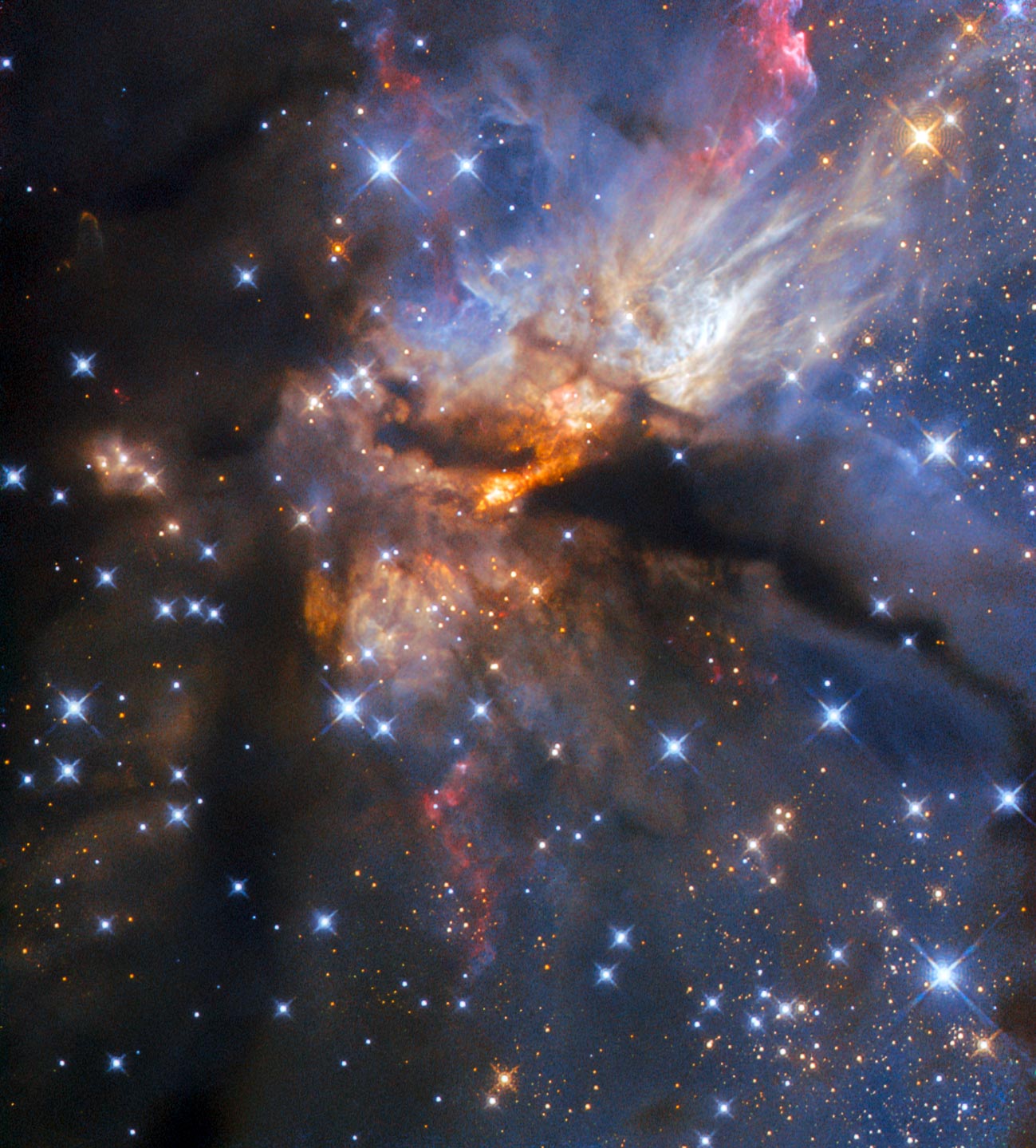
    The Hubble Space Telescope captured this spectacular image of G35.2-0.7N, a region known for its high-mass star formation. Located approximately 7200 light-years from Earth in the Aquila constellation, this area houses at least one B-type star. This star emits a powerful protostellar jet, which can be observed as a radiant display in the image.  Credit: ESA/Hubble & NASA, R. Fedriani, J. Tan

    Hubble’s image of G35.2-0.7N reveals a massive protostar ejecting a jet, providing insights into high-mass star formation and ionization processes.

    This breathtaking image from the Hubble Space Telescope shows a region called G35.2-0.7N, which is known as a hotbed of high-mass star formation. The kind of stars that form here are so massive that they will end their lives as destructive supernovae. However, even as they form they greatly impact their surroundings. At least one B-type star — the second most massive type — lurks within the region pictured here, and a powerful protostellar jet that it is launching towards us is the source of the spectacular light show.

    Taken with the Wide Field Camera 3 (WFC3), which is mounted on the NASA/ESA Hubble Space Telescope, this image captures the region G35.2-0.7N which lies approximately 7200 light-years from Earth in the constellation Aquila.

    This beautiful picture was assembled using data that were collected primarily for very specific research purposes, as are many of the Hubble Pictures of the Week. The research conducted using these data included measuring the extent of ionization in the jets being blasted out of the protostar buried within G35.2-0.7N. Ionization is a process by which atoms or molecules become charged, often because they are in such a high-energy environment that they have lost some of their electrons (the tiny negatively charged particles that orbit nuclei in atoms and molecules).

    Protostellar jets are enormous collimated beams of matter that are ejected from protostars. Collimated simply means that the matter is ejected in parallel (column-like) streams, which in turn means that the jets do not spread out much, but extend out very far in relatively straight lines.

    The visual result of the ejected matter is the glorious display visible in this image. Much of the nebula is dark, with light being blocked from Hubble’s view by the rich dust clouds that produce these massive stars.

    Near the very center, the location of the star and the jet of material it is emitting can be seen. The small, bright orange streak there is a cavity in the dust carved out by the ferocity of the jet as it streams toward us. By breaking through its dusty cocoon, the jet reveals light from the protostar, but there is still so much dust that the light is “reddened” to a fiery orange. The massive protostar lies at the very lower-left tip of this cavity.

    Never miss a breakthrough: Join the SciTechDaily newsletter.
    Follow us on Google and Google News.

    Astronomy European Space Agency Hubble Space Telescope
    Share. Facebook Twitter Pinterest LinkedIn Email Reddit

    Related Articles

    A Diamond Necklace of Cosmic Proportions

    Hubble Snaps a Stunning Close-Up of a Magnificent Spiral Galaxy

    Extraordinary Hubble Image: Light Bends From the Beyond

    Hubble Space Telescope Sees Volcanic Activity Reforming the Atmosphere on a Rocky Exoplanet

    Hubble Spies a Luminous Heart With Dark Tendrils

    Spectacular Return to the Veil Nebula

    Hubble Spots a Peculiar Sight: Unusual Spiral Galaxy With a Heavy Arm

    A Flash of Life: Hubble Spies an Unusual Planetary Nebula

    Through the Cosmic Clouds: Hubble Spots a Beautiful Stellar Nursery

    Leave A Reply Cancel Reply

    • Facebook
    • Twitter
    • Pinterest
    • YouTube

    Don't Miss a Discovery

    Subscribe for the Latest in Science & Tech!

    Trending News

    Common Laxative May Help Reverse Depression-Related Brain Fog

    Younger Generations Are Aging Faster – and It May Be Fueling a Surge in Cancer

    New Discovery Could Unlock Quantum Computers the Size of a Coin

    Shingles Vaccine Linked to 24% Lower Dementia Risk in Older Adults

    Scientists Found a Wordle Trick That Solves 99% of Puzzles

    A Hidden Galaxy Called Shadow Blaster May Explain One of Astronomy’s Biggest Mysteries

    These 3 Common Sleep Habits May Be Aging Your Brain Faster

    Rare Goblin Shark Spotted Alive in Its Natural Habitat for the First Time

    Follow SciTechDaily
    • Facebook
    • Twitter
    • YouTube
    • Pinterest
    • Newsletter
    • RSS
    SciTech News
    • Biology News
    • Chemistry News
    • Earth News
    • Health News
    • Physics News
    • Science News
    • Space News
    • Technology News
    Recent Posts
    • New Fossils Show the Arctic Was an Evolutionary Powerhouse During the Age of Dinosaurs
    • What Happened to Australasia’s Lost Crocodiles? New Research Reveals a Dramatic Extinction Story
    • 520-Million-Year-Old Fossils Solve One of Evolution’s Biggest Mysteries
    • This Extraordinary Desert Mouse Defies Aging – and It Could Change Human Longevity
    • A Simple Blood Test Can Reveal the True Age of Your Brain, Heart, and Other Organs
    Copyright © 1998 - 2026 SciTechDaily. All Rights Reserved.
    • Science News
    • About
    • Contact
    • Editorial Board
    • Privacy Policy
    • Terms of Use

    Type above and press Enter to search. Press Esc to cancel.