
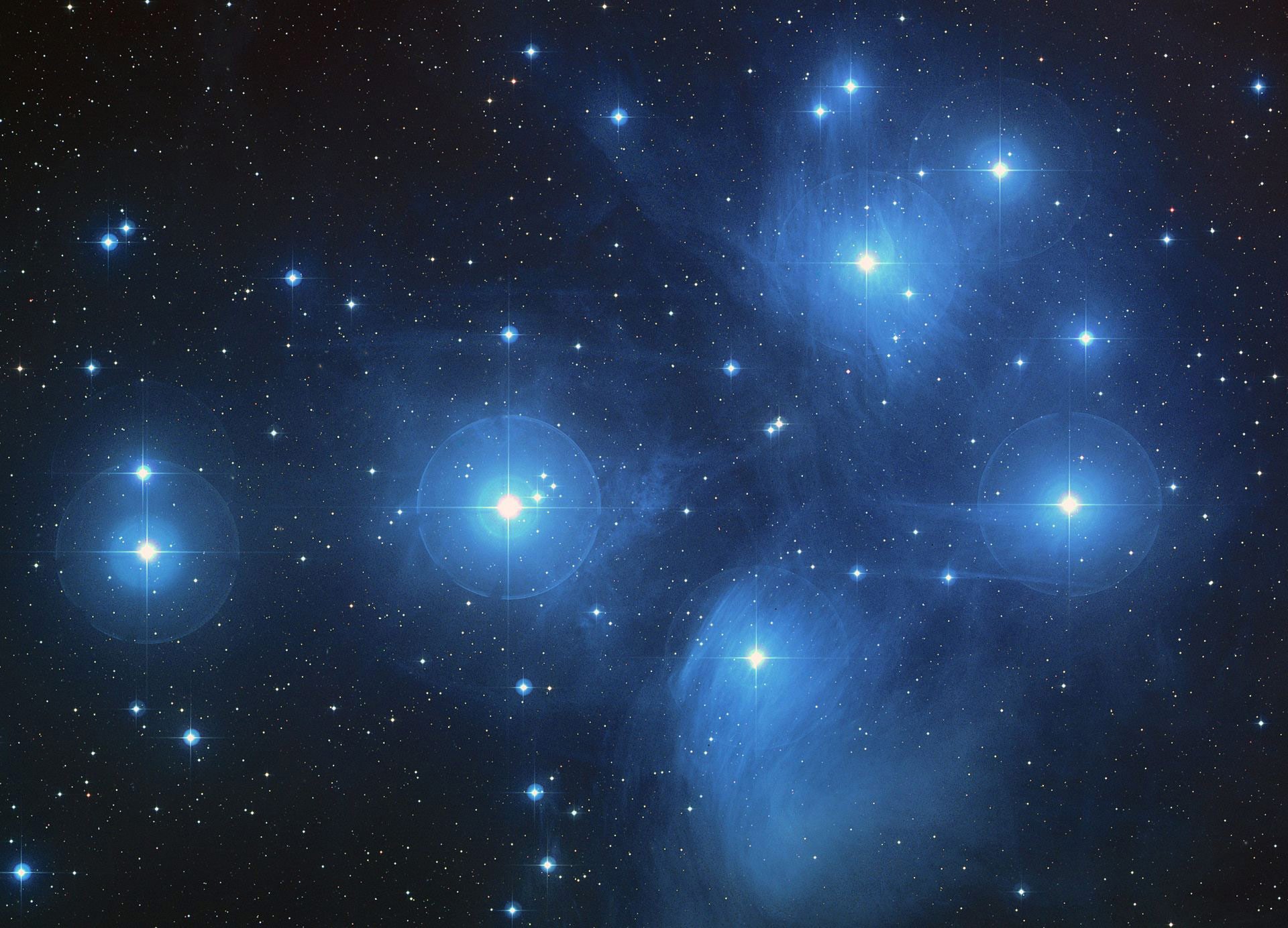
Astronomers from the Harvard-Smithsonian Center for Astrophysics have completed a new distance measurement to the Pleiades Cluster, strengthening the existing astrophysical models and contradicting an earlier distance result that challenged those models.
The Pleiades star cluster, a brilliant collection of several hundred stars visible in the winter sky near the constellation of Orion, has been admired by people for thousands of years; it is cited in the Bible and the works of Greek authors. The Pleiades is a relatively young cluster of stars: its estimated age, only around 100 million years old, means it was born long after the Jurassic dinosaurs passed into history.
The Pleiades cluster is also relatively close by, about 439 light-years according to most measures, with an uncertainty of less than about 1%. The distance is a crucial factor (as it is in many astronomical studies) because the intrinsic luminosity of a star is determined by measuring its observed flux and then correcting for its distance. The intrinsic luminosity in turn is used to determine the star’s age and general properties. Astronomers think they understand the inner workings of stars like those in the Pleiades well enough to account precisely for the flux observed, so well in fact that even a small change in the distance to the Pleiades, at the 10% level, would modify the intrinsic values enough to throw a wrench into the stellar models. Unfortunately, in 2009, a re-analyses of data from the European Hipparcos mission, a satellite designed to measure stellar distances, announced that the true distance to the Pleiades was only 395 light-years with a 1% uncertainty. This change was enough to disrupt the current thinking not only about the stars in the Pleiades, but more generally to call into question some details about how stars work.
CfA astronomer Mark Reid, along with four colleagues, has just completed a 1.5-year study of the distances to the stars in the Pleiades using techniques of radio interferometry, in which an array of radio telescopes across the globe work in concert to obtain extremely high spatial resolution images. These images are then compared as the Earth orbits the Sun to obtain parallax measurements of the stellar distances, the most direct and reliable method of distance measurement. Writing in the latest issue of Science, the astronomers report that the true distance is 448 light-years with an uncertainty of 0.9% – essentially the same as the traditional value and in disagreement with the Hipparcos result, which they argue suffers from some uncorrected errors. The new results cement the existing astrophysical models of Pleiades-age stars.
Reference: “A VLBI resolution of the Pleiades distance controversy” by Carl Melis, Mark J. Reid, Amy J. Mioduszewski, John R. Stauffer and Geoffrey C. Bower, 29 August 2014, Science.
DOI: 10.1126/science.1256101
Never miss a breakthrough: Join the SciTechDaily newsletter.
Follow us on Google and Google News.
2 Comments
Did you mean “10 million years old”? If not, then your statement that these stars were born long after the dinosaurs had disappeared is not accurate. Dinosaurs were still roaming the earth up to about 65 million years ago.
“The Pleiades is a relatively young cluster of stars: its estimated age, only around 100 million years old, means it was born long after the Jurassic dinosaurs passed into history.” The statement is referring to dinosaurs from the Jurassic period, which was roughly 201 – 145 million years ago.