
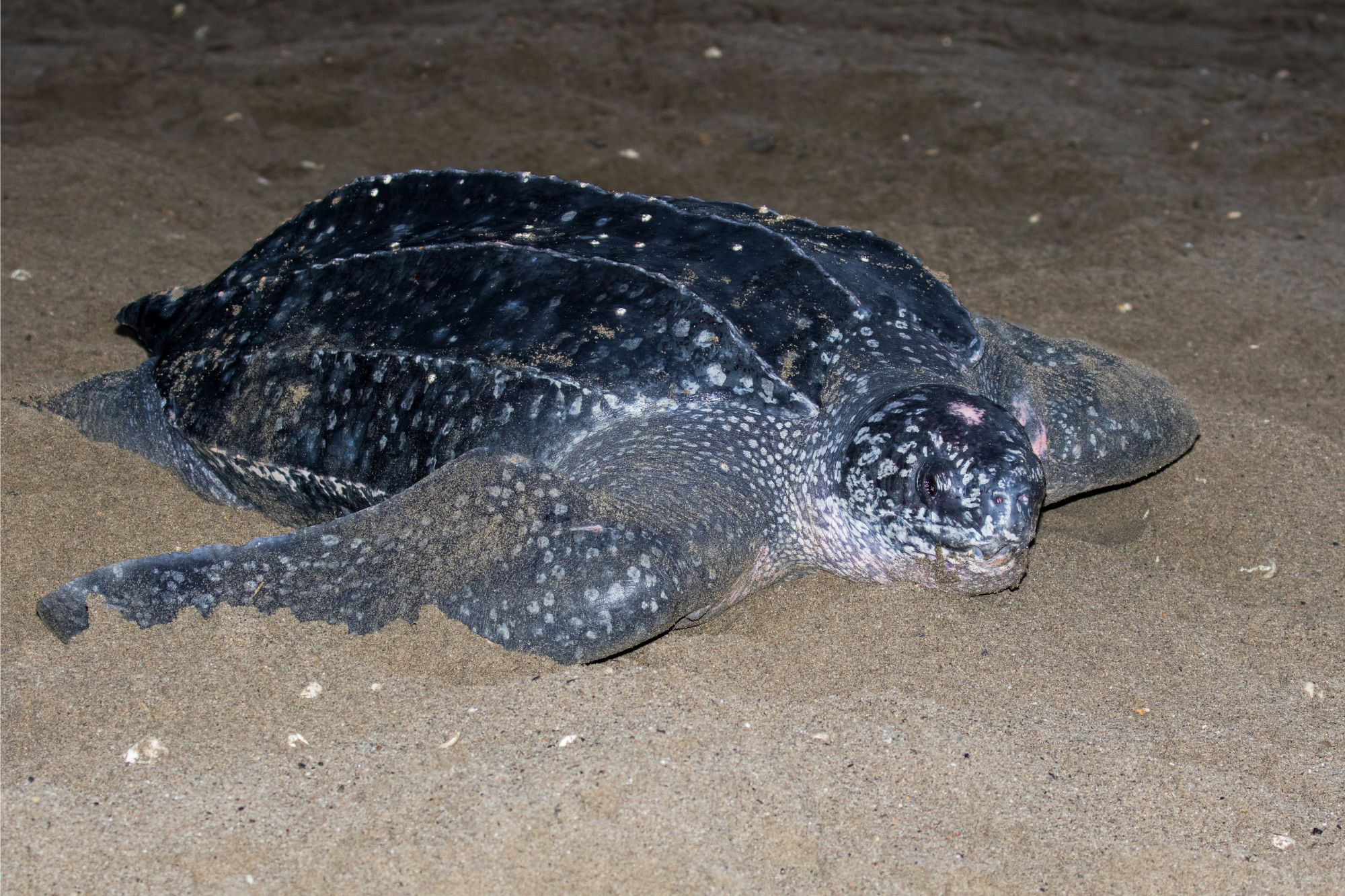
Leatherback sea turtles, the largest of all living turtles, embark on extensive migratory journeys that may extend over several years. These turtles move from warm subtropical and tropical nesting grounds to cooler temperate zones where they forage. Even after years of tracking, knowledge gaps remain, particularly regarding their migration pathways and feeding grounds in certain areas, such as the north-west Atlantic Ocean.
Using new and more sophisticated tracking technology, a team of researchers in the US set out to identify migratory corridors and potential foraging areas used by leatherbacks along the east coast of the US. The findings have been published in Frontiers in Marine Science.
“Using movement behavior models, we show that leatherbacks migrating along the east coast of the US display inferred foraging behavior in specific areas in the South Atlantic Bight (SAB), which is the coastal area stretching from North Carolina to the upper Florida Keys; the Mid-Atlantic Bight (MAB), which is the coastal region running from Massachusetts to North Carolina; and southern New England (SNE),” said Dr Mitchell Rider, a postdoctoral researcher at the University of Miami. “It appears that the MAB may hold a significant foraging ground for leatherbacks.”
New foraging locations discovered
To track the turtles, the researchers fixed satellite transmitters to two groups of leatherbacks. The first group was tagged off Massachusetts in the summer, the second off North Carolina in the spring.
Off Massachusetts is a known foraging area from which leatherbacks migrate northwards after foraging. Tracking them from there allowed the researchers to identify secondary foraging- and over-wintering areas along the continental shelf. Tracking turtles captured off North Carolina enabled them to assess diving and movement behavior along migratory routes and identify subsequent foraging areas. Between 2017 and 2022, 52 leatherbacks were tracked successfully between 15 and 302 days.
The researchers’ findings suggest that in addition to known foraging areas in SNE and Nova Scotia, leatherbacks use SNE, MAB, and SAB regions as both migratory corridors and for foraging. “The high use of the MAB by both groups of leatherbacks is the most important finding of our study. High use was mostly characterized by inferred foraging behavior,” Rider said. “To date, several studies have tracked leatherbacks into this region, but we are the first to take that a step further and characterize the behaviors associated with their movement patterns.”
Knowledge for conservation
New knowledge about foraging areas and leatherbacks’ movement ecology along the north-west Atlantic Shelf is likely to open new doors for future work on leatherbacks in the MAB and SAB, the researchers said. “Now that we understand the key hotspots where foraging is occurring, we need to focus our attention on these specific areas by implementing methods that allow for direct observations,” explained Rider. “For that, we need to implement more in situ styles of research such as animal-borne video surveillance.”
Despite their now deeper understanding of leatherbacks’ movement and foraging, there is work to be done, the researchers said. This includes studying leatherbacks in the SAB, as this region appears to serve the turtles for overwintering, nesting in the spring, and foraging during the summer.
Their findings are also important for the conservation of the endangered species, the researchers said. Leatherbacks are prone to incidental capture and strikes by fishing vessels. The new findings may be used to highlight key areas for conservation and help prevent these accidents. Additionally, the MAB and southern New England are set to see a large amount of offshore wind farm development and conservationists may use this knowledge to help mitigate impacts on the endangered turtles.
Reference: “Where the leatherbacks roam: movement behavior analyses reveal novel foraging locations along the Northwest Atlantic shelf” by Mitchell J. Rider, Larisa Avens, Heather L. Haas, Joshua M. Hatch, Samir H. Patel and Christopher R. Sasso, 2 January 2024, Frontiers in Marine Science.
DOI: 10.3389/fmars.2024.1325139
Never miss a breakthrough: Join the SciTechDaily newsletter.
Follow us on Google and Google News.