
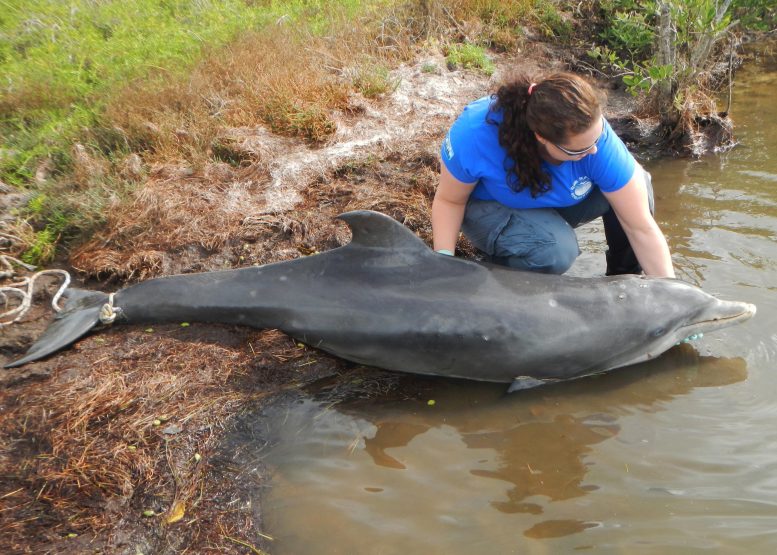
A phytoplankton bloom harmed marine habitats, reduced the availability of nutritious prey for bottlenose dolphins, and caused a significant increase in strandings and deaths.
In 2013, 8 percent of the bottlenose dolphins living in Florida’s Indian River Lagoon died. Researchers have since found that the dolphins may have starved after a phytoplankton bloom destroyed vital habitats that supported their most nutritious prey. This bloom was fueled by a buildup of nutrient-rich runoff in the lagoon, including fertilizer, septic tank waste, and other human-related pollutants containing nitrogen and phosphorus.
“We linked mortality and malnutrition to a decreased intake of energy following a shift in dolphins’ diets,” said Dr. Charles Jacoby of the Florida Flood Hub for Applied Research and Innovation, corresponding author of the article in Frontiers in Marine Science. “We linked the dietary shifts to changes in prey availability, and we connected changes in prey to system-wide reductions in the abundance of seagrass and drifting macroalgae. These reductions were driven by shading from an intense, extensive, and long-lasting bloom of phytoplankton.”
Signs of trouble
In 2013, scientists monitoring the Indian River Lagoon observed that the dolphin population was in decline. Of the 337 dolphins studied, 64 percent were underweight, 5 percent were emaciated, and 77 died. This death toll was classified as an unusual mortality event.
“An unusual mortality event is a stranding event that is unexpected and involves a significant die-off of any marine mammal,” explained Megan Stolen of the Blue World Research Institute, first author of the article. “The 2013 event was characterized by a marked increase in mortality and widespread evidence of malnourishment.”
Bottlenose dolphins are large, long-lived animals that eat relatively large amounts of many different types of prey, which means that any disruption to the local ecosystem can affect them. In this case, researchers suspected that critical changes were caused by a 2011 phytoplankton bloom that was fueled by nutrient-rich by-products of human activity flowing into, and accumulating in, the lagoon.
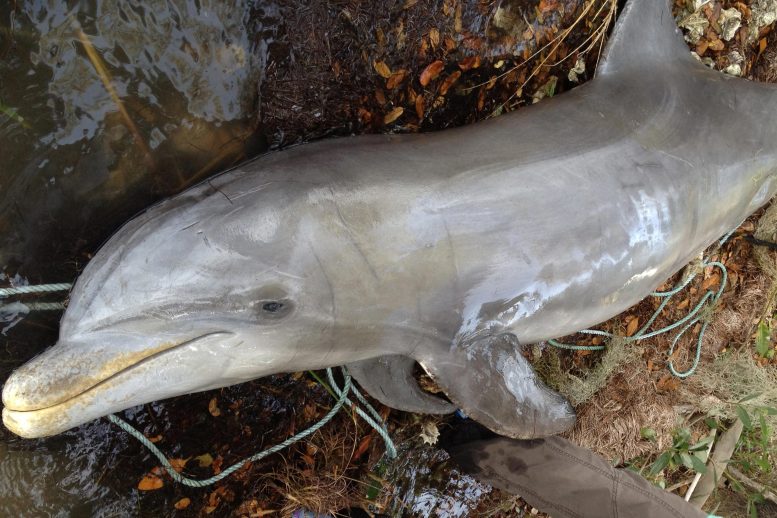
The bloom shaded bottom-dwelling seagrass and macroalgae in large parts of the lagoon, killing off these key habitats for dolphins’ prey and potentially compromising the dolphins’ ability to hunt. But it’s difficult to prove what dolphins are eating: observations of dolphins feeding at the water’s surface don’t yield a full picture of their diets, and stranded dolphins often have empty stomachs.
Instead, the researchers focused on isotopic analysis of muscle biopsies collected from stranded dolphins between 1993 and 2013. The ratios of stable isotopes of carbon and nitrogen in muscle from dolphins represent a mixture of similar ratios in their prey, so — using reference values from prey species — the scientists could track dietary changes over time and compare them to contemporary fisheries monitoring and the presence of seagrass and macroalgae.
Ripple effect
The scientists found a shift in the dolphins’ diets: during 2011-2013, they ate more sea bream and less ladyfish — a more energy-dense fish associated with seagrass. This agreed with the fisheries monitoring, which recorded changes in the availability of the two species: less ladyfish and more sea bream. It also matched the falling abundance of seagrass and macroalgae habitats over the same period. The shift from ladyfish to sea bream meant that dolphins would need to eat about 15% more prey to acquire the same amount of energy.
“In combination, the shift in diets and the widespread presence of malnourishment suggest that dolphins were struggling to catch enough prey of any type,” said Wendy Noke Durden of Hubbs-SeaWorld Research Institute, a co-author. “The loss of key structural habitats may have reduced overall foraging success by causing changes in the abundance and distribution of prey.”
The data also tallied with the causes of death recorded for stranded dolphins. Between 2000 and 2020, malnutrition caused 17% of all recorded deaths, but in 2013, this figure rose to 61%.
“All studies have their limitations,” cautioned co-author Dr. Graham Worthy of the University of Central Florida. “We did not have data on ratios of stable isotopes in all the prey that dolphins were eating from 1993 to 1999, so we could not fully explain the shift in diets observed from that early period to 2000–2010. Additionally, the link between malnourishment and a change in diet would have been enhanced by stable isotope data from the muscle of surviving dolphins.”
“Blooms of phytoplankton are part of productive ecological systems,” said Jacoby. “Detrimental effects arise when the quantities of nutrients entering a system fuel unusually intense, widespread, or long-lasting blooms. In most cases, people’s activities drive these excess loads. Managing our activities to keep nutrients at a safe level is key to preventing blooms that disrupt ecological systems.”
Reference: “An unusual mortality event for bottlenose dolphins links to altered diets resulting from ecological changes” by Megan K. Stolen, Wendy Noke Durden, Teresa Jablonski, Graham A. J. Worthy, Richard Paperno and Charles A. Jacoby, 19 February 2025, Frontiers in Marine Science.
DOI: 10.3389/fmars.2025.1531742
Never miss a breakthrough: Join the SciTechDaily newsletter.
Follow us on Google and Google News.
1 Comment
The underwater volcano in the Gulf of Mexico (America)???