
Close Menu
    Facebook X (Twitter) Instagram
    SciTechDaily
    • Biology
    • Chemistry
    • Earth
    • Health
    • Physics
    • Science
    • Space
    • Technology
    Facebook X (Twitter) Pinterest YouTube RSS
    SciTechDaily
    Home»Space»Decoding Earth’s Cosmic Shields in Groundbreaking Study
    Space

    Decoding Earth’s Cosmic Shields in Groundbreaking Study

    By University of BirminghamApril 1, 2024No Comments3 Mins Read
    Facebook Twitter Pinterest Telegram LinkedIn WhatsApp Email Reddit
    Share
    Facebook Twitter LinkedIn Pinterest Telegram Email Reddit
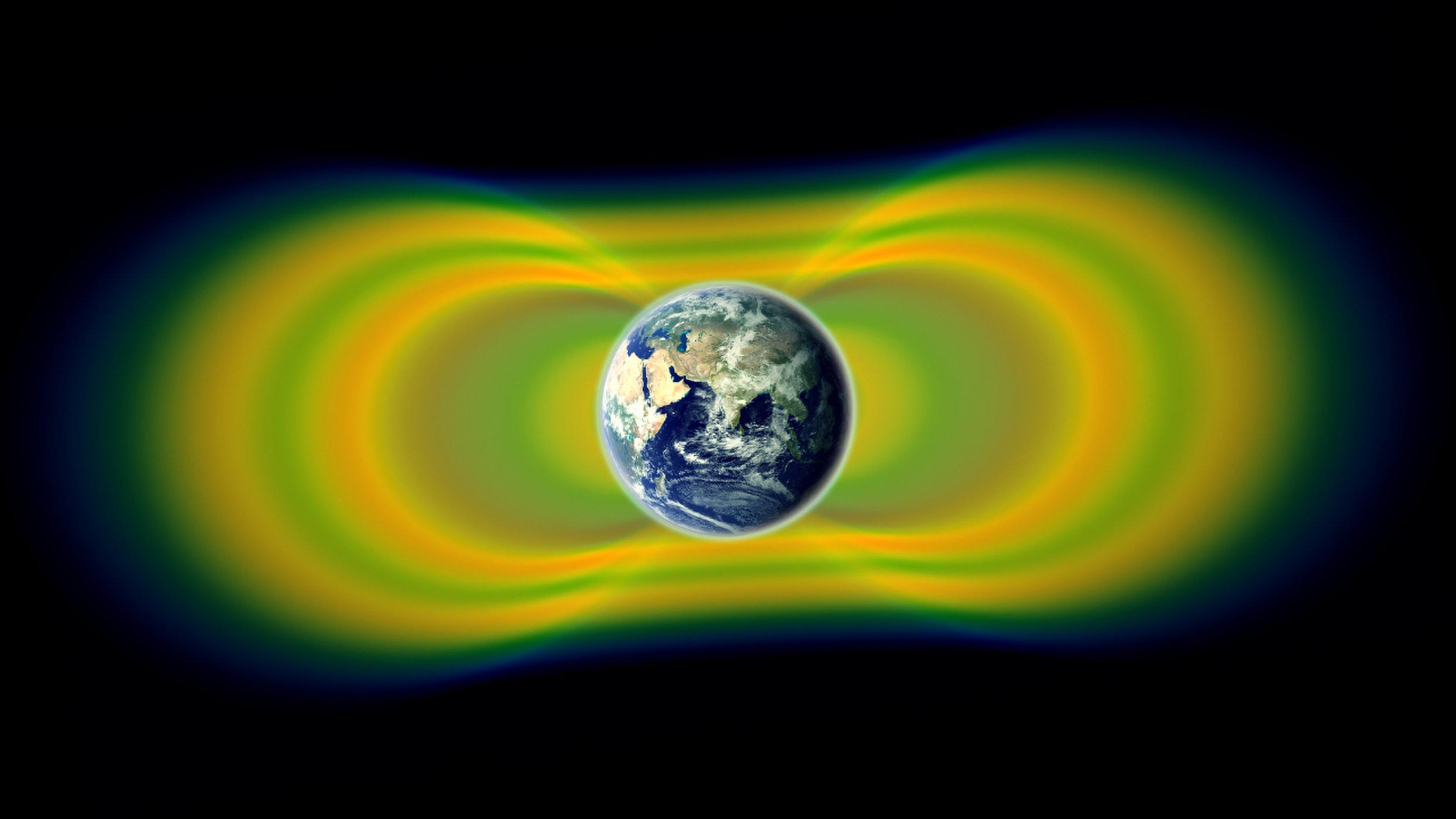
    Van Allen Belts Surrounding Earth
    The University of Birmingham spearheads research to redefine understanding of near-Earth space particles, questioning traditional models and aiming to enhance space weather forecasts. Credit: NASA/Van Allen Probes/Goddard Space Flight Center

    New insights into near-Earth space’s hazardous environment could revolutionize space weather prediction, driven by collaborative international research.

    A challenge to space scientists to better understand our hazardous near-Earth space environment has been set in a new study led by the University of Birmingham.

    The research represents the first step towards new theories and methods that will help scientists predict and analyze the behavior of particles in space. It has implications for theoretical research, as well as for practical applications such as space weather forecasting.

    Exploring the Radiation Belts

    The research focused on two bands of energetic particles in near-Earth space, referred to as the Radiation Belts, or the Van Allen Belts. These particles are trapped within the Earth’s magnetosphere and can damage electronics on satellites and spacecraft passing through, as well as posing risks to astronauts.

    Understanding how these particles behave has been a goal for physicists and engineers for decades. Since the 1960s, researchers have used principles contained within ‘quasilinear models’ to explain how the charged particles move through space.

    Challenges in Space Physics Theories

    In the new study, however, researchers have found evidence that the standard theory might not apply as often as previously assumed. The team of 16 scientists, from institutions in the UK, USA, and Finland, explored the limits of standard theories. The application of the quasilinear theory can seem straightforward, but in fact integrating it into space physics models in accordance with scientific measurements made in space is a delicate procedure. This paper breaks down the challenges behind this process.

    The findings are published in a special edition of Frontiers in Astronomy and Space Sciences: “Editor’s Challenge in Space Physics: Solved and Unsolved Problems in Space Physics.”

    Future Directions and Collaborative Research

    Lead author, Dr. Oliver Allanson, from the Space Environment and Radio Engineering (SERENE) Group at the University of Birmingham, said: “Gaining a better understanding of the behavior of these particles is crucial for interpreting satellite data and for understanding the underlying physics of space environments.”

    Researchers involved in the study are based in the UK at the Universities of Birmingham, Exeter, Northumbria, Warwick, St Andrews, and at the British Antarctic Survey; in the USA at the University of California at Los Angeles, University of Iowa and the US Air Force Research Lab, New Mexico; and in Finland at the University of Helsinki.

    Next steps for the research will include an enhanced theoretical description based on the findings in this work, which can then be used in space weather models to forecast the behavior of these hazardous particles in near-Earth space.

    Reference: “The challenge to understand the zoo of particle transport regimes during resonant wave-particle interactions for given survey-mode wave spectra” by Oliver Allanson, Donglai Ma, Adnane Osmane, Jay M. Albert, Jacob Bortnik, Clare E. J. Watt, Sandra C. Chapman, Joseph Spencer, Daniel J. Ratliff, Nigel P. Meredith, Thomas Elsden, Thomas Neukirch, David P. Hartley, Rachel Black, Nicholas W. Watkins and Sean Elvidge, 27 February 2024, Frontiers in Astronomy and Space Sciences.
    DOI: 10.3389/fspas.2024.1332931

    Never miss a breakthrough: Join the SciTechDaily newsletter.
    Follow us on Google and Google News.

    Astronomy Astrophysics University of Birmingham Van Allen Radiation Belts
    Share. Facebook Twitter Pinterest LinkedIn Email Reddit

    Related Articles

    New Exoplanet Discovery Challenges Established Astronomical Theories

    Cosmic Gold Factory: Single Kilonova Produced 1,000x the Mass of the Earth in Very Heavy Elements

    Astronomers Discover BEBOP-1c: Tatooine-Like Exoplanet Orbits Twin Stars in a Multiplanetary System

    Mysterious Astronomical Signal Is Black Hole Jet Pointing Straight Toward Earth

    Astronomers Discover Two “Super-Earth” Planets About 100 Light-Years Away

    New Evidence of Gravitational Wave Background Permeating All of Spacetime

    Astrophysicists on the Hunt for “Hierarchical” Black Holes

    The Odd Couple: Groundbreaking New Discovery From Gravitational Whispers

    Asteroseismologists Confirm That Older Stars Rotate Faster Than Expected

    Leave A Reply Cancel Reply

    • Facebook
    • Twitter
    • Pinterest
    • YouTube

    Don't Miss a Discovery

    Subscribe for the Latest in Science & Tech!

    Trending News

    Breakthrough Bowel Cancer Trial Leaves Patients Cancer-Free for Nearly 3 Years

    Natural Compound Shows Powerful Potential Against Rheumatoid Arthritis

    100,000-Year-Old Neanderthal Fossils in Poland Reveal Unexpected Genetic Connections

    Simple “Gut Reset” May Prevent Weight Gain After Ozempic or Wegovy

    2.8 Days to Disaster: Scientists Warn Low Earth Orbit Could Suddenly Collapse

    Common Food Compound Shows Surprising Power Against Superbugs

    5 Simple Ways To Remember More and Forget Less

    The Atomic Gap That Could Cost the Semiconductor Industry Billions

    Follow SciTechDaily
    • Facebook
    • Twitter
    • YouTube
    • Pinterest
    • Newsletter
    • RSS
    SciTech News
    • Biology News
    • Chemistry News
    • Earth News
    • Health News
    • Physics News
    • Science News
    • Space News
    • Technology News
    Recent Posts
    • Early Cannabis Use May Stall Key Brain Skills in Teens
    • Popular Vitamin D Supplement Has “Previously Unknown” Negative Effect, Study Finds
    • Powerful Antioxidant Found To Play a Key Role in Proper Protein Folding
    • MIT Laser Breakthrough Lets Scientists Watch Drugs Enter the Brain in Real Time
    • Study Reveals Malaria’s Hidden Role in Human Evolution
    Copyright © 1998 - 2026 SciTechDaily. All Rights Reserved.
    • Science News
    • About
    • Contact
    • Editorial Board
    • Privacy Policy
    • Terms of Use

    Type above and press Enter to search. Press Esc to cancel.