
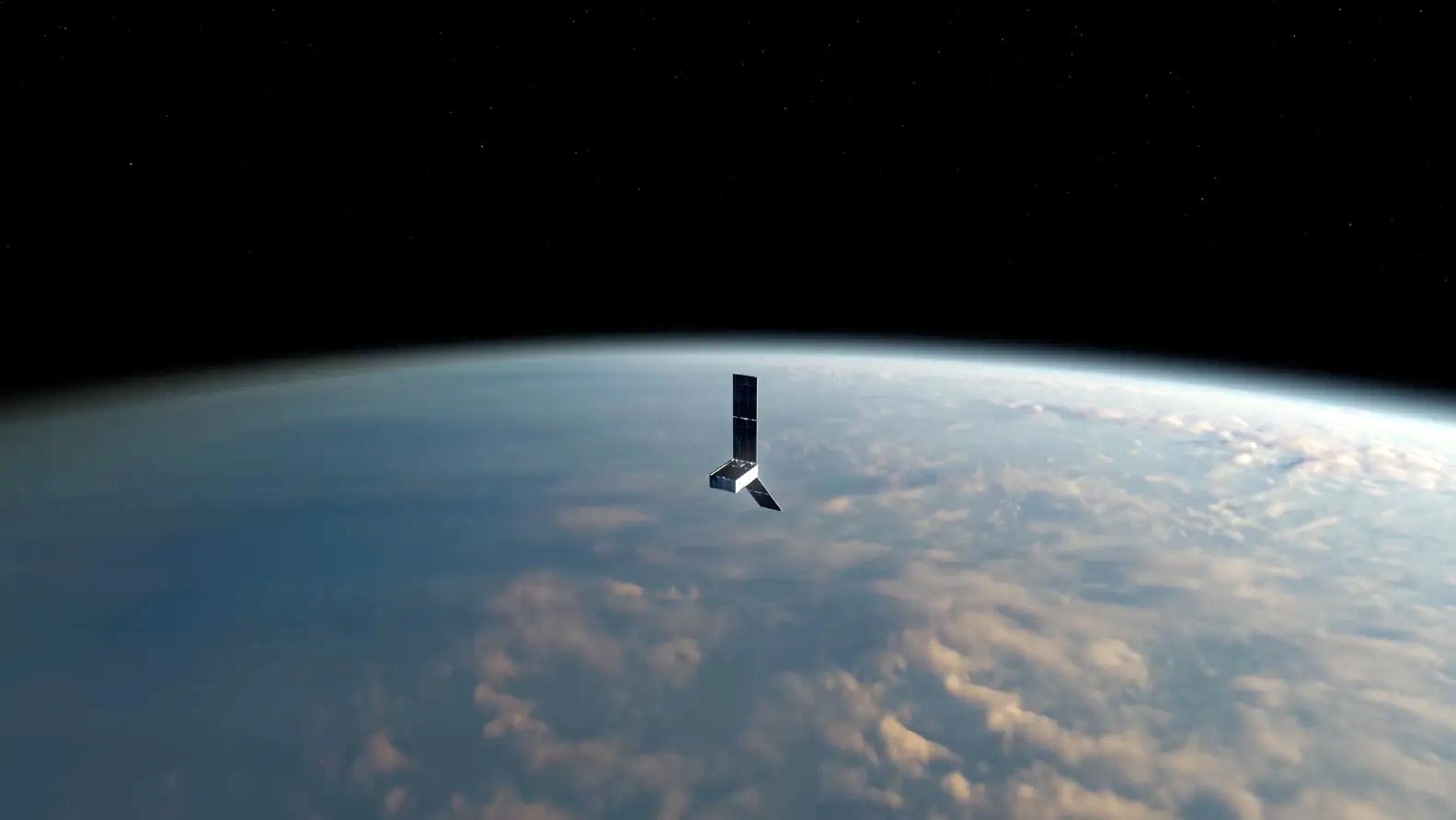
NASA’s PREFIRE mission, involving two CubeSats launched from New Zealand, aims to resolve uncertainties about far-infrared emissions at Earth’s poles and their effect on global climate.
By studying how clouds and water vapor influence heat radiation into space, PREFIRE seeks to refine climate models, improving predictions of climate dynamics and global warming impacts.
NASA’s PREFIRE Mission
Two small NASA satellites, each about the size of a shoebox, are on a mission to solve a longstanding atmospheric puzzle: how clouds and water vapor in Earth’s polar regions influence the planet’s climate.
The first satellite in NASA’s Polar Radiant Energy in the Far-InfraRed Experiment (PREFIRE) mission launched from New Zealand on May 25 and began transmitting scientific data in July. The second satellite followed with a launch on June 5, starting its data collection in August.

Unveiling Polar Climate Dynamics
PREFIRE’s goal is to measure the heat emitted by Earth into space from its coldest and most remote areas — the Arctic and Antarctic. By providing detailed data on polar heat emissions, the mission aims to refine climate models used to predict the effects of global warming on Earth’s ice, oceans, and weather systems.
Earth absorbs a lot of the Sun’s energy in the tropics, and weather and ocean currents transport that heat toward the poles (which receive much less sunlight). Ice, snow, and clouds, among other parts of the polar environment, emit some of that heat into space, much of it in the form of far-infrared radiation. The difference between the amount of heat Earth absorbs at the tropics and that radiated out from the Arctic and Antarctic is a key influence on the planet’s temperature, helping to drive dynamic systems of climate and weather.
Clouds in Polar Regions
But far-infrared emissions at the poles have never been systematically measured. This is where PREFIRE comes in. The mission will help researchers gain a clearer understanding of when and where Earth’s polar regions emit far-infrared radiation to space, as well as how atmospheric water vapor and clouds influence the amount that escapes.
Clouds and water vapor can trap far-infrared radiation on Earth, thereby increasing global temperatures — part of the greenhouse effect.
“It’s critical that we get the effects of clouds right if we want to accurately model Earth’s climate,” said Tristan L’Ecuyer, a professor at the University of Wisconsin-Madison and PREFIRE’s principal investigator.

Clouds in Climate Modeling
Clouds and water vapor at Earth’s poles act like windows on a summer day: A clear, relatively dry day in the Arctic is like opening a window to let heat out of a stuffy room. A cloudy, relatively humid day traps heat like a closed window.
The types of clouds — and the altitude at which they form — influence how much heat the polar atmosphere retains. Like a tinted window, low-altitude clouds, composed mainly of water droplets, tend to have a cooling effect. High-altitude clouds, made mainly of ice particles, more readily absorb heat, generating a warming effect. Because clouds at mid-altitudes can have varying water-droplet and ice-particle contents, they can have either a warming or cooling effect.
Enhancing Climate Predictions
But clouds are notoriously difficult to study: They’re made up of microscopic particles that can move and change in a matter of seconds to hours. When it rains or snows, there’s a great reshuffling of water and energy that can alter the character of clouds entirely. These ever-changing factors complicate the task of realistically capturing cloud behavior in climate models, which try to project global climate scenarios.
Inconsistencies in how various climate models represent clouds can mean the difference between predicting 5 or 10 degrees Fahrenheit (3 or 6 degrees Celsius) of warming. The PREFIRE mission aims to reduce that uncertainty.
Mission Technology
The thermal infrared spectrometer on each spacecraft will make crucial measurements of wavelengths of light in the far-infrared range. The instruments will be able to detect clouds largely invisible to other types of optical instruments. And PREFIRE’s instruments will be sensitive enough to detect the approximate size of particles to distinguish between liquid droplets and ice particles.
“PREFIRE will give us a new set of eyes on clouds,” said Brian Kahn, an atmospheric scientist at NASA’s Jet Propulsion Laboratory and a member of the PREFIRE science team. “We’re not quite sure what we’re going to see, and that’s really exciting.”
More About the Mission
The PREFIRE mission is a collaborative effort between NASA and the University of Wisconsin-Madison. NASA’s Jet Propulsion Laboratory (JPL), a division of Caltech in Pasadena, California, manages the mission for NASA’s Science Mission Directorate and supplied the spectrometers. Blue Canyon Technologies designed and built the CubeSats, while the University of Wisconsin-Madison is responsible for processing and analyzing the collected data.
The spacecraft were launched by Rocket Lab under NASA’s Venture-class Acquisition of Dedicated and Rideshare (VADR) contract, managed by NASA’s Launch Services Program. CubeSats like PREFIRE are valuable tools for advancing science and technology, serving as cost-effective platforms for innovation in both mission architecture and scientific research.
Never miss a breakthrough: Join the SciTechDaily newsletter.
Follow us on Google and Google News.