

Close Menu
    Facebook X (Twitter) Instagram
    SciTechDaily
    • Biology
    • Chemistry
    • Earth
    • Health
    • Physics
    • Science
    • Space
    • Technology
    Facebook X (Twitter) Pinterest YouTube RSS
    SciTechDaily
    Home»Science»Feeling the Beat: Music’s Global Language of Emotion
    Science

    Feeling the Beat: Music’s Global Language of Emotion

    By University of TurkuJune 22, 20241 Comment3 Mins Read
    Facebook Twitter Pinterest Telegram LinkedIn WhatsApp Email Reddit
    Share
    Facebook Twitter LinkedIn Pinterest Telegram Email Reddit
    Music Effect Culture Art
    A recent study demonstrated that music universally triggers similar emotional responses and bodily sensations, irrespective of cultural background. The research indicates that different types of music, such as those evoking happiness or sadness, generate distinct physical sensations, such as feelings in the arms and legs or chest area, respectively. The findings suggest that these reactions are likely driven by innate biological mechanisms rather than cultural influences.

    A study shows music evokes consistent emotional and physical responses globally, driven by inherent biological mechanisms, not culture. Music influences feelings in different body parts based on the emotion it conveys, supporting its role in social bonding.

    New research shows that music evokes similar emotions and bodily sensations around the world. The study, by the Turku PET Centre in Finland, was published in the Proceedings of the National Academy of Sciences.

    Music can be felt directly in the body. When we hear our favorite catchy song, we are overcome with the urge to move to the music. Music can activate our autonomic nervous system and even cause shivers down the spine. A new study shows how emotional music evokes similar bodily sensations across cultures.
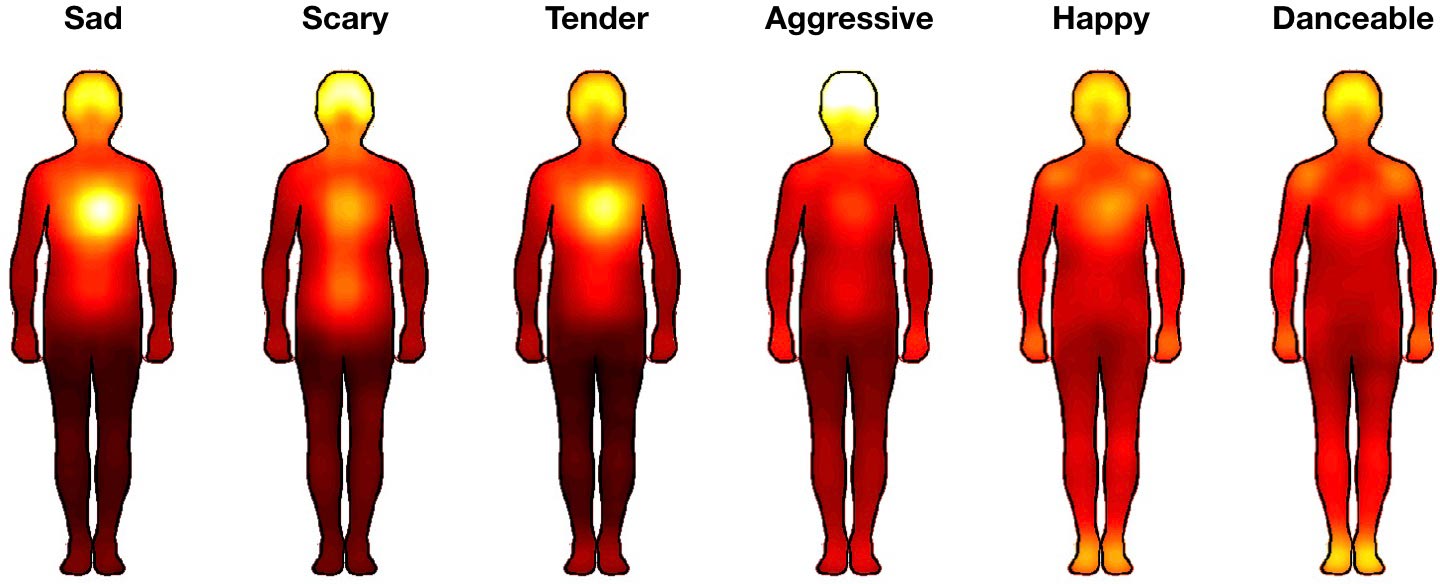
    Topographies of Bodily Sensations Evoked by Music
    Music evokes similar emotions and bodily sensations in Western and Asian listeners. Credit: Lauri Nummenmaa, University of Turku

    Cross-Cultural Emotional Responses to Music

    “Music that evoked different emotions, such as happiness, sadness or fear, caused different bodily sensations in our study. For example, happy and danceable music was felt in the arms and legs, while tender and sad music was felt in the chest area,” explains Academy Research Fellow Vesa Putkinen.

    The emotions and bodily sensations evoked by music were similar across Western and Asian listeners. The bodily sensations were also linked with the music-induced emotions.

    Music as a Social and Evolutionary Tool

    “Certain acoustic features of music were associated with similar emotions in both Western and Asian listeners. Music with a clear beat was found happy and danceable while dissonance in music was associated with aggressiveness. Since these sensations are similar across different cultures, music-induced emotions are likely independent of culture and learning and based on inherited biological mechanisms,” says Professor Lauri Nummenmaa.

    “Music’s influence on the body is universal. People move to music in all cultures and synchronized postures, movements, and vocalizations are a universal sign of affiliation. Music may have emerged during the evolution of the human species to promote social interaction and sense of community by synchronizing the bodies and emotions of the listeners,” continues Putkinen.

    Reference: “Bodily maps of musical sensations across cultures” by Vesa Putkinen, Xinqi Zhou, Xianyang Gan, Linyu Yang, Benjamin Becker, Mikko Sams and Lauri Nummenmaa, 25 January 2024, Proceedings of the National Academy of Sciences.
    DOI: 10.1073/pnas.2308859121

    The study was conducted in collaboration with Aalto University from Finland and the University of Electronic Science and Technology of China (UESTC) as an online questionnaire survey. Altogether 1,500 Western and Asian participants rated the emotions and bodily sensations evoked by Western and Asian songs.

    The study was funded by the Research Council of Finland.

    Never miss a breakthrough: Join the SciTechDaily newsletter.
    Follow us on Google and Google News.

    Music Perception Psychology University of Turku
    Share. Facebook Twitter Pinterest LinkedIn Email Reddit

    Related Articles

    Nostalgia Can Relieve Pain: Viewing Images From Childhood Reduces Pain Perception

    Nostalgia Pain Relief: Viewing Images From Childhood Reduces Pain Perception

    How Do You See the World? People With Creative Personalities Really Do See the Things Differently

    Study Finds Listening to Music Near Bedtime Is Disruptive To Sleep

    Our Brains Encode Musical Predictions Even When Music Doesn’t Play

    Where Do We Place the Blame for the COVID-19 Pandemic?

    Screams of “Joy” Are Often Mistaken for “Fear” When Heard Out of Context

    Neuroscientists Study How Your Favorite Music Can Send Your Brain Into Pleasure Overload

    Listening to Mozart Can Make You Smarter but No More Than Justin Bieber

    1 Comment

    1. Tom Goff on June 25, 2024 6:23 am

      Animals have shown that they too are affected by music. It is not something unique to humans.

      Reply
    Leave A Reply Cancel Reply

    • Facebook
    • Twitter
    • Pinterest
    • YouTube

    Don't Miss a Discovery

    Subscribe for the Latest in Science & Tech!

    Trending News

    289-Million-Year-Old Reptile Mummy Reveals Origin of Human Breathing System

    New Brain Discovery Challenges Long-Held Theory of Teenage Brain Development

    Scientists Discover Plants “Scream” – We Just Couldn’t Hear Them Until Now

    Scientists Discover a Surprising Reason Intermittent Fasting Extends Life

    This Simple Fruit Wash Could Make Produce Safer and Last Days Longer

    Scientists Say Adding This Unusual Seafood to Your Diet Could Reverse Signs of Aging

    Scientists Say a Hidden Structure May Exist Inside Earth’s Core

    Doctors Surprised by the Power of a Simple Drug Against Colon Cancer

    Follow SciTechDaily
    • Facebook
    • Twitter
    • YouTube
    • Pinterest
    • Newsletter
    • RSS
    SciTech News
    • Biology News
    • Chemistry News
    • Earth News
    • Health News
    • Physics News
    • Science News
    • Space News
    • Technology News
    Recent Posts
    • Scientists Propose Radical New Way To Detect Alien Life – Without Traditional Biosignatures
    • Scientists Just Discovered Light Can Actually Slow Plant Growth
    • Scientists Finally Solved One of Water’s Biggest Mysteries
    • 7,000-Year-Old DNA Rewrites the Story of the “Neolithic Revolution”
    • Missing Medieval Relic of Legendary English King Found After Being Missing for 40 Years
    Copyright © 1998 - 2026 SciTechDaily. All Rights Reserved.
    • Science News
    • About
    • Contact
    • Editorial Board
    • Privacy Policy
    • Terms of Use

    Type above and press Enter to search. Press Esc to cancel.