
Close Menu
    Facebook X (Twitter) Instagram
    SciTechDaily
    • Biology
    • Chemistry
    • Earth
    • Health
    • Physics
    • Science
    • Space
    • Technology
    Facebook X (Twitter) Pinterest YouTube RSS
    SciTechDaily
    Home»Health»New Yale Study Pinpoints Key Protein in Severe Vascular Disease
    Health

    New Yale Study Pinpoints Key Protein in Severe Vascular Disease

    By Ziba Kashef, Yale UnversityFebruary 9, 2016No Comments2 Mins Read
    Facebook Twitter Pinterest Telegram LinkedIn WhatsApp Email Reddit
    Share
    Facebook Twitter LinkedIn Pinterest Telegram Email Reddit
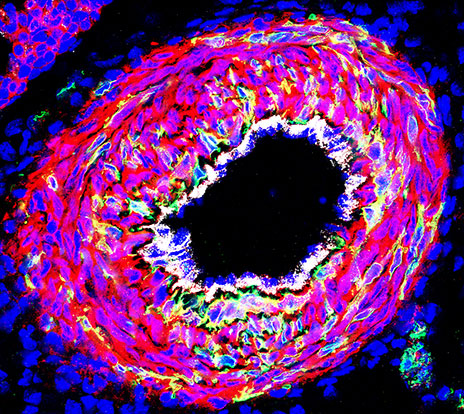
    Key Protein in Severe Vascular Disease Revealed
    Fate mapping indicates that pre–existing smooth muscle cells contribute to the excess aortic smooth muscle in elastin mutants.

    New research from Yale University investigates factors that squeeze, or narrow, the aorta in a common vascular disease, revealing a target for potential new treatments.

    Individuals who suffer from supravalvular aortic stenosis, a condition characterized by narrowing of the aorta, have only one copy instead of the usual two copies of the gene encoding elastin. Elastin is critical because it allows the artery to expand and contract as blood is pumped through it. To better understand this genetic defect, the research team analyzed tissue from patients as well as mice with the mutant gene. In both cases, the researchers observed an increase in a protein known as integrin beta3. When the scientists inhibited integrin beta3 genetically or with a drug that blocks its activity, the aortic stenosis was mitigated.

    “The most important findings were that when we inhibit integrin beta3 in mice lacking the elastin gene, it prevents the stenosis and increases their survival,” said senior author Daniel Greif, assistant professor of cardiology and the study’s senior author. First author Ashish Misra, a postdoctoral fellow in the Greif lab, emphasized that this increased survival is unprecedented in mice that lack elastin.

    The study results promise to lead to medical therapies that would replace or at least delay major surgery or other invasive treatments, which are the only current options for patients, say the investigators.

    The study was published online February 8 in the Journal of Experimental Medicine.

    Reference: “Integrin β3 inhibition is a therapeutic strategy for supravalvular aortic stenosis” by Ashish Misra, Abdul Q. Sheikh, Abhishek Kumar, Jiesi Luo, Jiasheng Zhang, Robert B. Hinton, Leslie Smoot, Paige Kaplan, Zsolt Urban, Yibing Qyang, George Tellides and Daniel M. Greif, 8 February 2016, Journal of Experimental Medicine.
    DOI: 10.1084/jem.20150688

    Never miss a breakthrough: Join the SciTechDaily newsletter.
    Follow us on Google and Google News.

    Cardiology Disease Medicine Yale University
    Share. Facebook Twitter Pinterest LinkedIn Email Reddit

    Related Articles

    Trans-Fatty Acid Ban Results in Reduced Heart Attacks and Stroke

    New Strategy to Better Protect Cancer Patients from the Flu

    Study Shows Diabetes Drug Significantly Reduces Risk of Heart Failure

    Yale Cardiologists Identify a Potential Therapeutic Target for Pulmonary Hypertension

    Yale Researchers Reveal How HIV Spreads in Real Time

    Yale Study Shows One in Four Hepatitis C Patients Denied Initial Drug Therapy

    Researchers May Have Pinpointed a Strategy for Eliminating Latent HIV

    New Treatments for Pulmonary Arterial Hypertension

    Intensive Glycemic Control Does Not Definitively Reduce the Risk of Impaired Kidney Function

    Leave A Reply Cancel Reply

    • Facebook
    • Twitter
    • Pinterest
    • YouTube

    Don't Miss a Discovery

    Subscribe for the Latest in Science & Tech!

    Trending News

    JWST Finds a “Star” 100 Billion Times Brighter Than Any Star Should Be

    Scientists Find a Hidden Biological Link Across Different Forms of Autism

    Astronomers Discover a Ghostly River of Stars That Could Reveal Dark Matter

    Why Is Colorectal Cancer Rising in People Under 50? New Clues Point to the Environment

    Quantum Fluctuations Break a Crystal’s Symmetry Rules

    Why Does an Irregular Heartbeat Strike 40 Years Early in Some People?

    Scientists Reveal How ADHD Could Fuel Creative Thinking

    Scientists Find Just 3 Minutes of Sprinting Can Transform Blood Chemistry

    Follow SciTechDaily
    • Facebook
    • Twitter
    • YouTube
    • Pinterest
    • Newsletter
    • RSS
    SciTech News
    • Biology News
    • Chemistry News
    • Earth News
    • Health News
    • Physics News
    • Science News
    • Space News
    • Technology News
    Recent Posts
    • A Vast Clean Energy Source May Be Hiding Beneath Australia’s Red Soil
    • Scientists Uncover Signs of an Ancient Climate “Tipping Point”
    • Cleaner Cars May Be Hiding a New Pollution Problem
    • Common Plant Chemical Linked to Widespread Organ Damage in Aquatic Animals
    • Scientists Discover a Hidden Baobab Species in Madagascar
    Copyright © 1998 - 2026 SciTechDaily. All Rights Reserved.
    • Science News
    • About
    • Contact
    • Editorial Board
    • Privacy Policy
    • Terms of Use

    Type above and press Enter to search. Press Esc to cancel.