

A new system developed by Chalmers University researchers overcomes key limitations in quantum computing, enabling more durable and error-resistant computations.
Quantum computers face a significant challenge due to a trade-off problem. Systems capable of performing complex operations are more prone to errors and noise, while those that are better protected against noise tend to be slower and less efficient in computation.
Now a research team from Chalmers University of Technology, in Sweden, has created a unique system that combats the dilemma, thus paving the way for longer computation time and more robust quantum computers.
For the impact of quantum computers to be realized in society, quantum researchers first need to deal with some major obstacles. So far, errors and noise stemming from, for example, electromagnetic interference or magnetic fluctuations, cause the sensitive qubits to lose their quantum states – and subsequently, their ability to continue the calculation.
The amount of time that a quantum computer can work on a problem is thus so far limited. Additionally, for a quantum computer to be able to tackle complex problems, quantum researchers need to find a way to control the quantum states. Like a car without a steering wheel, quantum states may be considered somewhat useless if there is no efficient control system to manipulate them.
However, the research field is facing a trade-off problem. Quantum systems that allow for efficient error correction and longer computation times are on the other hand deficient in their ability to control quantum states – and vice versa. But now a research team at Chalmers University of Technology has managed to find a way to battle this dilemma.
“We have created a system that enables extremely complex operations on a multi-state quantum system, at an unprecedented speed.” says Simone Gasparinetti, leader of the 202Q-lab at Chalmers University of Technology and senior author of the study.
Deviates from the two-quantum-state principle
While the building blocks of a classical computer, bits, have either the value 1 or 0, the most common building blocks of quantum computers, qubits, can have the value 1 and 0 at the same time – in any combination. The phenomenon is called superposition and is one of the key ingredients that enable a quantum computer to perform simultaneous calculations, with enormous computing potential as a result.
However, qubits encoded in physical systems are extremely sensitive to errors, which has led researchers in the field to search for ways to detect and correct these errors. The system created by the Chalmers researchers is based on so-called continuous-variable quantum computing and uses harmonic oscillators, a type of microscopic component, to encode information linearly.
The oscillators used in the study consist of thin strips of superconducting material patterned on an insulating substrate to form microwave resonators, a technology fully compatible with the most advanced superconducting quantum computers. The method is previously known in the field and departs from the two-quantum state principle as it offers a much larger number of physical quantum states, thus making quantum computers significantly better equipped against errors and noise.
“Think of a qubit as a blue lamp that, quantum mechanically, can be both switched on and off simultaneously. In contrast, a continuous variable quantum system is like an infinite rainbow, offering a seamless gradient of colors. This illustrates its ability to access a vast number of states, providing far richer possibilities than the qubit’s two states,” says Axel Eriksson, researcher in quantum technology at Chalmers University of Technology and lead author of the study.
Combats trade-off problem between operation complexity and fault tolerance
Although continuous-variable quantum computing based on harmonic oscillators enables improved error correction, its linear nature does not allow for complex operations to be carried out. Attempts to combine harmonic oscillators with control systems such as superconducting quantum systems have been made but have been hindered by the so-called Kerr effect. The Kerr effect in turn scrambles the many quantum states offered by the oscillator, canceling the desired effect.
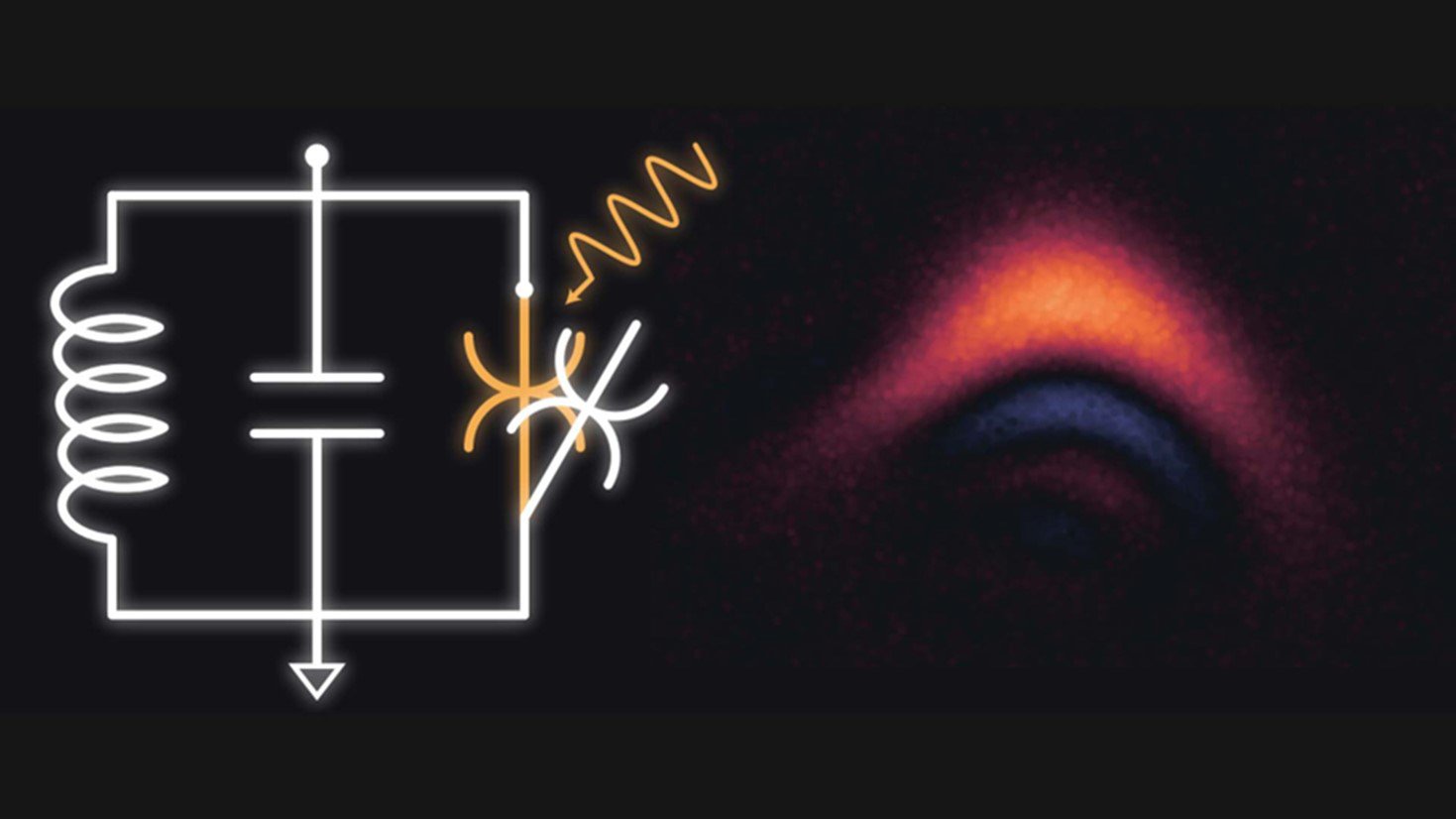
By putting a control system device inside the oscillator, the Chalmers researchers were able to circumvent the Kerr effect and combat the trade-off problem. The system presents a solution that preserves the advantages of the harmonic oscillators, such as a resource-efficient path towards fault tolerance while enabling accurate control of quantum states at high speed. The system is described in an article published in Nature Communications and may pave the way for more robust quantum computers.
“Our community has often tried to keep superconducting elements away from quantum oscillators, not to scramble the fragile quantum states. In this work, we have challenged this paradigm. By embedding a controlling device at the heart of the oscillator we were able to avoid scrambling the many quantum states while at the same time being able to control and manipulate them. As a result, we demonstrated a novel set of gate operations performed at very high speed,” says Simone Gasparinetti.
Reference: “Universal control of a bosonic mode via drive-activated native cubic interactions” by Axel M. Eriksson, Théo Sépulcre, Mikael Kervinen, Timo Hillmann, Marina Kudra, Simon Dupouy, Yong Lu, Maryam Khanahmadi, Jiaying Yang, Claudia Castillo-Moreno, Per Delsing and Simone Gasparinetti, 21 March 2024, Nature Communications.
DOI: 10.1038/s41467-024-46507-1
The research was funded by Chalmers University of Technology.
Never miss a breakthrough: Join the SciTechDaily newsletter.
Follow us on Google and Google News.
2 Comments
Innovative New System Overcomes Key Quantum Computing Limitations. Please ask researchers to think deeply:
1. What is the physical essence of quantum computing?
2. Is quantum a cat that is both dead and alive?
Scientific research guided by correct theories can help humanity avoid detours, failures, and pomposity. Please witness the exemplary collaboration between theoretical physicists and experimentalists (https://scitechdaily.com/microscope-spacecrafts-most-precise-test-of-key-component-of-the-theory-of-general-relativity/#comment-854286). Some people in contemporary physics has always lived in a self righteous children’s story world. Whose values have been overturned by such a comical and ridiculous reality?
From Physical Review Letters (PRL), to Nature, and Science, even the Proceedings of the National Academy of Sciences (PNAS), the so-called academic journals firmly believe that two high-dimensional spacetime objects (such as two sets of cobalt-60) rotating in opposite directions can be transformed into two objects that mirror each other, and that the asymmetry between the amount of created matter and antimatter led to the matter-dominated Universe as we know it today.
Does the facts tell the so-called academic journals that two sets of cobalt-60 rotating in opposite directions can be transformed into two objects that mirror each other? Does mathematics tell the so-called academic journals that matter and antimatter are asymmetric? When physics no longer believes in facts and mathematics, it is no different from theology.
Naked walkers never consider themselves ugly, but rather consider themselves cool.
Space has physical properties of zero viscosity and absolute incompressibility. Zero viscosity and absolute incompressibility are physical characteristics of ideal fluids. The space with ideal fluid physical characteristics forms vortices via topological phase transitions, which is not difficult to understand mathematically. Once the topological vortex is formed, it occupies space and maintains its presence in time. This is the transition from chaos to order via two bidirectional coupled continuous chaotic systems.
From cosmic accretion disks to particle spins, topological vortex fractal structures are ubiquitous. Symmetry of topological vortex can be used to explore particle behavior under spatial, temporal, and quantum reversals, involving quantum gravity, discrete and continuous changes. It underpins the consistency of natural laws and experiment reproducibility.
The physical phenomena observed in scientific experiments are always just appearances, not the natural essence of things. The natural essence of things needs to be extracted and sublimated based on natural phenomena via mathematical theories. Mathematics is the main environment for modeling problems in other areas. Observations and experiments, theory, and modeling reinforce each other and together lead to our understanding of physical phenomena. After understanding and mastering the natural essence of things, humans can predict more possible natural phenomena, and even manipulate and implement them.
And we were led to believe, just recently, that quantum computing is already here. They were even showing the thing to the sitting president of the USA. Guess it was just for show… and investors.