
Close Menu
    Facebook X (Twitter) Instagram
    SciTechDaily
    • Biology
    • Chemistry
    • Earth
    • Health
    • Physics
    • Science
    • Space
    • Technology
    Facebook X (Twitter) Pinterest YouTube RSS
    SciTechDaily
    Home»Space»New Cassini Image – Tethys Tops Saturn
    Space

    New Cassini Image – Tethys Tops Saturn

    By SciTechDailyJuly 11, 20161 Comment1 Min Read
    Facebook Twitter Pinterest Telegram LinkedIn WhatsApp Email Reddit
    Share
    Facebook Twitter LinkedIn Pinterest Telegram Email Reddit
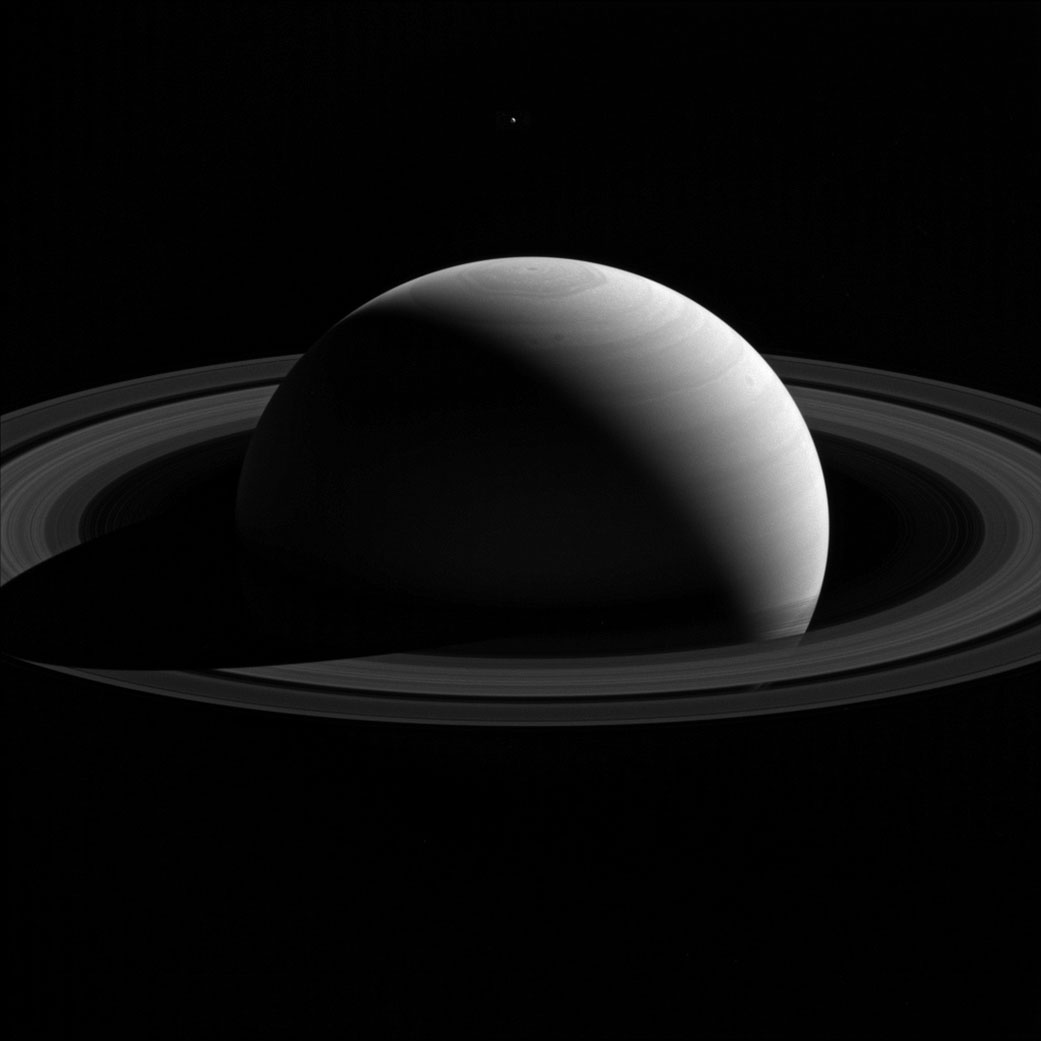
    New Cassini Image of Tethys and Saturn
    Saturn’s moon Tethys above the planet’s north pole. Credit: NASA/JPL-Caltech/Space Science Institute

    This newly released Cassini image provides an illusion of perspective, showing Saturn’s moon Tethys above the planet’s north pole.

    Tethys (660 miles or 1,062 kilometers across) is actually farther away than Saturn in this image. Lacking visual clues about distance, our brains place the moon above Saturn’s north pole. Tethys, like all of Saturn’s major moons and its ring system, orbits almost exactly in the planet’s equatorial plane.

    This view looks toward the sunlit side of the rings from about 17 degrees above the ring plane. The image was taken with the Cassini spacecraft’s wide-angle camera on Jan. 26, 2015, using a spectral filter which preferentially admits wavelengths of near-infrared light centered at 752 nanometers.

    The view was acquired at a distance of approximately 2.1 million miles (3.4 million kilometers) from Saturn. The image scale on Saturn is 120 miles (200 kilometers) per pixel. Tethys has been brightened by a factor of three relative to Saturn to enhance its visibility.

    Never miss a breakthrough: Join the SciTechDaily newsletter.
    Follow us on Google and Google News.

    Astronomy Cassini-Huygens Mission Planetary Science Saturn Tethys
    Share. Facebook Twitter Pinterest LinkedIn Email Reddit

    Related Articles

    NASA’s Cassini Spacecraft Views a Saturn-lit Tethys

    Cassini Views Saturn’s Icy Moon Tethys

    Ices and Shadows – Cassini Views Saturn’s Moon Tethys

    Cassini Spacecraft Image Shows the Difference between Janus and Tethys

    New Cassini View of Saturn and Tethys

    New Cassini Image Shows Tethys Dwarfed by Saturn and Its Rings

    New Cassini Night Side Image of Saturn and Tethys

    NASA’s Cassini Views Saturn’s Moon Tethys

    Storm Spawns the Largest Tropospheric Vortex Ever Seen on Saturn

    1 Comment

    1. Bonnie Davis on July 11, 2016 10:33 am

      The distances are so great and this is just our own solar system. The Universe is astonishing in its depth and breadth.

      Reply
    Leave A Reply Cancel Reply

    • Facebook
    • Twitter
    • Pinterest
    • YouTube

    Don't Miss a Discovery

    Subscribe for the Latest in Science & Tech!

    Trending News

    Common Laxative May Help Reverse Depression-Related Brain Fog

    Younger Generations Are Aging Faster – and It May Be Fueling a Surge in Cancer

    New Discovery Could Unlock Quantum Computers the Size of a Coin

    Shingles Vaccine Linked to 24% Lower Dementia Risk in Older Adults

    Scientists Found a Wordle Trick That Solves 99% of Puzzles

    A Hidden Galaxy Called Shadow Blaster May Explain One of Astronomy’s Biggest Mysteries

    These 3 Common Sleep Habits May Be Aging Your Brain Faster

    Rare Goblin Shark Spotted Alive in Its Natural Habitat for the First Time

    Follow SciTechDaily
    • Facebook
    • Twitter
    • YouTube
    • Pinterest
    • Newsletter
    • RSS
    SciTech News
    • Biology News
    • Chemistry News
    • Earth News
    • Health News
    • Physics News
    • Science News
    • Space News
    • Technology News
    Recent Posts
    • New Fossils Show the Arctic Was an Evolutionary Powerhouse During the Age of Dinosaurs
    • What Happened to Australasia’s Lost Crocodiles? New Research Reveals a Dramatic Extinction Story
    • 520-Million-Year-Old Fossils Solve One of Evolution’s Biggest Mysteries
    • This Extraordinary Desert Mouse Defies Aging – and It Could Change Human Longevity
    • A Simple Blood Test Can Reveal the True Age of Your Brain, Heart, and Other Organs
    Copyright © 1998 - 2026 SciTechDaily. All Rights Reserved.
    • Science News
    • About
    • Contact
    • Editorial Board
    • Privacy Policy
    • Terms of Use

    Type above and press Enter to search. Press Esc to cancel.