
Close Menu
    Facebook X (Twitter) Instagram
    SciTechDaily
    • Biology
    • Chemistry
    • Earth
    • Health
    • Physics
    • Science
    • Space
    • Technology
    Facebook X (Twitter) Pinterest YouTube RSS
    SciTechDaily
    Home»Space»ALMA Images the Planetesimal Belt around HR8799
    Space

    ALMA Images the Planetesimal Belt around HR8799

    By Harvard-Smithsonian Center for AstrophysicsAugust 15, 2016No Comments3 Mins Read
    Facebook Twitter Pinterest Telegram LinkedIn WhatsApp Email Reddit
    Share
    Facebook Twitter LinkedIn Pinterest Telegram Email Reddit
    Resolving the Planetesimal Belt of HR 8799
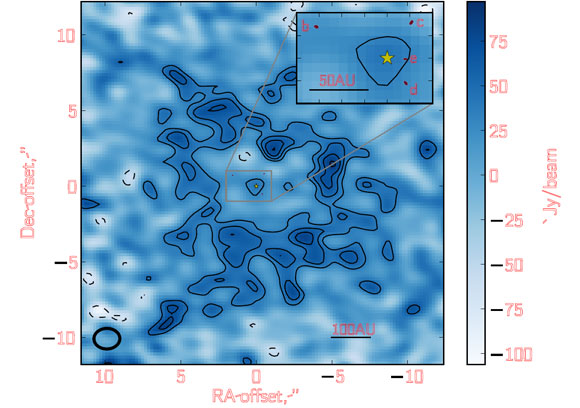
    A submillimeter image of the planetesimal disk around the star HR8799, the first directly imaged system of four exoplanets and their dust disk. The insert shows the innermost region of the system and the location of the four exoplanets.

    Using the ALMA submillimeter array, astronomers image the disk around HR8799 with a spatial scale as small as only thirty-two au, enough to probe the inner zones of the disk.

    Planets develop from the dusty placental disk of material that surrounds a star after it begins to shine. The dust in that disk, according to most models, starts to stick to itself until clumps develop large enough to attract other clumps gravitationally. Astronomers believe the process of building planets and dissipating the disk takes about ten million years. Many mysteries remain, however, including the tendency of dust not to stick together, and the likelihood that colliding clumps could break apart rather than agglomerate. Recent discoveries of exoplanets have begun to overlap with studies of planetesimal disks, and enable astronomers to probe the development and evolution of a star’s system of planets and their interactions with the disk.

    Direct imaging of dust disks has been very limited, and so far has principally probed regions in disks at the outer zones of planetary systems – analogous to the Kuiper Belt in our own solar system. At the same time, the vast majority of exoplanets discovered and studied so far have been very close to the star, even within a distance that in the solar system would be within the orbit of Mercury. The star HR8799 is so far the only star around which direct imaging has found multiple planets. Its circumstellar disk has been known to exist for several decades, and has been modeled as having three zones: an inner asteroid belt analog, a planetesimal belt from about one hundred astronomical units (au) to about 430 au, and a halo region extending out to over 1500 au.

    CfA astronomer Denis Barkats has joined a team of colleagues to use the giant ALMA submillimeter array to image the disk around HR8799 with a spatial scale as small as only thirty-two au, enough to probe the inner zones of the disk. The team has determined that the inner edge of the planetesimal belt actually starts at around 145 au, and that the belt extends out to 430 au. The known four exoplanets in this system orbit within this inner edge. The most distant of these four planets, planet b, has a chaotic orbit that is expected to take it beyond this inner edge, which therefore poses a stability problem in this interpretation. The astronomers propose two interesting suggestions: either that the orbit of planet b has varied over time more than thought, or that there is a fifth, so-far undetected small planet in a larger orbit whose gravity provides some stability. Whichever the answer, the new paper marks the dawn of a new age in imaging and analyzing extrasolar planetary systems.

    Reference: “Resolving the Planetesimal Belt of HR 8799 with ALMA” by Mark Booth, Andres Jordan, Simon Casassus, Antonio S. Hales, William R. F. Dent, Virginie Faramaz, Luca Matra, Denis Barkats, Rafael Brahm and Jorge Cuadra, 21 March 2016, MNRAS.
    DOI: 10.1093/mnrasl/slw040
    arXiv:1603.04853
    PDF

    Never miss a breakthrough: Join the SciTechDaily newsletter.
    Follow us on Google and Google News.

    ALMA Astronomy Astrophysics Cosmology Harvard-Smithsonian Center for Astrophysics
    Share. Facebook Twitter Pinterest LinkedIn Email Reddit

    Related Articles

    ALMA Views the Dust Disk Around Young Protostar HH-212

    Harvard Astronomers Find Evidence of Shocked Gas in Galaxy Collisions

    Astronomers Reveal a Planet Forming in an Earth-Like Orbit Around Young Star TW Hydrae

    ALMA Telescope Reveals Planetary Influences on Young Stellar Disks

    Herschel Observations Help Identify the Physical Processes Underway in Cold, Dense Clouds

    CfA Scientists Measure the Rate of Expansion of the Universe

    ALMA Reveals First Ever Snow Line Seen Around a Distant Star

    New Study Challenges Planck Results

    Calculations Show the Ideal Time to Study the Cosmos

    Leave A Reply Cancel Reply

    • Facebook
    • Twitter
    • Pinterest
    • YouTube

    Don't Miss a Discovery

    Subscribe for the Latest in Science & Tech!

    Trending News

    Scientists Discover Game-Changing New Way To Treat High Cholesterol

    This Small Change to Your Exercise Routine Could Be the Secret to Living Longer

    Scientists Discover 430,000-Year-Old Wooden Tools, Rewriting Human History

    AI Could Detect Early Signs of Alzheimer’s in Under a Minute – Far Before Traditional Tests

    What if Dark Matter Has Two Forms? Bold New Hypothesis Could Explain a Cosmic Mystery

    This Metal Melts in Your Hand – and Scientists Just Discovered Something Strange

    Beef vs. Chicken: Surprising Results From New Prediabetes Study

    Alzheimer’s Breakthrough: Scientists Discover Key Protein May Prevent Toxic Protein Clumps in the Brain

    Follow SciTechDaily
    • Facebook
    • Twitter
    • YouTube
    • Pinterest
    • Newsletter
    • RSS
    SciTech News
    • Biology News
    • Chemistry News
    • Earth News
    • Health News
    • Physics News
    • Science News
    • Space News
    • Technology News
    Recent Posts
    • Revolutionary Imaging Technique Unlocks Secrets of Matter at Extreme Speeds
    • Where Does Mass Come From? Scientists Find Evidence of a New Exotic Nuclear State
    • Quantum Breakthrough: Unhackable Keys Sent Over 120 km Using Quantum Dots
    • Researchers Discover Unknown Beetle Species Just Steps From Their Lab
    • Jellyfish Caught Feasting on Exploding Sea Worms for the First Time
    Copyright © 1998 - 2026 SciTechDaily. All Rights Reserved.
    • Science News
    • About
    • Contact
    • Editorial Board
    • Privacy Policy
    • Terms of Use

    Type above and press Enter to search. Press Esc to cancel.