
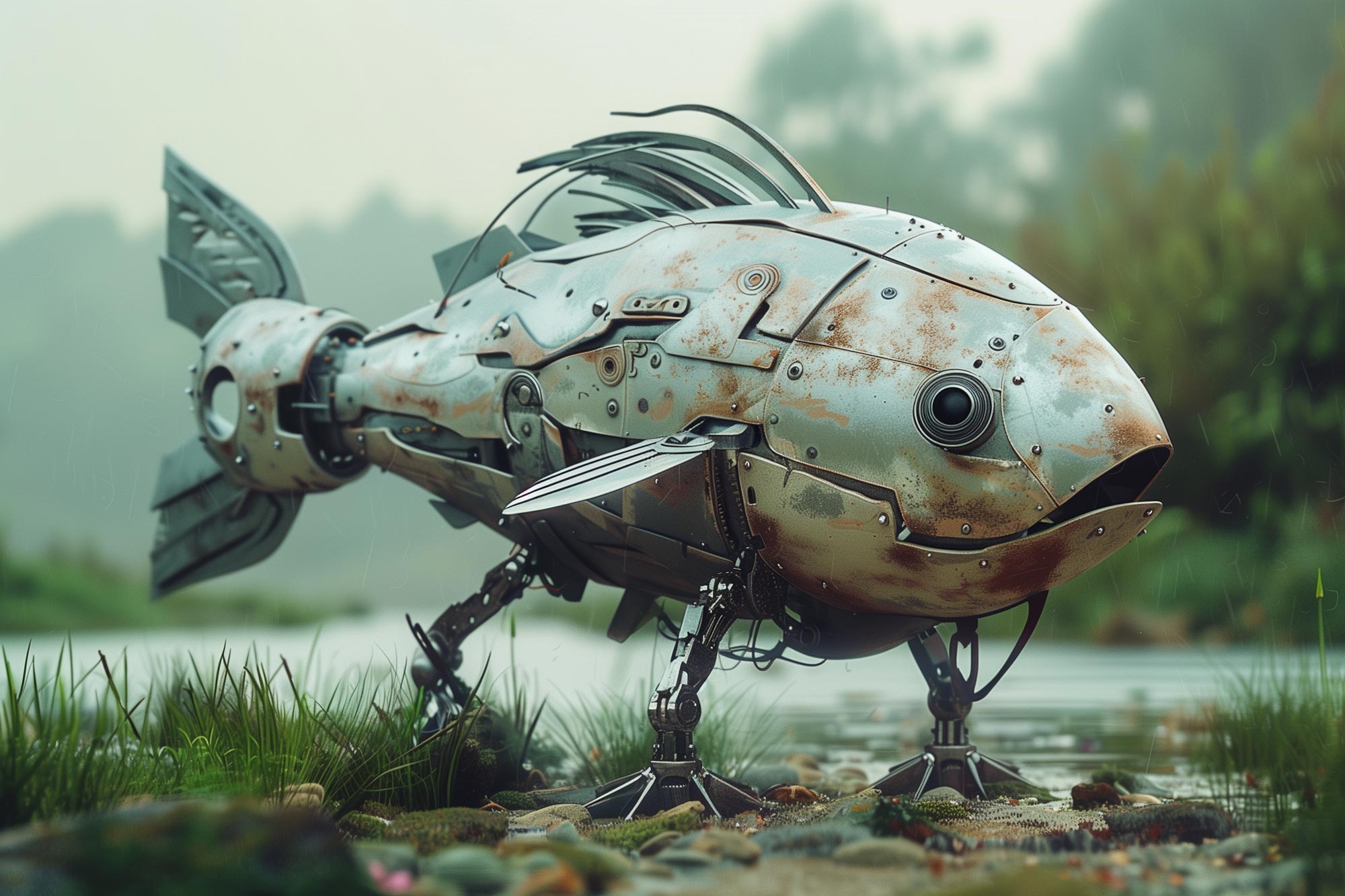
Researchers are developing robots inspired by ancient fish to study the water-to-land transition, approximately 390 million years ago.
By replicating the anatomy and movements of extinct species, they hope to overcome the limitations of fossil evidence and test theories on early vertebrate locomotion. This approach aims to provide new insights into the evolution of walking.
Exploring the Transition from Water to Land
The transition from water to land marks one of the most important milestones in Earth’s history. Today, a team of roboticists, paleontologists, and biologists is using robots to investigate how the ancestors of modern land animals made the shift from swimming to walking roughly 390 million years ago.
In a study published today (October 23) in Science Robotics, researchers from the University of Cambridge explain how “paleo-inspired robotics” offers a promising way to explore how the pectoral and pelvic fins of ancient fish evolved to bear weight on land.
“Since fossil evidence is limited, we have an incomplete picture of how ancient life made the transition to land,” said lead author Dr. Michael Ishida from Cambridge’s Department of Engineering. “Palaeontologists examine ancient fossils for clues about the structure of hip and pelvic joints, but there are limits to what we can learn from fossils alone. That’s where robots can come in, helping us fill gaps in the research, particularly when studying major shifts in how vertebrates moved.”

Bridging the Gap Between Fossils and Movement
Ishida is a member of Cambridge’s Bio-Inspired Robotics Laboratory, led by Professor Fumiya Iida, the paper’s senior author. The team is developing energy-efficient robots for a variety of applications, which take their inspiration from the efficient ways that animals and humans move.
With funding from the Human Frontier Science Program, the team is developing palaeo-inspired robots, in part by taking their inspiration from modern-day ‘walking fish’ such as mudskippers, and from fossils of extinct fish. “In the lab, we can’t make a living fish walk differently, and we certainly can’t get a fossil to move, so we’re using robots to simulate their anatomy and behavior,” said Ishida.
Robotics: A Window Into Ancient Life
The team is creating robotic analogs of ancient fish skeletons, complete with mechanical joints that mimic muscles and ligaments. Once complete, the team will perform experiments on these robots to determine how these ancient creatures might have moved.
“We want to know things like how much energy different walking patterns would have required, or which movements were most efficient,” said Ishida. “This data can help confirm or challenge existing theories about how these early animals evolved.”
Challenges in Paleo-Robotic Research
One of the biggest challenges in this field is the lack of comprehensive fossil records. Many of the ancient species from this period in Earth’s history are known only from partial skeletons, making it difficult to reconstruct their full range of movement.
“In some cases, we’re just guessing how certain bones connected or functioned,” said Ishida. “That’s why robots are so useful—they help us confirm these guesses and provide new evidence to support or rebut them.”
Future Directions in Robotic Paleontology
While robots are commonly used to study movement in living animals, very few research groups are using them to study extinct species. “There are only a few groups doing this kind of work,” said Ishida. “But we think it’s a natural fit – robots can provide insights into ancient animals that we simply can’t get from fossils or modern species alone.”
The team hopes that their work will encourage other researchers to explore the potential of robotics to study the biomechanics of long-extinct animals. “We’re trying to close the loop between fossil evidence and real-world mechanics,” said Ishida. “Computer models are obviously incredibly important in this area of research, but since robots are interacting with the real world, they can help us test theories about how these creatures moved, and maybe even why they moved the way they did.”
The team is currently in the early stages of building their palaeo-robots, but they hope to have some results within the next year. The researchers say they hope their robot models will not only deepen understanding of evolutionary biology, but could also open up new avenues of collaboration between engineers and researchers in other fields.
Reference: “Paleoinspired robotics as an experimental approach to the history of life” by Michael Ishida, Fidji Berio, Valentina Di Santo, Neil H. Shubin and Fumiya Iida, 23 October 2024, Science Robotics.
DOI: 10.1126/scirobotics.adn1125
The research was supported by the Human Frontier Science Program. Fumiya Iida is a Fellow of Corpus Christi College, Cambridge. Michael Ishida a Postdoctoral Research Associate at Gonville and Caius College, Cambridge.
Never miss a breakthrough: Join the SciTechDaily newsletter.
Follow us on Google and Google News.
1 Comment
Ok, Grammarly AI bot, I meant to say exasperation. Figure it out you can’t-get-right fool.