
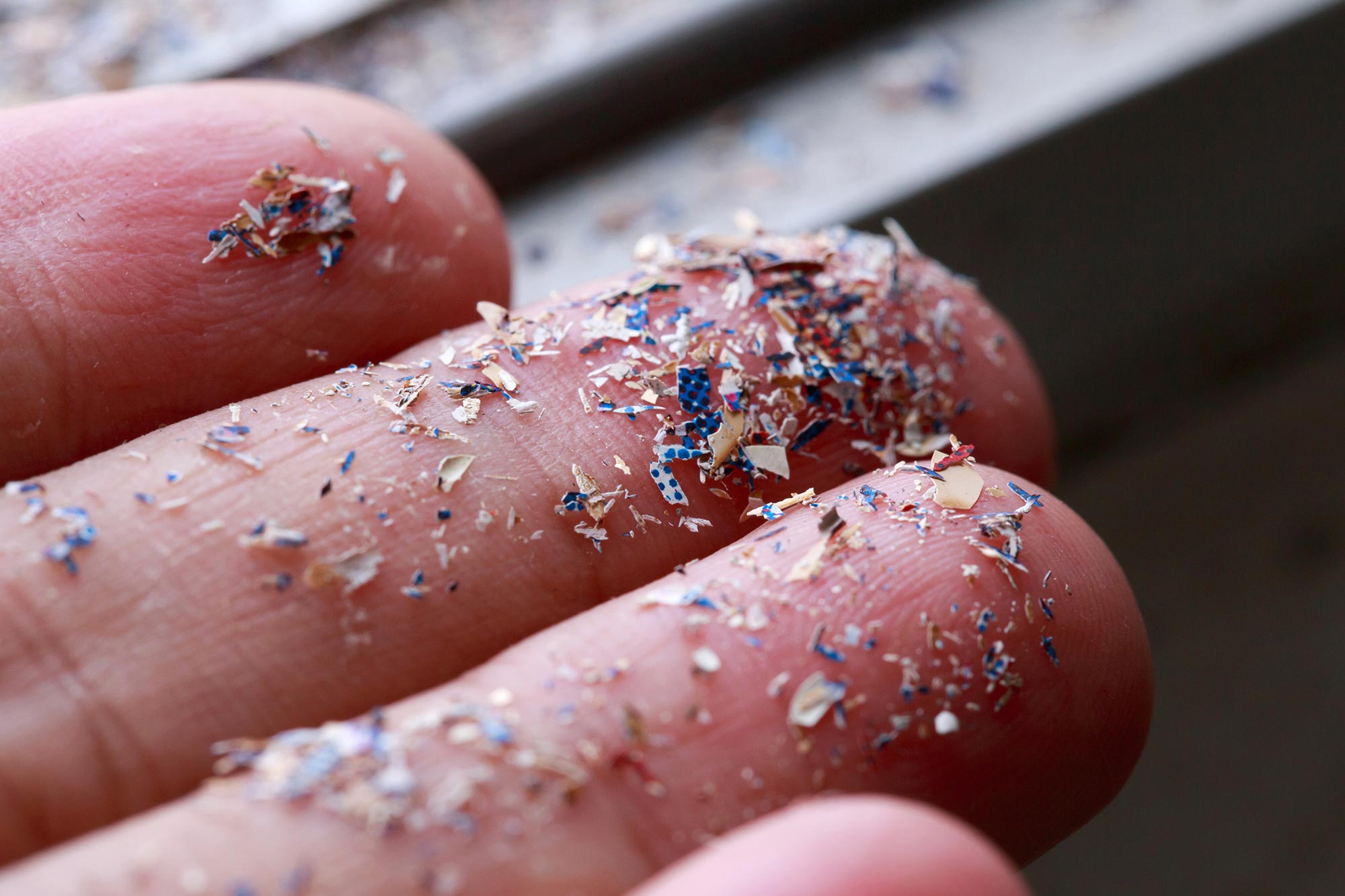
Penn State researchers found that microplastic levels in freshwater have risen with global plastic production, though they unexpectedly dipped between 2010 and 2020, possibly due to recycling efforts.
A new study by an interdisciplinary team from Penn State reveals that microplastics have been accumulating in freshwater environments for decades, closely linked to the surge in global plastic production since the 1950s. The researchers suggest that their findings offer valuable insights into the movement and dispersion of microplastics in freshwater systems, which could be crucial for developing sustainable strategies to mitigate pollution.
The work is available online now and will be published in the December issue of Science of the Total Environment.
“Few studies examine how microplastics change over time,” said Nathaniel Warner, associate professor of civil and environmental engineering and the corresponding author on the paper. “Ours is one of the first to track microplastic levels in freshwater sediment from before the 1950s to today, showing that concentrations rise in line with plastic production.”
Microplastics are tiny plastic particles that range in size from one micrometer, or 1/100 of the width of a human hair, to five millimeters, which is about the size of a pencil eraser. They can come from larger plastics that break down into smaller pieces or be made directly by manufacturers. For this study, the team examined freshwater sediment cores from four watersheds in Pennsylvania: Kiskiminetas River, Blacklick Creek, Raystown Lake, and Darby Creek.
Unexpected Findings: Population Density and Land Use
Contrary to the team’s expectations, the study found no correlation between population density or land use and high levels of microplastics.
“Based on other findings in the literature, what we thought would be important turned out not to be driving forces in microplastic variation across sites, notably the percentage of microplastics related to developed area and population density,” said Lisa Emili, associate professor of physical geography and environmental studies at Penn State Altoona and a co-author on the paper.

The researchers also said they were surprised to discover that while microplastic accumulation increased each decade through 2010, it decreased from 2010 to 2020.
“Although this is a preliminary finding that requires further study, this decrease could be related to increased recycling efforts,” Emili said.
According to the U.S. Environmental Protection Agency, recycling efforts for plastic increased significantly between 1980 and 2010. Although plastic production also increased, the percentage of recycled plastic increased from less than 0.3% in 1980 to nearly 8% in 2010.
Insights into the “Missing Plastics” Paradox
Additionally, Raymond Najjar, a professor of oceanography and a co-author on the paper, said that this study could shed light on the “missing plastics” paradox. This paradox challenges researchers’ understanding of plastic waste in the ocean because, while estimates suggest that 7,000 to 25,000 kilotons of plastic enter the ocean each year, only about 250 kilotons are believed to be floating on the surface.
“This suggests that estuaries, especially tidal marshes, may trap river-borne plastics before they reach the ocean,” said Najjar, who previously published in Frontiers in Marine Science on simulations of filter estuaries. “This could explain why there is far less plastic floating around in the surface ocean compared to how much is expected to be there given the input to the ocean from rivers.”
Warner said these findings suggest that there will continue to be increasing amounts of microplastics in both water and sediment as people use more plastic.
“Humans are ingesting plastic when they eat and drink and inhaling it when they breathe, and the long-term impacts are just beginning to be studied,” Warner said. “However, we need to figure out how to release less plastic into the environment and how to reduce consumption and exposure.”
According to Emili, making a study like this one successful requires an interdisciplinary team.
The Power of Interdisciplinary Collaboration
“This research shows Penn State’s broad expertise, bringing together a team from three campuses, five colleges, and five disciplines,” Emili said. “We brought together complementary skillsets from our fields of chemistry, engineering, hydrology, oceanography, and soil science.”
This research project was initially funded with an Institute of Energy and the Environment seed grant.
“That funded project really served as an ‘incubator’ for a continuation and expansion of our work exploring the fate and transport of microplastics in freshwater environments, with a particular focus on coastal locations,” Emili said.
Najjar agreed and said he would like to get a more comprehensive assessment of the trapping of river-borne plastics in estuaries.
“We have known for a long time that estuaries heavily process river-borne materials, like carbon, sediment, and nutrients, and this processing has a big impact on what eventually reaches the ocean,” Najjar said. “I think estuaries could be functioning in a similar way for plastics, but we need more than just a modeling study and a single core. We need to consider the likely sources and sinks of plastics for a given system, such as rivers, atmosphere, estuarine sediment, and marshes.”
Warner added that he hopes to examine how the composition and types of microplastics have changed over time and assess how the associated health risks have evolved.
Reference: “Decadal changes in microplastic accumulation in freshwater sediments: Evaluating influencing factors” by Jutamas Bussarakum, William D. Burgos, Samuel B. Cohen, Kimberly Van Meter, Jon N. Sweetman, Patrick J. Drohan, Raymond G. Najjar, Jill M. Arriola, Katharina Pankratz, Lisa A. Emili and Nathaniel R. Warner, 1 October 2024, Science of The Total Environment.
DOI: 10.1016/j.scitotenv.2024.176619
In addition to Emili, Najjar, and Warner, the other Penn State researchers who contributed to the study include, Jutamas Bussarakum, lead author and doctoral student in the Department of Civil and Environmental Engineering; William Burgos, professor in the Department of Civil and Environmental Engineering; Samual Cohen, who graduated with their master’s degree in geography earlier this year; Kimberly Van Meter, assistant professor in the Department of Geography; Jon Sweetman, assistant research professor in the Department of Ecosystem Science and Management; Patrick Drohan, professor in the Department of Ecosystem Science and Management; Jill Arriola, assistant research professor in the Department of Meteorology and Atmospheric Science; and Katharina Pankratz, who graduated with their doctorate in civil and environmental engineering earlier this year.
The U.S. National Science Foundation the Penn State’s Commonwealth Campus Center Nodes (C3N) Program and the Institute of Energy and the Environment supported this research.
Never miss a breakthrough: Join the SciTechDaily newsletter.
Follow us on Google and Google News.
2 Comments
And still the Congress fails to take corrective action. For years now we have known of this problem, including PFA and PFOAS
IN water supplies. Reverse osmosis cleans these out. Filter Free brand filters are certified to remove them. The plastic industry and
Their users are all complicit.
What corrective action do you want? There is not even any evidence yet that micro plastics are causing all the harm that everyone is concerned with. It may be that micro plastics are benign. Secondly, do you have any comprehension the number of lives saved daily because we have plastics? Even if plastic were found to cause problems, you’d need to weigh it against the benefits. And you think the idiots in Congress know the best route? You people are lost. As long as Congress does what you want they’re making the right choices, and everyone else be damned. Their users? That would be you, you buffoon!