
Close Menu
    Facebook X (Twitter) Instagram
    SciTechDaily
    • Biology
    • Chemistry
    • Earth
    • Health
    • Physics
    • Science
    • Space
    • Technology
    Facebook X (Twitter) Pinterest YouTube RSS
    SciTechDaily
    Home»Space»A Catalog of Kepler Habitable Zone Exoplanet Candidates
    Space

    A Catalog of Kepler Habitable Zone Exoplanet Candidates

    By Harvard-Smithsonian Center for AstrophysicsJanuary 18, 2017No Comments2 Mins Read
    Facebook Twitter Pinterest Telegram LinkedIn WhatsApp Email Reddit
    Share
    Facebook Twitter LinkedIn Pinterest Telegram Email Reddit
    Catalog of Habitable Zone Exoplanets
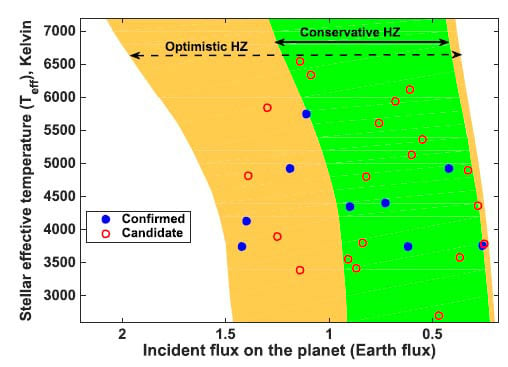
    A plot of the flux incident on an exoplanet (in units of the amount on Earth) versus the host star’s temperature. The plot shows two ranges for the habitable zone, conservative green area) and optimistic (yellow area); it also shows where confirmed (blue dots) and unconfirmed (red circles) exoplanets lie in the plot. There are currently twenty known exoplanet candidates smaller than two Earth-radii that fall in their optimistically-defined habitable zones.

    A newly published study provides a list of habitable zone exoplanet candidates from the Kepler Data Release 24 Q1-Q17 data vetting process.

    In our solar system, the Earth is cozily situated in the middle of the habitable zone which, depending on the model, extends roughly from Venus to Mars. The Kepler mission has as one of its primary goals the determination of the frequency of terrestrial planets in their habitable zones. CfA astronomer Guillermo Torres and his colleagues have now produced a complete catalog of Kepler exoplanet candidates in their habitable zones from the Kepler data releases to date. After reviewing the various criteria for determining the boundaries of the HZ, they report there are 104 candidates within an optimistic (larger) HZ definition, and twenty within a more conservative (smaller) definition of the HZ and which also have radii less than two Earth-radii, making this group in particular potential “Earth-like” candidates.

    The scientists also refined the definitions for the HZ for the purpose of more useful statistical diagnostics. They define four overlapping subgroups: candidates in the conservatively defined zone with a radius less than 2 Earth-radii; those in the larger, optimistic zone with this radius; those in the conservative zone with any radius; and those in the optimistic zone with any radius. The current catalog statistics for these four groups are 20, 29, 63, and 104 respectively. They note that these subgroups are useful when conducting specific follow-up studies; for example, searches for exomoons in the HZ are best done on the fourth group and its giant exoplanets.

    Reference: “A Catalog of Kepler Habitable Zone Exoplanet Candidates” by Stephen R. Kane, Michelle L. Hill, James F. Kasting, Ravi Kumar Kopparapu, Elisa V. Quintana, Thomas Barclay, Natalie M. Batalha, William J. Borucki, David R. Ciardi, Nader Haghighipour, Natalie R. Hinkel, Lisa Kaltenegger, Franck Selsis, and Guillermo Torres, 30 September 2016, The Astrophysical Journal.
    DOI: 10.3847/0004-637X/830/1/1
    arXiv: 1608.00620

    Never miss a breakthrough: Join the SciTechDaily newsletter.
    Follow us on Google and Google News.

    Astronomy Exoplanet Harvard-Smithsonian Center for Astrophysics Kepler Space Telescope Planetary Science
    Share. Facebook Twitter Pinterest LinkedIn Email Reddit

    Related Articles

    The Nearest Potentially Habitable Planet is Roughly Nine Light-Years Away

    Kepler Detects A Super-Earth Transiting the Bright K-Dwarf HIP 116454

    Architecture of Kepler’s Multi-Transiting Systems

    Water Planets in the Habitable Zone: A Closer Look at Kepler 62e and 62f

    Kepler Finds Over 2,300 Candidate Exoplanets

    Kepler Data Suggests 17 Billion Earth-Sized Worlds in the Milky Way

    A New Subclass of Extra-Solar Planets Discovered

    Volunteer Scientists Aid in Discovery of Four-Star Planet PH1

    Distant Exoplanets Form Planetary Syzygy Celestial Alignment

    Leave A Reply Cancel Reply

    • Facebook
    • Twitter
    • Pinterest
    • YouTube

    Don't Miss a Discovery

    Subscribe for the Latest in Science & Tech!

    Trending News

    JWST Finds a “Star” 100 Billion Times Brighter Than Any Star Should Be

    Scientists Find a Hidden Biological Link Across Different Forms of Autism

    Astronomers Discover a Ghostly River of Stars That Could Reveal Dark Matter

    Why Is Colorectal Cancer Rising in People Under 50? New Clues Point to the Environment

    Quantum Fluctuations Break a Crystal’s Symmetry Rules

    Why Does an Irregular Heartbeat Strike 40 Years Early in Some People?

    Scientists Reveal How ADHD Could Fuel Creative Thinking

    Scientists Find Just 3 Minutes of Sprinting Can Transform Blood Chemistry

    Follow SciTechDaily
    • Facebook
    • Twitter
    • YouTube
    • Pinterest
    • Newsletter
    • RSS
    SciTech News
    • Biology News
    • Chemistry News
    • Earth News
    • Health News
    • Physics News
    • Science News
    • Space News
    • Technology News
    Recent Posts
    • Does Vitamin C Really Prevent Colds? The Answer May Surprise You
    • Study Reveals Your Organs May Be Aging at Very Different Speeds
    • T Cells Have a Hidden Ability Scientists Never Knew Existed
    • This Grain-of-Rice-Sized “Rainbow” Chip Could Transform 6G Communications
    • Physicists Discover Time Crystals Can Communicate Across a Semiconductor
    Copyright © 1998 - 2026 SciTechDaily. All Rights Reserved.
    • Science News
    • About
    • Contact
    • Editorial Board
    • Privacy Policy
    • Terms of Use

    Type above and press Enter to search. Press Esc to cancel.