
A new study from the Harvard-Smithsonian Center for Astrophysics has examined Kepler observations for exoplanet transits around lower mass M-dwarf stars, revealing that the nearest potentially habitable Earth-sized planet is likely to be about nine light-years away.
The Kepler mission has so far spotted an astonishing 4696 possible exoplanets; about one-third of them, 1030, have been confirmed as exoplanets so far. A small percentage of this set are potentially habitable, by which astronomers generally mean that they have surface temperatures suitable for water to remain liquid, rather than frozen out as ice or suspended as vapor in the atmosphere.
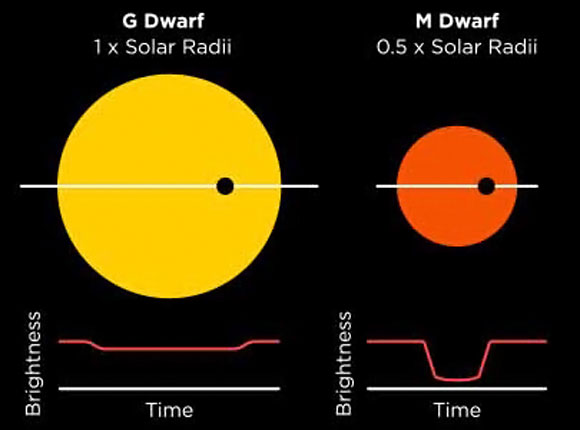
Exoplanets can exist around all kinds of stars, not only ones like the Sun. Sun-like stars are comparatively rare — the less massive (“M dwarf”) stars are about ten times more common. They are also cooler and dimmer, and so their planetary systems will have habitable zones closer to the star than is the case in our solar system, but exoplanets orbiting in that zone are of great interest, especially rocky, Earth-sized ones large enough to retain an atmosphere.
CfA astronomers Courtney Dressing and David Charbonneau have reanalyzed the full Kepler mission dataset, using their own transiting planet detection software to search for exoplanets around M dwarf stars. They use both archival and follow-up data to refine the stellar sample and the transit details, explicitly address issues of sample completeness, and incorporate a sophisticated treatment of the habitable zone in these stars.
After accounting for sampling effects that influence the transit detection (for example, the line-of-sight geometry to the stellar system), they conclude that Earth-sized planets (rocky planets between 1 to 1.5 times the Earth’s size) are common: there is probably one with an orbital period less than fifty days for every 1.8 early M dwarf stars. With a somewhat expanded range of parameters, including sizes up to four Earth-radii and orbiting in less than two hundred days, there are on average an estimated 2.5 Earth-like planets per M dwarf star.
Based on these statistics, the astronomers conclude that the nearest potentially habitable Earth-sized planet is likely to be a mere nine light-years away.
Reference: “The Occurrence of Potentially Habitable Planets Orbiting M Dwarfs Estimated from the Full Kepler Dataset and an Empirical Measurement of the Detection Sensitivity” by Courtney D. Dressing and David Charbonneau, 30 June 2015, The Astrophysical Journal.
DOI: 10.1088/0004-637X/807/1/45
arXiv: 1501.01623
Never miss a breakthrough: Join the SciTechDaily newsletter.
Follow us on Google and Google News.
5 Comments
Nice to know, but honestly futile nonetheless barring a huge advancement in many complex and risky fields, it says ‘merely” 9 light years away because we so often deal in thousands to millions of light years away when talking about space things that we vastly underestimate the level of engineering a capable vessel to accomplish such a mission.
Considering the fact that terraforming planets like Mars for colonization and our own close proximity space areas has asteroids with unlimited amounts of water and minerals and resources, going beyond our Solar System is a fools errand.
Light travels 9,454,254,955,488 Km per year.
Spacecraft travels at around 50,000 Km per hour 438,000,000 Km per year
Just over 21,585 years to cover the distance.
O___o 21 thousand years…
The religionist will protest this because truth is their enemy. Just the thought of life anywhere else threatens their scam. They don’t want the truth of scientific discovery taught in schools either. Of course nothing they believe in can be seen with a microscope or telescope because they don’t exist.
You sir, are an arrogant, misinformed, @sshole.
That is actually incorrect. I know of a few religious individuals who are convinced life is only found on Earth, but a habital planet besides Earth will not effect their beliefs in any way.
Additionally, even if life is found, several religions (such as Mormons) believe that God created multiple worlds with life on it. So, finding life outside of Earth would only confirm their religious beliefs (to them, anyway).
Nah, that’s simply not true. I live in Texas, part of the bible belt. Most religious folks here already believe that there’s probably life on other planets.
Granted, there’s a lot of resistance to evolution, but it is at least taught in our schools. Also, the Catholic church officially accepts evolution. This is why you can’t make an accurate blanket statement to cover all of religion.