
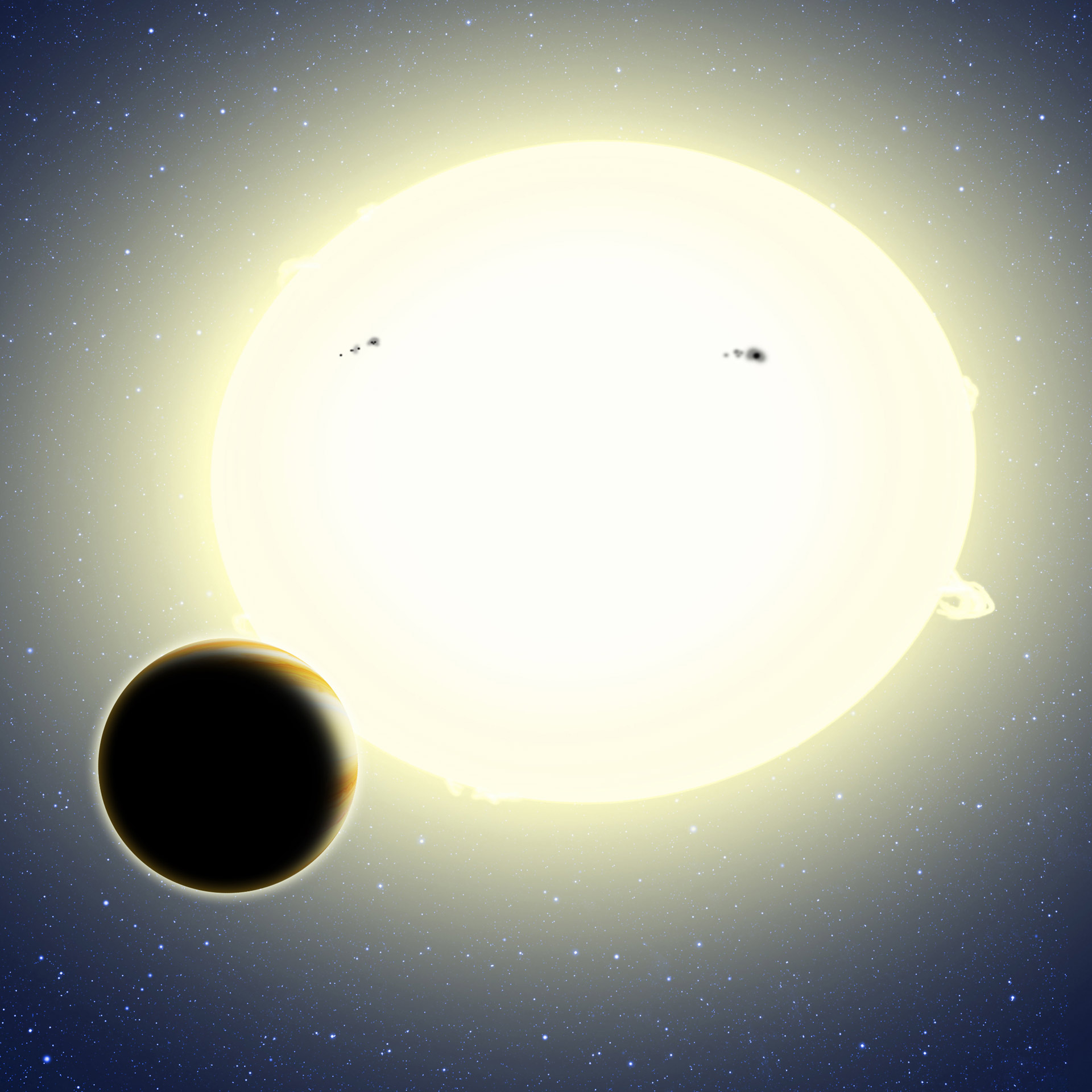
Despite a malfunction that ended its primary mission in May 2013, NASA’s Kepler spacecraft is still alive and working and has detected a newfound planet, HIP 116454b, has a diameter of 20,000 miles, two and a half times the size of Earth.
To paraphrase Mark Twain, the report of the Kepler spacecraft’s death was greatly exaggerated. “Like a phoenix rising from the ashes, Kepler has been reborn and is continuing to make discoveries. Even better, the planet it found is ripe for follow-up studies,” says lead author Andrew Vanderburg of the Harvard-Smithsonian Center for Astrophysics (CfA).
NASA’s Kepler spacecraft detects planets by looking for transits, when a star dims slightly as a planet crosses in front of it. The smaller the planet, the weaker the dimming, so brightness measurements must be exquisitely precise. To enable that precision, the spacecraft must maintain a steady pointing.
Kepler’s primary mission came to an end when the second of four reaction wheels used to stabilize the spacecraft failed. Without at least three functioning reaction wheels, Kepler couldn’t be pointed accurately.
Rather than giving up on the plucky spacecraft, a team of scientists and engineers developed an ingenious strategy to use pressure from sunlight as a virtual reaction wheel to help control the spacecraft. The resulting second mission, K2, promises to not only continue Kepler’s search for other worlds, but also introduce new opportunities to observe star clusters, active galaxies, and supernovae.
Due to Kepler’s reduced pointing capabilities, extracting useful data requires sophisticated computer analysis. Vanderburg and his colleagues developed specialized software to correct spacecraft movements, achieving about half the photometric precision of the original Kepler mission.
Kepler’s new life began with a 9-day test in February 2014. When Vanderburg and his colleagues analyzed that data, they found that Kepler had detected a single planetary transit.
They confirmed the discovery with radial velocity measurements from the HARPS-North spectrograph on the Telescopio Nazionale Galileo in the Canary Islands. Additional transits were weakly detected by the Microvariability and Oscillations of STars (MOST) satellite.
The newfound planet, HIP 116454b, has a diameter of 20,000 miles (32,000 kilometers), two and a half times the size of Earth. HARPS-N showed that it weighs almost 12 times as much as Earth. This makes HIP 116454b a super-Earth, a class of planets that don’t exist in our solar system. The average density suggests that this planet is either a water world (composed of about three-fourths water and one-fourth rock) or a mini-Neptune with an extended, gaseous atmosphere.
This close-in planet circles its star once every 9.1 days at a distance of 8.4 million miles (13.5 million kilometers). Its host star is a type K orange dwarf slightly smaller and cooler than our sun. The system is 180 light-years from Earth in the constellation Pisces.
Since the host star is relatively bright and nearby, follow-up studies will be easier to conduct than for many Kepler planets orbiting fainter, more distant stars.
“HIP 116454b will be a top target for telescopes on the ground and in space,” says Harvard astronomer and co-author John Johnson of the CfA.
The research paper reporting this discovery has been accepted for publication in The Astrophysical Journal.
Headquartered in Cambridge, Mass., the Harvard-Smithsonian Center for Astrophysics (CfA) is a joint collaboration between the Smithsonian Astrophysical Observatory and the Harvard College Observatory. CfA scientists, organized into six research divisions, study the origin, evolution, and ultimate fate of the universe.
Reference: “Characterizing K2 Planet Discoveries: A super-Earth transiting the bright K-dwarf HIP 116454” by Andrew Vanderburg, Benjamin T. Montet, John Asher Johnson, Lars A. Buchhave, Li Zeng, Francesco Pepe, Andrew Collier Cameron, David W. Latham, Emilio Molinari, Stephane Udry, Christophe Lovis, Jaymie M. Matthews, Chris Cameron, Nicholas Law, Brendan P. Bowler, Ruth Angus, Christoph Baranec, Allyson Bieryla, Walter Boschin, David Charbonneau, Rosario Cosentino, Xavier Dumusque, Pedro Figueira, David B. Guenther, Avet Harutyunyan, Coel Hellier, Rainer Kuschnig, Mercedes Lopez-Morales, Michel Mayor, Giusi Micela, Anthony F. J. Moffat, Marco Pedani, David F. Phillips, Giampaolo Piotto, Don Pollacco, Didier Queloz, Ken Rice, Reed Riddle, Jason F. Rowe, Slavek M. Rucinski, Dimitar Sasselov, Damien Segransan, Alessandro Sozzetti, Andrew Szentgyorgyi, Chris Watson and Werner W. Weiss, 9 February 2015, The Astrophysical Journal.
DOI: 10.1088/0004-637X/800/1/59
arXiv: 1412.5674
Never miss a breakthrough: Join the SciTechDaily newsletter.
Follow us on Google and Google News.