

Cyanobacteria use an AM radio-like principle to coordinate cell division with circadian rhythms, encoding information through pulse amplitude modulation.
Cyanobacteria, an ancient group of photosynthetic bacteria, have been discovered to regulate their genes using the same physics principle used in AM radio transmission.
New research published in Current Biology has found that cyanobacteria use variations in the amplitude (strength) of a pulse to convey information in single cells. The finding sheds light on how biological rhythms work together to regulate cellular processes.
In AM (amplitude modulation) radio, a wave with constant strength and frequency – called a carrier wave – is generated from the oscillation of an electric current. The audio signal, which contains the information (such as music or speech) to transmit, is superimposed onto the carrier wave. This is done by varying the amplitude of the carrier wave in accordance with the frequency of the audio signal.
The research team, led by Professor James Locke at the Sainsbury Laboratory Cambridge University (SLCU) and Dr Bruno Martins at the University of Warwick found that a similar AM radio-like mechanism is at work in cyanobacteria.
In cyanobacteria, the cell division cycle, the process through which one cell grows and divides into two new cells, acts as the ‘carrier signal’. The modulating signal then comes from the bacteria’s 24-hour circadian clock, which acts as an internal time-keeping mechanism.
Solving a Long-Standing Cellular Puzzle
This finding answers a long-standing question in cell biology – how do cells integrate signals from two oscillatory processes – the cell cycle and the circadian rhythm – which operate a different frequencies? Until now, it was unclear how these two cycles could be coordinated.
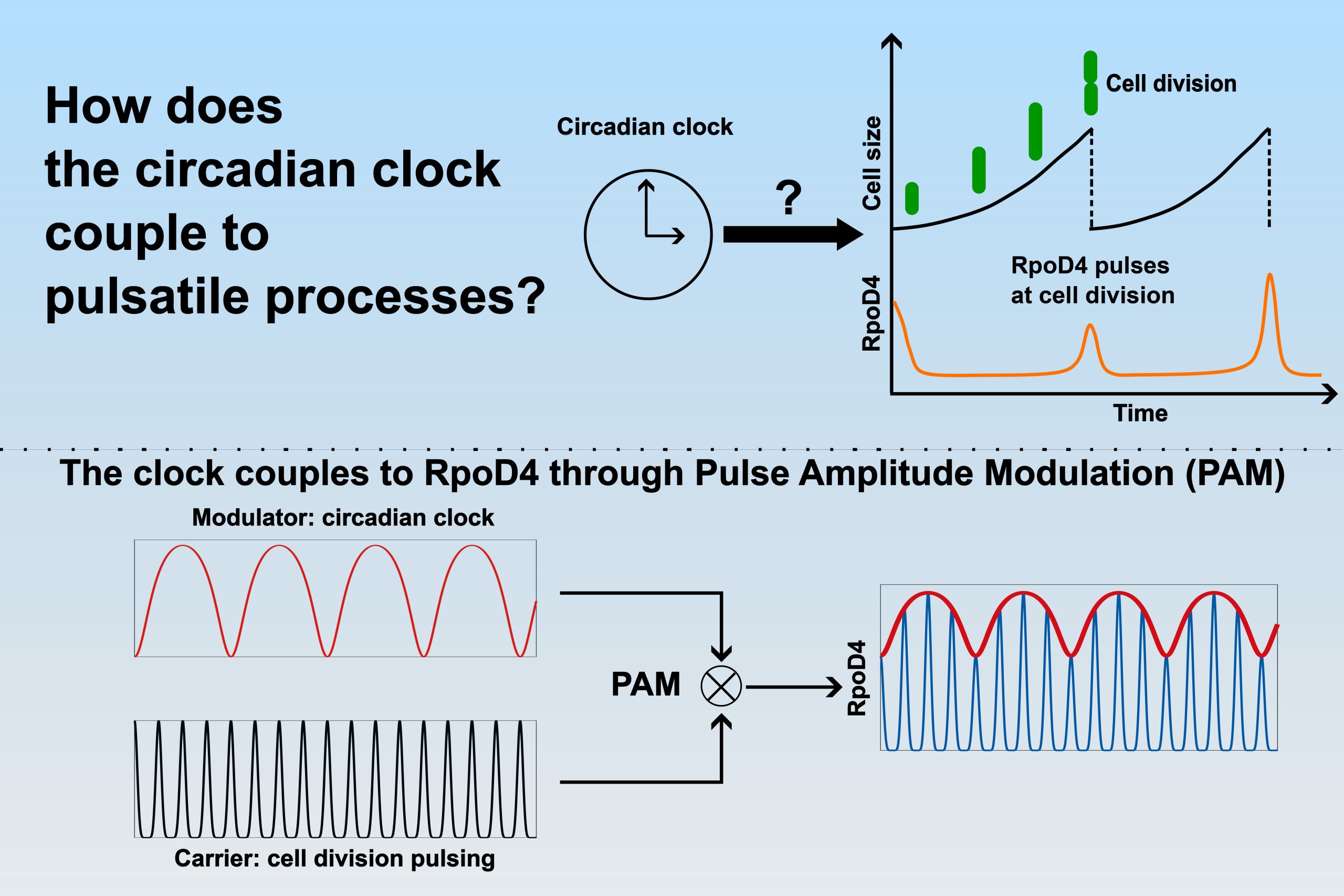
To solve the puzzle, the research team used single-cell time-lapse microscopy and mathematical modeling. With the time-lapse microscopy, they tracked expression of a protein, the alternative sigma factor RpoD4. RPoD4 plays an important role in the initiation of transcription, which is the process by which genetic information from DNA is transcribed into RNA. The modeling allowed researchers to explore signal processing mechanisms, comparing modeling results with microscopy data. The team found RpoD4 is turned on in pulses that occur only at cell division, which made it an ideal candidate for tracking.
Lead author Dr Chao Ye explained: “We found that the circadian clock dictates how strong these pulses are over time. Using this strategy, cells can encode information about two oscillatory signals in the same output: information about the cell cycle in the pulsing frequency, and about the 24-hour clock in the pulsing strength. This is the first time we’ve observed a circadian clock using pulse amplitude modulation, a concept typically associated with communication technology, to control biological functions.”
Implications of the Findings
“Varying the frequency of either the cell cycle, through ambient light, or the circadian clock, through genetic mutations, validated the underlying principle. It is striking to see examples in nature of what we sometimes think of as ‘our’ engineering rules,” said co-corresponding author Dr Martins. “The cyanobacterial lineage evolved 2.7 billion years ago, and have an elegant solution to this information processing problem.”
Professor Locke added: “One reason we study cyanobacteria is that they have the simplest circadian clock of any organism, so understanding it lays the foundation we need to understand clocks in more complex organisms, like people and crops.
“These principles could have broader implications in synthetic biology and biotechnology. For example, this could help us develop crops that are more resilient to changing environmental conditions, with implications for agriculture and sustainability.”
Reference: “The cyanobacterial circadian clock couples to pulsatile processes using pulse amplitude modulation” by Chao Ye, Chris N. Micklem, Teresa Saez, Arijit K. Das, Bruno M.C. Martins and James C.W. Locke, 25 November 2024, Current Biology.
DOI: 10.1016/j.cub.2024.10.047
This research was funded by BBSRC, ERC, the Gatsby Charitable Foundation and the Royal Society.
Never miss a breakthrough: Join the SciTechDaily newsletter.
Follow us on Google and Google News.
2 Comments
The title of this article is nonsense! What the research has shown is amplitude variation in a pulsatile process coupled to the circadian rhythm. There is no indication that this has anything to do with radio communication in bacteria!
This is fascinating, but..well..I cant focus on it because I’m curious what happens if one were to lack the genes for a circadian rhythm?