
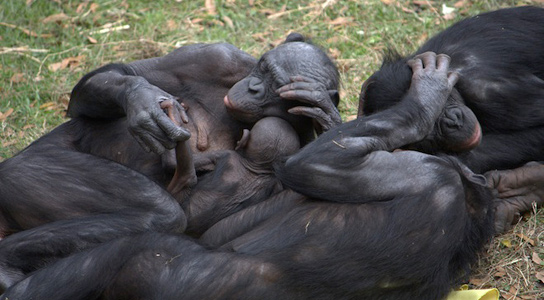
While it’s expected that the animal kingdom is a fierce place, where aggression for survival dominates, a new study on bonobos (Pan paniscus) published in January 20th’s Animal Behaviour suggests that some animals outcompete others by becoming ‘nicer’.
It’s most apparent in bonobos, which are a close cousin to chimpanzees. Unlike chimps, which can be quite aggressive and violent, bonobos are generally peaceful creatures. Bonobos have changed their physical and behavioral traits, which indicate that an evolutionary process towards domestication has taken place without the intervention of humans.
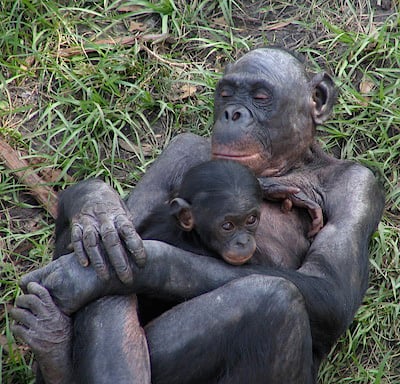 Domesticated animals lose aggression, which involves modifications to the nervous and endocrine systems of the animals in questions, as well as alterations to complex gene networks. The principles are distilled from a famous Russian experiment with foxes that has shown that wild foxes became playful, face-licking animals instead of fierce-tempered and untouchable. The behavior is typical of juveniles, but what was surprising is that these foxes continued to display juvenile physical features even as adults. They are effectively evolutionary suspended in childhood.
Bonobos split from chimpanzees about one million years ago. While male chimps compete violently for dominance, male bonobos rarely fight others. Male chimps often coerce females into sex while bonobos ask for permission. In lab tests, bonobos are stressed by competition, attention to others’ needs, and eager to cooperate and share. The brain regions that are crucial for this behavior, like the amygdala and occipital frontal cortex, are arranged differently than chimpanzees.
Bonobos play like juvenile chimps all throughout their lives. Some of their physical features seem to showcase this as well, with pedomorphic features such as white tail tuft and extra pink lips.
According to Brian Hare, a Duke University evolutionary anthropologist, and Richard Wrangham, a primatologist, these are signs of domestication. About 2.5 million years ago, a drought drove gorillas from the south of the Zaire River, which made competing for resources less fierce than before for bonobos. Aggression was lessened, species-wide, and allowed females to cooperate. Reproduction was no longer traumatic, so females became fertile more often. This also reduced competition between males.
By doing this, bonobos rose to primate supremacy in a large region, and reigned unchallenged before humans came along. While it may sound like bonobos might turn out to be cute future pets, they’re still far from that. Wolves took the same path thousands of years ago to exploit a new ecological niche at the edge of human settlements.
Many changes underlying the domestication syndrome don’t involve mutation into genes, but epigenetic changes in the timing of gene activity, which can occur more rapidly than changes through mutation alone.
Reference: “The self-domestication hypothesis: evolution of bonobo psychology is due to selection against aggression” by Brian Hare, Victoria Wobber, and Richard Wrangham, 20 January 2012, Animal Behaviour.
DOI: 10.1016/j.anbehav.2011.12.007
Never miss a breakthrough: Join the SciTechDaily newsletter.
Follow us on Google and Google News.