

Close Menu
    Facebook X (Twitter) Instagram
    SciTechDaily
    • Biology
    • Chemistry
    • Earth
    • Health
    • Physics
    • Science
    • Space
    • Technology
    Facebook X (Twitter) Pinterest YouTube RSS
    SciTechDaily
    Home»Health»New Study Links Belly Fat and Brain Health: A Key to Preventing Cognitive Decline?
    Health

    New Study Links Belly Fat and Brain Health: A Key to Preventing Cognitive Decline?

    By Toho UniversityMarch 13, 2025No Comments3 Mins Read
    Facebook Twitter Pinterest Telegram LinkedIn WhatsApp Email Reddit
    Share
    Facebook Twitter LinkedIn Pinterest Telegram Email Reddit
    Overweight Man Fat Belly
    Researchers found that aging reduces the ability of visceral adipose tissue to maintain brain BDNF levels, leading to cognitive decline. The study reveals that decreased CX3CL1 expression and reduced steroid hormone responsiveness in older mice may underlie age-related brain aging and could guide new treatments.

    New research reveals that visceral adipose tissue helps maintain brain-derived neurotrophic factor (BDNF) levels, but this effect weakens with age, potentially contributing to cognitive decline.

    A new study, led by Dr. Yoshinori Takei and Dr. Atsushi Sugiyama from Toho University’s Department of Pharmacology, along with Dr. Akira Hirasawa of Kyoto University’s Graduate School of Pharmaceutical Sciences and Dr. Yoko Amagase of Osaka Medical and Pharmaceutical University’s Faculty of Pharmacy, uncovers a novel link between visceral adipose tissue aging and brain health.

    The findings were recently published in GeroScience, the official journal of the American Aging Association.

    Key Points

    • Visceral adipose tissue aids in maintaining the brain-derived neurotrophic factor (BDNF) level in the brain.
    • The effects of the visceral adipose tissue on brain BDNF expression decrease with age.
    • Some mechanisms corresponding to middle-aged weight gain appear to be involved in brain aging.
    • The findings may contribute to the prevention and improvement of cognitive decline and depressive symptoms in older adults.

    Research Overview

    The research shows that the visceral adipose tissue, which stores fat in the peritoneal cavity, expresses the protein CX3CL1 to promote the production of BDNF, a critical molecule for maintaining cognitive function. In young mice, the adipose-to-brain crosstalk helps sustain cognitive health by ensuring adequate BDNF production.
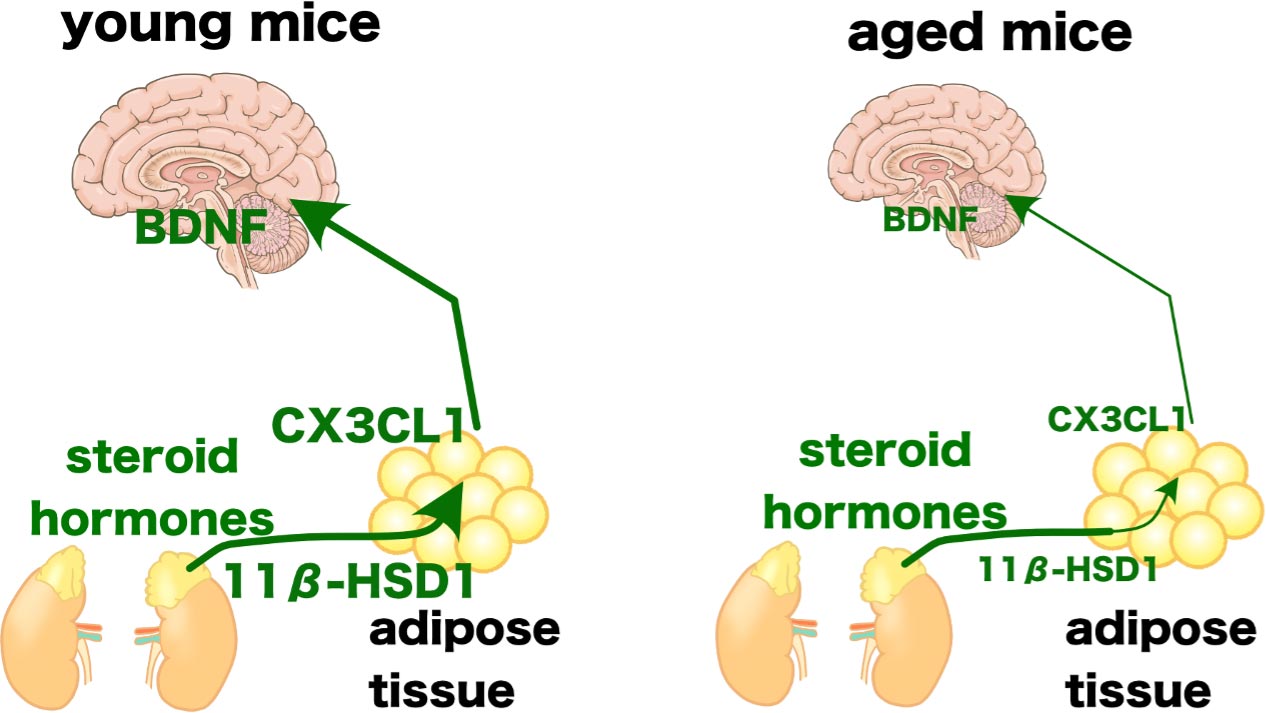
    Relationship Between Adipose CX3CL1 and BDNF
    This figure illustrates a putative relationship between adipose CX3CL1 and brain BDNF, and its age-related changes. In young mice, steroid hormones contribute to maintaining brain BDNF levels via adipose CX3CL1. However, in aged mice, a deficiency of adipose 11β-HSD1 leads to insensitivity to steroid hormones, which in turn decreases the expression of adipose CX3CL1 and subsequently reduces brain BDNF levels. Credit: Dr. Yoshinori Takei

    However, the crosstalk falters in aged mice, as CX3CL1 expression decreases in the adipose tissue with age. This age-related alteration potentially leads to cognitive decline, since brain BDNF is correlated to the cognition levels of older adults. Adjusting for the age-related decrease in peritoneal CX3CL1 has been shown to restore cognitive function impaired by aging.

    Moreover, the research indicates that steroid hormones causing lipolysis in the adipose tissue promote CX3CL1 expression, and that the responsiveness of the tissue to steroid hormones declines in aged mice. Thus, in aged mice, insensitivity to steroid hormones appears to result in lower CX3CL1 production in the adipose tissue and a subsequent drop in BDNF levels in the brain.

    Since the reduction of hormone-induced lipolysis is associated with abdominal fat accumulation in middle-age, the study suggests that the mechanism corresponding to middle-aged weight gain may also contribute to the age-related decline in brain BDNF.

    These results open the door to new treatments aimed at preventing cognitive decline and alleviating depressive symptoms, ultimately enhancing the quality of life for older adults.

    Reference: “Adipose chemokine ligand CX3CL1 contributes to maintaining the hippocampal BDNF level, and the effect is attenuated in advanced age” by Yoshinori Takei, Yoko Amagase, Ai Goto, Ryuichi Kambayashi, Hiroko Izumi-Nakaseko, Akira Hirasawa and Atsushi Sugiyama, 13 February 2025, GeroScience.
    DOI: 10.1007/s11357-025-01546-4

    Never miss a breakthrough: Join the SciTechDaily newsletter.
    Follow us on Google and Google News.

    Aging Brain Gerontology Obesity Public Health
    Share. Facebook Twitter Pinterest LinkedIn Email Reddit

    Related Articles

    New Study: Helping Others Slows Cognitive Decline by Up to 20%

    Fecal Transplants Reverse Hallmarks of Aging in the Gut, Eyes, and Brain

    Simple Daily Activities – Like Washing Dishes – Reduce Heart Disease Risk in Senior Women

    Brain Benefits: Exercise Can Help Older Adults Retain Their Memories

    Loneliness and Social Isolation Increase Heart Disease Risk in Senior Women

    Feelings of Physical Fatigue Predict Death in Older Adults

    “Cognitive Clock” – Researchers Develop New Measure of Brain Health

    Amazon Indigenous People May Hold a Key to Slowing Down Aging

    Exposure to COVID-19 Could Pose a Risk to the Health and Aging of Individuals Who Aren’t Even Born Yet

    Leave A Reply Cancel Reply

    • Facebook
    • Twitter
    • Pinterest
    • YouTube

    Don't Miss a Discovery

    Subscribe for the Latest in Science & Tech!

    Trending News

    First-of-Its-Kind Discovery: Homer’s Iliad Found Embedded in a 1,600-Year-Old Egyptian Mummy

    Beyond Inflammation: Scientists Uncover New Cause of Persistent Rheumatoid Arthritis

    A Simple Molecule Could Unlock Safer, Easier Weight Loss

    Scientists Just Built a Quantum Battery That Charges Almost Instantly

    Researchers Unveil Groundbreaking Sustainable Solution to Vitamin B12 Deficiency

    Millions of People Have Osteopenia Without Realizing It – Here’s What You Need To Know

    Researchers Discover Boosting a Single Protein Helps the Brain Fight Alzheimer’s

    World-First Study Reveals Human Hearts Can Regenerate After a Heart Attack

    Follow SciTechDaily
    • Facebook
    • Twitter
    • YouTube
    • Pinterest
    • Newsletter
    • RSS
    SciTech News
    • Biology News
    • Chemistry News
    • Earth News
    • Health News
    • Physics News
    • Science News
    • Space News
    • Technology News
    Recent Posts
    • New Research Challenges Long-Held Beliefs About How the Brain Makes Decisions
    • Breakthrough Technology Reveals New Treatment Targets for Cancer
    • Scientists Discover New Way To Make Drug-Resistant Cancer Treatable Again
    • This Simple Exercise Trick Builds Muscle With Less Effort, Study Finds
    • Middle Age Is Becoming a Breaking Point in America, Study Reveals
    Copyright © 1998 - 2026 SciTechDaily. All Rights Reserved.
    • Science News
    • About
    • Contact
    • Editorial Board
    • Privacy Policy
    • Terms of Use

    Type above and press Enter to search. Press Esc to cancel.