
Living together in communities requires mutual cooperation. To achieve this, we punish others when they are uncooperative. Until now, it has been unclear as to when we develop the impulse to penalize this behavior — and whether this is an exclusively human feature. Scientists at the Max Planck Institute for Human Cognitive and Brain Sciences and the Max Planck Institute for Evolutionary Anthropology in Leipzig discovered that even six-year-old children feel the need to reprimand antisocial behavior and that they are willing to take risks and make an effort to be present when the ‘guilty’ one is punished.
When we see somebody suffering, we normally feel uneasy and want to help. However, this feeling can be reversed. When we know someone behaved in an antisocial manner, we can remain unsympathetic even though we know they are hurt. It is known from previous studies that we perceive the perpetrator’s pain as a just punishment and a tool to penalize misbehavior. Moreover, we feel a sense of spite when we witness the disciplinary measure.
Until now, not much was known about the evolutionary origin of this behavior. Scientists from the department of social neuroscience at the Max Planck Institute for Human Cognitive and Brain Sciences together with colleagues from the Max Planck Institute for Evolutionary Anthropology explored the question at what age we develop the motivation to watch, from our perspective, a deserved punishment and if this feature also exists in our closest relatives – chimpanzees.
Puppet theater as social experiment
To investigate children’s behavior the researchers used a puppet theatre in which two characters each behaved differently. There was a friendly character, who gave the children their favorite toy back, and an uncooperative one who kept the toy for themselves. Additionally, there was a puppet that played the punishing role and pretended to hit the other two with a stick. The young audience, aged four to six years, could decide if they wanted to watch the pretend hits by paying with a coin, or if they would prefer to exchange the coin for stickers.
In the case of the friendly puppet, the children largely refused to observe how it suffered. However, in the case of the antisocial puppet, the six-year-old children’s preference to reject the stickers and spend their coins witnessing the punishment was significant. They even experienced pleasure by watching him suffer, shown in their expressions. In contrast, the four- and five-year-old children did not show this behavior.
Chimps enjoy just penalties
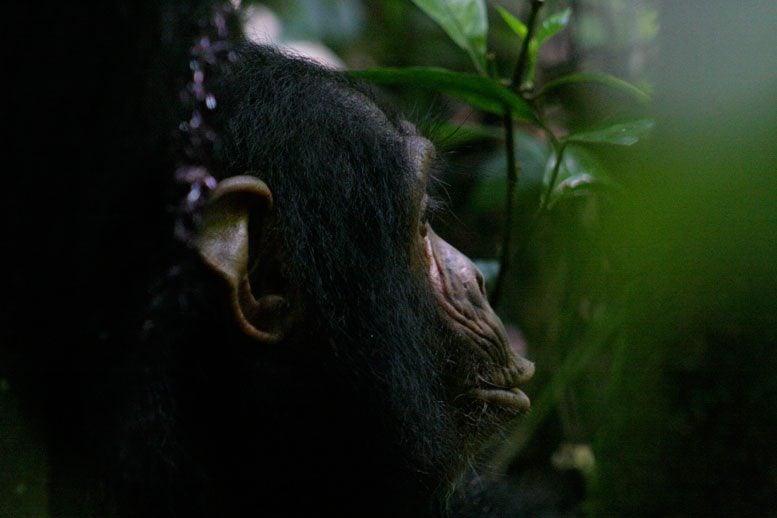
The scientists observed similar occurrences in chimpanzees. Their desire to penalize antisocial behavior was studied in the research unit of Max Planck Institute for Evolutionary Anthropology at Leipzig Zoo with the help of two zookeepers, who also slipped into contrasting roles; social and antisocial. While one regularly fed them, the other took their food away. In this situation also, another person pretended to beat them both with a stick. As with the children, a significant number of chimpanzees made an effort to witness the disliked keeper being punished. To do so, they had to open a heavy door to a neighboring room from where they could witness the scene. As for the friendly zookeeper, they refused this option and even protested strongly when pain was inflicted on them.
“Our results demonstrate that six-year-old children and even chimpanzees want to avenge antisocial behavior and that they feel an urge to watch it. “This is where the evolutionary roots of such behavior originate, a crucial characteristic to manage living in a community,” states Natacha Mendes, scientist at Max Planck Institute for Human Cognitive and Brain Sciences and one of the first authors of the underlying study. “We cannot definitely say that the children and chimpanzees felt spite. However, their behavior is a clear sign that six-year-old children as well as chimpanzees are eager to observe how uncooperative members of their community are punished,” adds Nikolaus Steinbeis, the co-author of the study and scientist at both Max Planck Institute for Human Cognitive and Brain Sciences and University College London.
Reference: “Preschool children and chimpanzees incur costs to watch punishment of antisocial others” by Natacha Mendes, Nikolaus Steinbeis, Nereida Bueno-Guerra, Josep Call and Tania Singer, 18 December 2017, Nature Human Behaviour.
DOI: 10.1038/s41562-017-0264-5
Never miss a breakthrough: Join the SciTechDaily newsletter.
Follow us on Google and Google News.
2 Comments
Equally, the person or toddler or chimp who breaks the behavioral “rules” by which others live, gains wealth, advantage, privilege and is willing to risk retribution for some perceived advantage. But what is that advantage?
Primate behavior is reenacted precisely by a leader, almost like a predictable choreography, when he or, less often, she seizes the most obviously desirable mate–based on reproductive signals, or the money or valuable item with impunity, and mocks, bullies, belittles would-be opponents to drive them off, shame them publicly, usually with bluster or some ritualized “battle” behavior. The display of this sort of success must be perceived to have some reward beyond simply garnering the best prize or most valuables for the primates to go through the trouble and then display the spoils and risk challenge or theft or mob action.
Equally, the weaker individuals, often those locked into the conventional “heads down” behavioral routine which they label “virtue,” delight in viewing the inevitable fall.
I know I will!
As Mr. Berman struggles to equate these findings to a particular leader,it seems he conveniently missed the elation the American electorate experienced when watching those who so gleefully robbed, humiliated, lied, while trying to destroy our social order for 8+ years,finally get the punishment they deserved.