
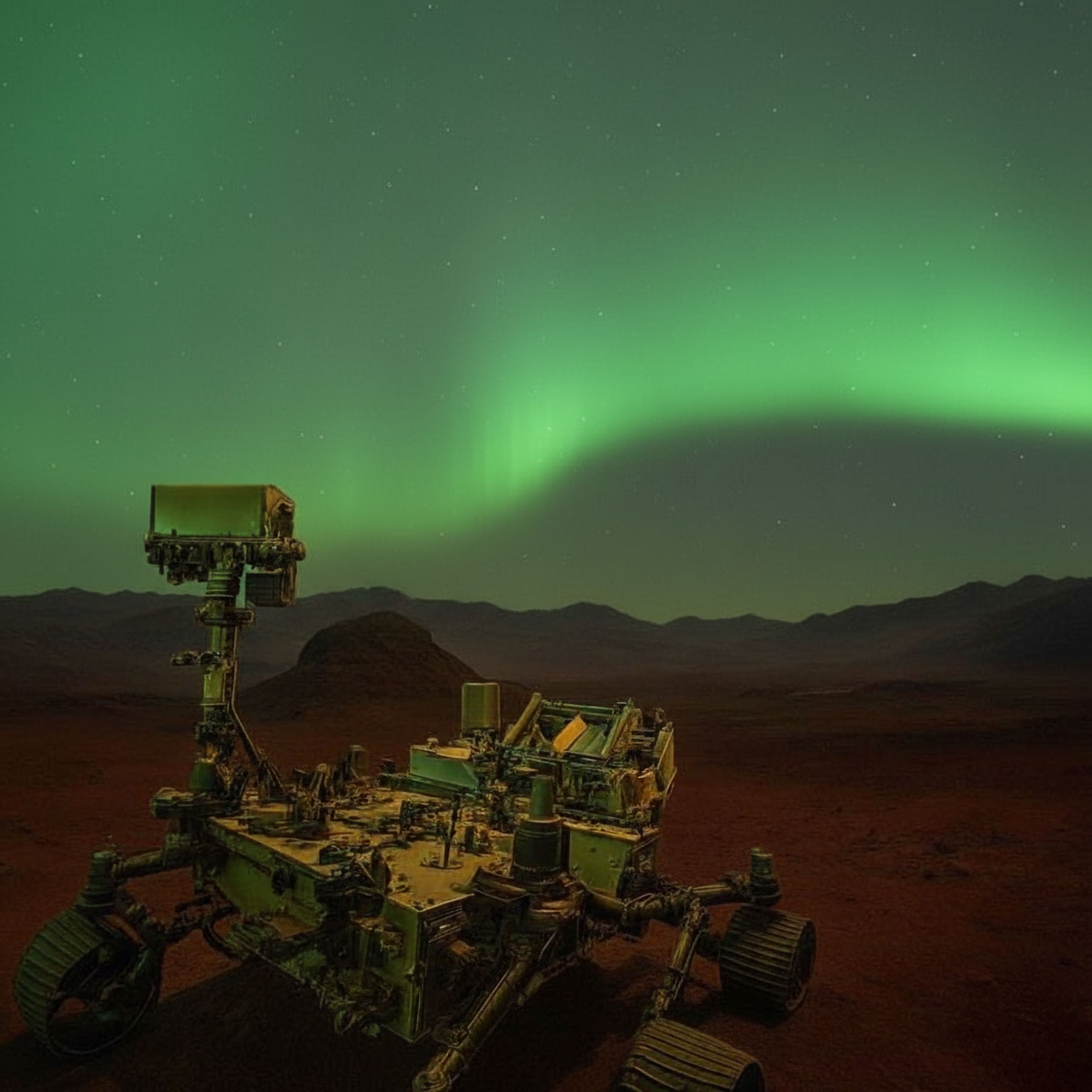
Scientists using NASA’s Perseverance rover have captured visible green auroras on Mars and developed tools to predict them.
Planetary scientists say they can now forecast when a green aurora will appear in Mars’s night sky, supported by new images.
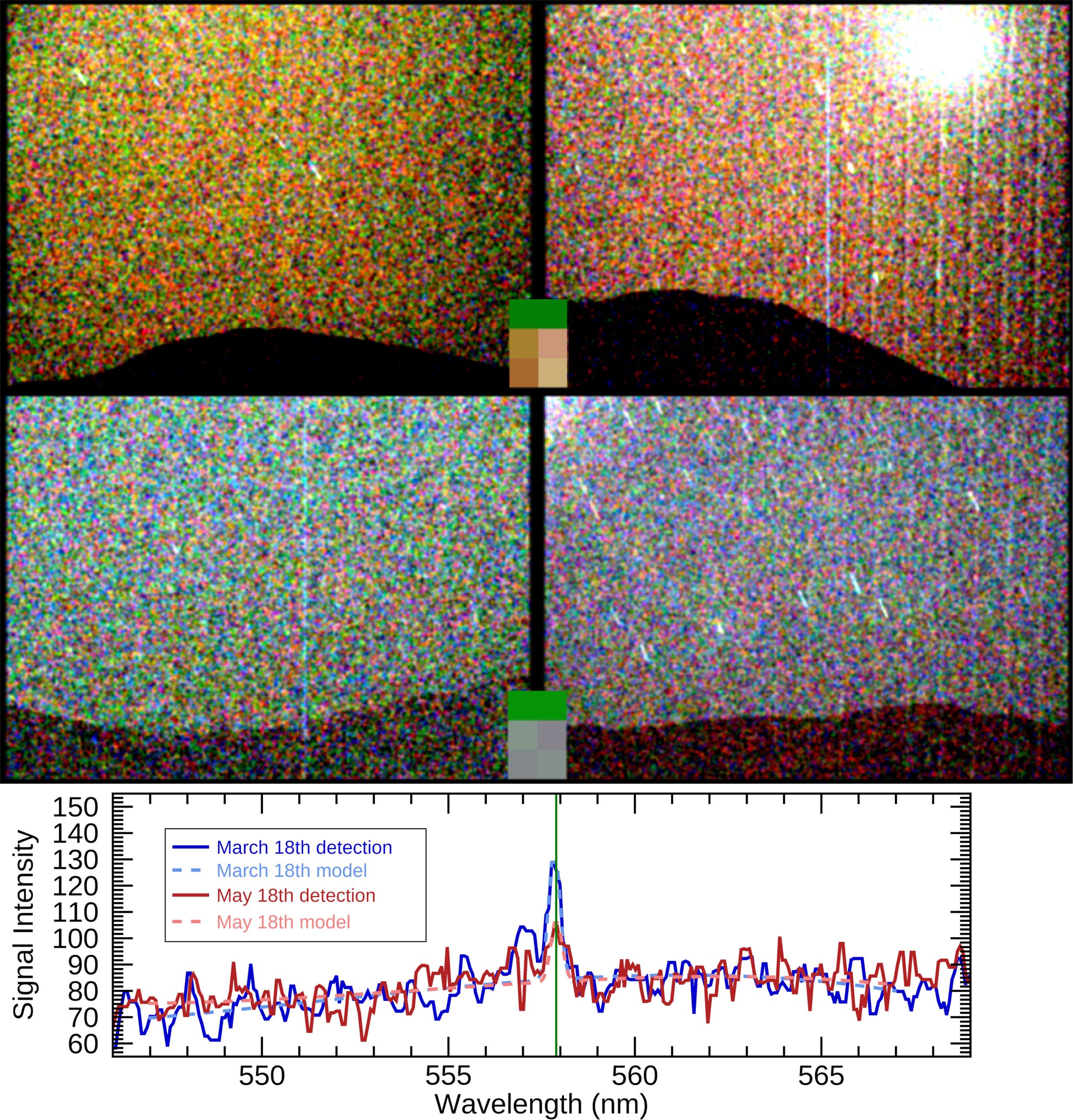
NASA’s Perseverance rover recorded the first visible-light aurora from the Martian surface in 2024. At the Europlanet Science Congress–Division of Planetary Science (EPSC–DPS) joint meeting in Helsinki this week, Dr Elise Wright Knutsen of the University of Oslo will present a second Perseverance image and, more importantly, a method for predicting when aurorae will occur on Mars.
“The fact that we captured the aurora again demonstrates that our method for predicting aurorae on Mars and capturing them works,” said Knutsen, who was also the science lead for the first image of a martian aurora seen from the ground.
Aurorae arise when bursts of energetic particles in the solar wind, released during a coronal mass ejection (CME) from the Sun, collide with atmospheric molecules and make them emit light. On Mars, these charged particles strike oxygen atoms high above the planet, producing a green glow bright enough to be seen by astronauts with the unaided eye.
Unlike Earth, Mars lacks a global magnetic field to steer incoming particles toward polar regions. As a result, aurorae can spread across the entire nightside as a broad glow in the sky, a phenomenon known as ‘diffuse’ aurora.
The same radiation that causes the aurora could also potentially be dangerous to astronauts without warning that they must take shelter, so having some idea of when a powerful solar storm will hit Mars is crucial if humans are going to one day survive on the surface.
Predicting Martian Auroras
Nonetheless, predicting aurorae on Mars is a complex business. Observations have to be planned and uploaded to the rover three days ahead once a CME bursts out in the direction of Mars. This means a lot of guesswork as to which solar storms will produce an aurora.
Knutsen’s team made eight attempts to view the aurora with Perseverance’s SuperCam and MastCam cameras between 2023 and 2024, and they found it to be a process of trial and error. The first three attempts saw nothing, but by retrospectively analyzing conditions as measured by NASA’s MAVEN and the ESA’s Mars Express orbiters, Knutsen and her colleagues realized that the velocities of those CMEs had likely not been fast enough to create a solar wind disturbance at Mars.
“The faster the CME, the more likely it is to accelerate particles towards Mars that create aurorae, and the stronger the solar wind disturbance around Mars, the more likely it is that those particles make it into Mars’s nightside atmosphere,” said Knutsen. “Later, we progressively targeted faster, more intense CMEs, and that’s when we found our first two detections.”
Unsolved Mysteries
The final three CMEs also didn’t produce aurorae, even though they met the criteria that Knutsen was looking for.
“The last three non-detections are more curious,” she said. “Statistically, there is also a degree of randomness to these things, so sometimes we’re just unlucky. This perhaps isn’t that surprising, since predicting the aurora on Earth down to minute precision isn’t an exact science either.”
Aurorae on Mars have previously been observed from orbit in ultraviolet light by ESA’s Mars Express and NASA’s MAVEN missions. Now, with the addition of visible-light detections, there is a growing dataset of observations for improving the accuracy of the aurora predictions. With further observations to come, they will hopefully help solve some ongoing mysteries about how the auroral lights are triggered on Mars.
“There is still much we don’t understand about how aurora occur on Mars as, unlike Earth, there is no global magnetic field to guide energetic solar particles onto the nightside where the aurora can be seen,” said Knutsen. “Comparing the timing of solar wind disturbances, the arrival of solar energetic particles, and the intensity and timing of aurora will advance our knowledge in this area.”
Reference: ” Green-line aurora detection attempts from the surface of Mars ” by Elise Wright Knutsen, Timothy H. McConnochie, Mark Lemmon, Shayla Viet, Agnes Cousin, Roger C. Wiens and James F. Bell, 8 July 2025, EPSC Abstracts.
DOI: 10.5194/epsc-dps2025-1314
This research was funded by the Research Council of Norway, and the NASA Mars 2020 Program.
Never miss a breakthrough: Join the SciTechDaily newsletter.
Follow us on Google and Google News.
3 Comments
The “artist’s concept” image is completely wrong. Structures like those shown in the image would only be present if there is a magnetic field to channel the charged particles into the atmosphere. When I first saw this image I thought “I didn’t know Mars had a magnetic field” – only to find out that it doesn’t, so the image is wrong.
Yeah – the artist’s concept – these may seem enhancing to the presentation – but only serve to place mis-constructs – in other words: wrong concepts for your readers.
The whole idea should be to provide meaningful insight.
This is dumbing down not smarten up. I’d like real photos – images reflecting reality.
I honestly can’t believe NASA send these Rovers to Mars and they don’t supply them with basic DSLR cameras that can take night time exposures like we do here on earth…