
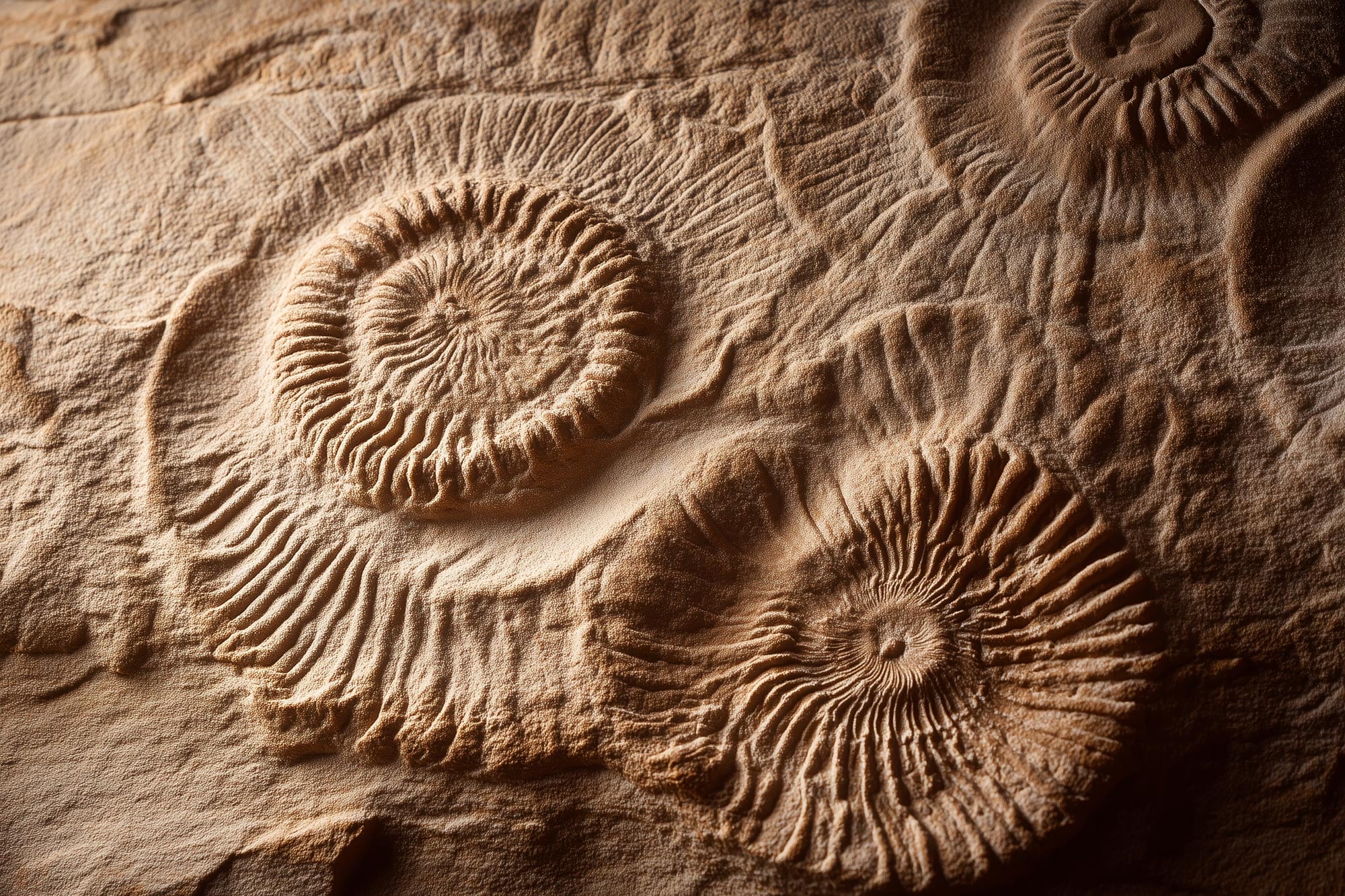
Exceptionally preserved fossils from the Ediacaran period challenge what scientists thought was possible in sandstone.
In the fossil record, creatures without hard shells or skeletons, such as jellyfish, are rarely preserved for long periods of time. Preservation is even less likely in sandstone, a rock made of coarse grains that is full of pores and typically forms in environments shaped by strong waves and frequent storms. Despite these challenges, fossils dating to about 570 million years ago tell a very different story. During the Ediacaran period, unusual soft-bodied organisms died on the seafloor, were quickly buried by sand, and were preserved with striking detail.
These remarkable fossils have since been discovered in rock formations across the globe. Researchers are working to understand how the Ediacara Biota could be preserved so clearly, especially as impressions in sandstone, a process rarely seen elsewhere in the fossil record. Solving this puzzle could help clarify a major missing chapter in the history of large, visible life on Earth.
“The Ediacara Biota look totally bizarre in their appearance. Some of them have triradial symmetry, some have spiraling arms, some have fractal patterning,” says Dr. Lidya Tarhan, a paleontologist at Yale University. “It’s really hard when you first look at them to figure out where to place them in the tree of life.”
These organisms lived during a brief but important window of time, just a few tens of millions of years before the Cambrian Explosion. That event, which began around 540 million years ago, marked a dramatic rise in the diversity and complexity of animal life. Rather than appearing suddenly, growing evidence supports what Tarhan describes as a “long fuse,” with the Ediacara Biota representing an early and essential phase leading up to this evolutionary turning point.
Why Preservation Matters
Figuring out how Ediacaran organisms were preserved so well is key to understanding where they fit in the broader story of evolution. Their fossils provide rare insight into the origins of complex life, including the distant ancestors of many modern animals and humans. A study led by Tarhan and her colleagues, published in the journal Geology, takes an important step toward answering these questions.
“If we want to understand the origins of complex life on Earth, the Ediacara Biota really occupies a critical point in that trajectory,” says Tarhan. “It’s incredibly important, not just for the Ediacara Biota but for all exceptionally preserved fossil assemblages, that we try to figure out what are the mechanisms behind that exceptional fossilization so we can better gauge to what extent these fossil assemblages provide a faithful reflection of life on the ancient sea floor.”
To investigate those mechanisms, Tarhan’s team turned to a new geochemical method. They analyzed lithium isotopes in Ediacara fossils collected from sites in Newfoundland and northwest Canada, including rocks made of both sand and mud. By studying these isotopes, the researchers could determine whether clay minerals played a role in preservation and whether those clays were detrital, meaning they washed off the continents, or authigenic, meaning the clays precipitated in the sea floor.
Rethinking How Soft Bodies Fossilize
The researchers found that detrital clay particles were present in the sediments that buried these organisms on the sea floor. These minerals then served as nucleation sites for authigenic clays to form from silica- and iron-rich seawater in the upper sea floor, driven by the unusual chemistry of the Ediacaran seawater. These clays acted like cement, holding together sand particles in the sandstone and preserving outlines and replicas of the soft-bodied forms of the Ediacara Biota.
This counters a longstanding idea that the exceptional preservation of the Ediacara Biota might have occurred because their bodies were made of a uniquely hardy substance. Instead, it was the chemistry of the environment that lent itself to fossilization, according to Tarhan and colleagues.
Going forward, Tarhan wants to apply this lithium isotope technique to more fossils from different locations and geologic ages to see if the same mechanism applies. In the meantime, Tarhan says their findings help fill in the picture of what the world was like at a critical time in the evolution of complex animal life on Earth.
“It’s hard to overemphasize how dramatic of a change it is from the small and microbial life forms that dominate much of the Precambrian to the big step up in size and complexity seen in the Ediacara Biota and Cambrian Explosion,” says Tarhan. “A clearer understanding of the processes responsible for fossilization across this interval will allow us to more robustly evaluate longstanding hypotheses for drivers of not only the appearance of the Ediacara Biota but also for their subsequent disappearance at the close of the Ediacaran period.”
Reference: “Authigenic clays shaped Ediacara-style exceptional fossilization” by Lidya G. Tarhan, Thomas H. Boag and Boriana Kalderon-Asael, 15 December 2025, Geology.
DOI: 10.1130/G53967.1
Never miss a breakthrough: Join the SciTechDaily newsletter.
Follow us on Google and Google News.
1 Comment
That photograph suggests a spiral asymmetry to those critters, sort of ammonitic, although ammonites weren’t around until a few hundred million years later. I know of no modern jellyfish with that spiral asymmetric build.