

Close Menu
    Facebook X (Twitter) Instagram
    SciTechDaily
    • Biology
    • Chemistry
    • Earth
    • Health
    • Physics
    • Science
    • Space
    • Technology
    Facebook X (Twitter) Pinterest YouTube RSS
    SciTechDaily
    Home»Chemistry»Breakthrough Calcium-Ion Battery Could Challenge Lithium for Clean Energy
    Chemistry

    Breakthrough Calcium-Ion Battery Could Challenge Lithium for Clean Energy

    By Hong Kong University of Science and TechnologyFebruary 16, 20261 Comment3 Mins Read
    Facebook Twitter Pinterest Telegram LinkedIn WhatsApp Email Reddit
    Share
    Facebook Twitter LinkedIn Pinterest Telegram Email Reddit
    Robot Hand Batteries
    Scientists at The Hong Kong University of Science and Technology have unveiled a major advance in calcium-ion battery technology that could reshape the future of clean energy storage. Credit: Shutterstock

    A next-generation calcium battery breakthrough could challenge lithium and transform clean energy storage.

    A research team at The Hong Kong University of Science and Technology (HKUST) has reported a major advance in calcium-ion battery (CIB) development that could influence how energy is stored in everyday technologies. By integrating quasi-solid-state electrolytes (QSSEs), the scientists created a new type of CIB designed to improve both performance and environmental sustainability.

    The innovation could support renewable energy storage, electric vehicles, and other power-hungry applications. The results were published in Advanced Science in a paper titled “High-Performance Quasi-Solid-State Calcium-Ion Batteries from Redox-Active Covalent Organic Framework Electrolytes.”

    Growing Demand for Lithium Alternatives

    As global investment in renewable energy accelerates, the need for dependable, high-capacity batteries continues to rise. Lithium-ion batteries (LIBs) currently dominate the market, but concerns about limited lithium supplies and constraints in energy density have pushed researchers to search for alternatives. Exploring battery chemistries beyond lithium has become increasingly important for long-term energy security and sustainability.

    Calcium-ion batteries offer several advantages. Calcium is widely available, and CIBs operate within an electrochemical window comparable to that of LIBs. Despite this promise, practical challenges have slowed their progress. Efficient movement of calcium ions inside the battery has been difficult to achieve, and maintaining stable performance over repeated charging cycles has proven problematic. These limitations have prevented CIBs from competing directly with commercial lithium-ion systems.
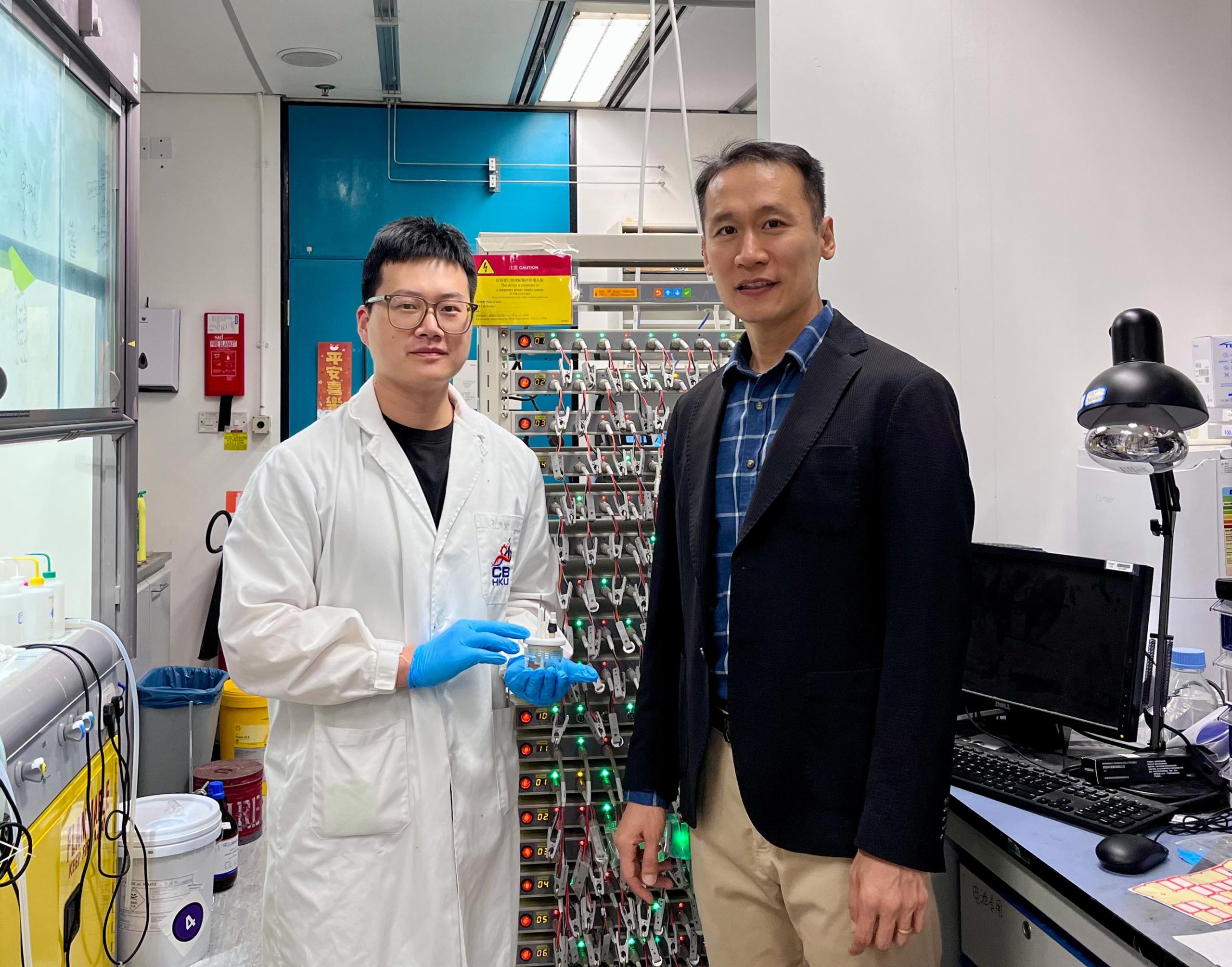
    Yoonseob Kim and Zhuoyu Yin
    Prof. Yoonseob Kim (right), Associate Professor in the Department of Chemical and Biological Engineering and the study’s corresponding author, and his PhD student Zhuoyu Yin (left), the study’s first author, who is holding an electrochemical cell mold. They are pictured beside a battery cell cycler. Credit: HKUST

    Redox Covalent Organic Framework Electrolytes

    To address these technical barriers, the team led by Prof. Yoonseob KIM, Associate Professor in the Department of Chemical and Biological Engineering at HKUST, developed redox covalent organic frameworks that function as QSSEs. These carbonyl-rich QSSEs achieved strong ionic conductivity (0.46 mS cm–1) and Ca2+ transport capability (>0.53) at room temperature.

    Through a combination of laboratory experiments and computational simulations, the researchers determined that Ca2+ ions move quickly along aligned carbonyl groups within the ordered pores of the covalent organic frameworks. This structured pathway enables faster ion transport and contributes to improved battery stability.

    High Performance Over 1,000 Cycles

    Using this approach, the team built a full calcium-ion battery cell that delivered a reversible specific capacity of 155.9 mAh g–1 at 0.15 A g–1. Even at 1 A g–1, the cell retained more than 74.6% of its capacity after 1,000 charge and discharge cycles. These results demonstrate the potential of redox covalent organic frameworks to significantly strengthen CIB technology and move it closer to practical use.

    Prof. Kim said, “Our research highlights the transformative potential of calcium-ion batteries as a sustainable alternative to lithium-ion technology. By leveraging the unique properties of redox covalent organic frameworks, we have taken a significant step towards realizing high-performance energy storage solutions that can meet the demands of a greener future.”

    Reference: “High-Performance Quasi-Solid-State Calcium-Ion Batteries from Redox-Active Covalent Organic Framework Electrolytes” by Zhuoyu Yin, Jixin Wu, Ye Tian, Yufei Yuan, Muhua Gu, Lei Cheng, Yanming Wang and Yoonseob Kim, 16 November 2025, Advanced Science.
    DOI: 10.1002/advs.202512328

    The project was conducted in collaboration with researchers at Shanghai Jiao Tong University.

    Never miss a breakthrough: Join the SciTechDaily newsletter.
    Follow us on Google and Google News.

    Battery Technology Energy Hong Kong University of Science and Technology Lithium-Ion
    Share. Facebook Twitter Pinterest LinkedIn Email Reddit

    Related Articles

    Scientists Unlock Secret to Safer, More Powerful Batteries – And It’s in Your Closet

    Rust to Rechargeable: How Seawater and Scrap Metal Are Changing Energy Storage

    Researchers Uncover the Mechanism of Ion Transport in Aqueous Li-Ion Batteries

    New Catalyst Promises Lighter, Cheaper, Higher-Capacity, Next-Generation Rechargeable Batteries

    Scientists Explore Hazards of Pushing Lithium-Ion Cells Too Far [Video]

    Post-Lithium Technology: High-Energy-Density Next-Generation Rechargeable Batteries

    New Electrolyte Improves Cycle Life of Next-Generation Lithium-Ion Batteries

    New Concept Enables More Eco-Friendly Batteries With Twice the Energy Density

    New Approach to Better Electrolytes for Next-Generation Lithium Batteries

    1 Comment

    1. kamir bouchareb st on February 18, 2026 2:15 pm

      thanks for this

      Reply
    Leave A Reply Cancel Reply

    • Facebook
    • Twitter
    • Pinterest
    • YouTube

    Don't Miss a Discovery

    Subscribe for the Latest in Science & Tech!

    Trending News

    Hair Loss May Be an Overlooked Side Effect of Ozempic and Mounjaro

    Scientists Develop a Groundbreaking Chip That Operates at Brain-Like Speed

    Viagra May Block a Hidden Pathway Cancer Cells Need To Spread

    How Brown Tree Snakes Became an Unstoppable Invasive Species

    Earth’s First Complex Organisms May Hold Clues to Life Beyond Our Planet

    A 25,000-Year-Old Ritual Tradition Was Hidden Beneath This Cave Floor

    Plant Compounds in Berries, Tea, and Cocoa May Support Healthy Brain Aging

    Scientists Turn an Old Antibiotic Back Into a Superbug Killer

    Follow SciTechDaily
    • Facebook
    • Twitter
    • YouTube
    • Pinterest
    • Newsletter
    • RSS
    SciTech News
    • Biology News
    • Chemistry News
    • Earth News
    • Health News
    • Physics News
    • Science News
    • Space News
    • Technology News
    Recent Posts
    • Rocks From the Moon’s Far Side Are Rewriting Lunar History
    • NASA’s Curiosity Finds a Vast Sea of Mysterious Polygons on Mars
    • Astronomers May Have Found the First Moon Beyond Our Solar System
    • Underwater Cameras Expose the Secret Lives of Whale Sharks
    • A Massive Study Reveals the Brain Is Far More Flexible Than We Thought
    Copyright © 1998 - 2026 SciTechDaily. All Rights Reserved.
    • Science News
    • About
    • Contact
    • Editorial Board
    • Privacy Policy
    • Terms of Use

    Type above and press Enter to search. Press Esc to cancel.