
Close Menu
    Facebook X (Twitter) Instagram
    SciTechDaily
    • Biology
    • Chemistry
    • Earth
    • Health
    • Physics
    • Science
    • Space
    • Technology
    Facebook X (Twitter) Pinterest YouTube RSS
    SciTechDaily
    Home»Health»What Happens to Your Brain When You Eat 30% Less for 20 Years?
    Health

    What Happens to Your Brain When You Eat 30% Less for 20 Years?

    By Boston University School of MedicineFebruary 26, 20261 Comment4 Mins Read
    Facebook Twitter Pinterest Telegram LinkedIn WhatsApp Email Reddit
    Share
    Facebook Twitter LinkedIn Pinterest Telegram Email Reddit
    Brain Boost Intelligence Increase Illustration
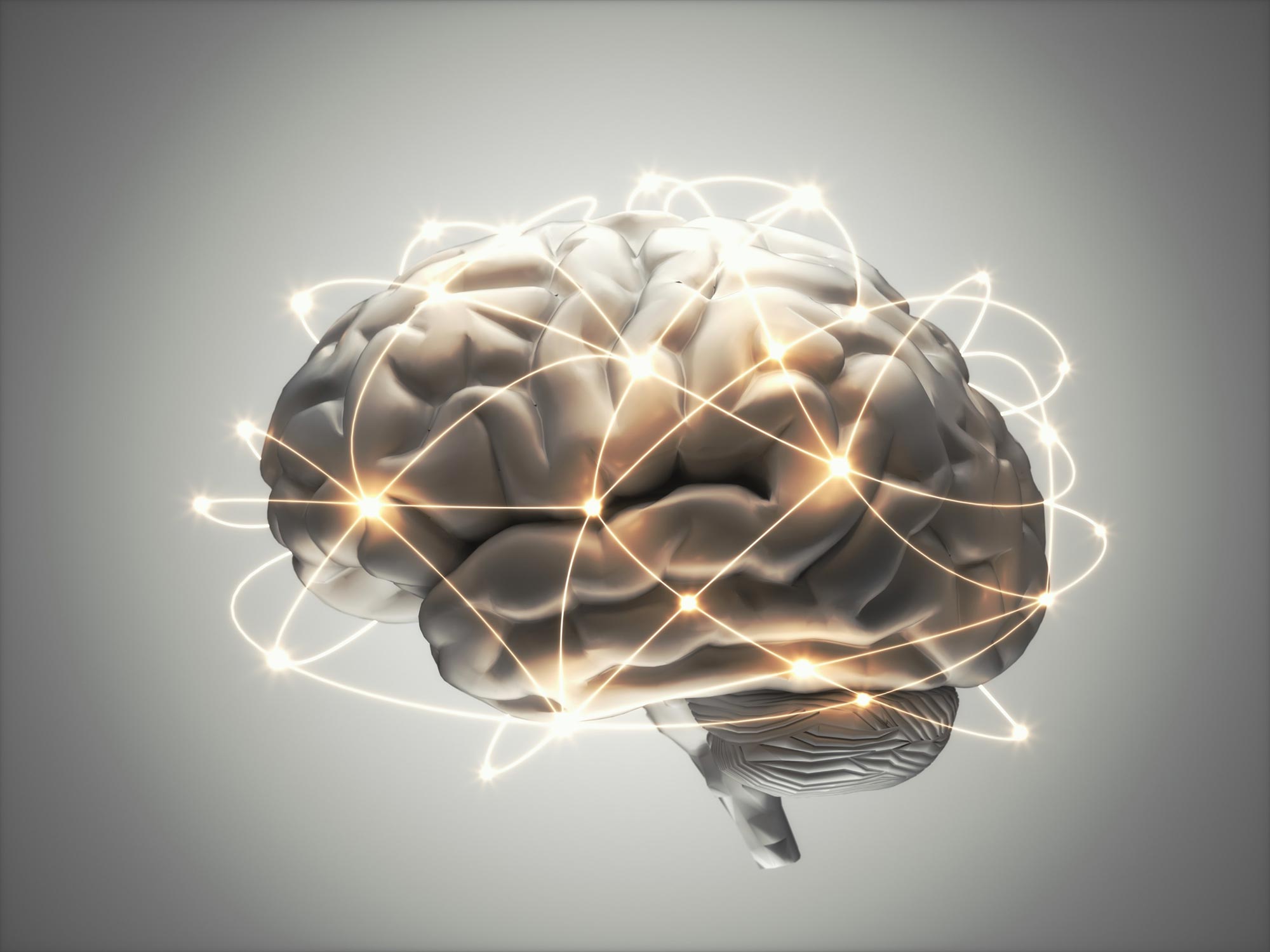
    A decades-long study suggests that sustained calorie restriction may influence how the brain ages at the cellular level. By analyzing individual brain cells, researchers found that reduced caloric intake was associated with key factors in preserving white matter integrity. Credit: Stock

    Long-term calorie restriction may help preserve brain cell function and slow molecular signs of aging.

    As we grow older, brain cells gradually lose efficiency. Cells in the central nervous system begin to show metabolic problems and accumulate oxidative damage, which interferes with their normal function. One important consequence is difficulty maintaining the myelin sheath (the protective covering around nerve fibers), a structure essential for fast and reliable communication between neurons.

    When myelin breaks down, white matter in the brain deteriorates, a change commonly seen with aging. At the same time, microglia, the brain’s primary immune cells, can shift from protective responders to persistently activated cells.

    Although microglial activation is a normal defense against injury or infection, in aging and in diseases such as Alzheimer’s, it can become chronic, fueling inflammation that harms neurons. The reasons this transition occurs are still not fully understood.
    Axonal Nerve Fibers Surrounded by Supporting Brain Cells
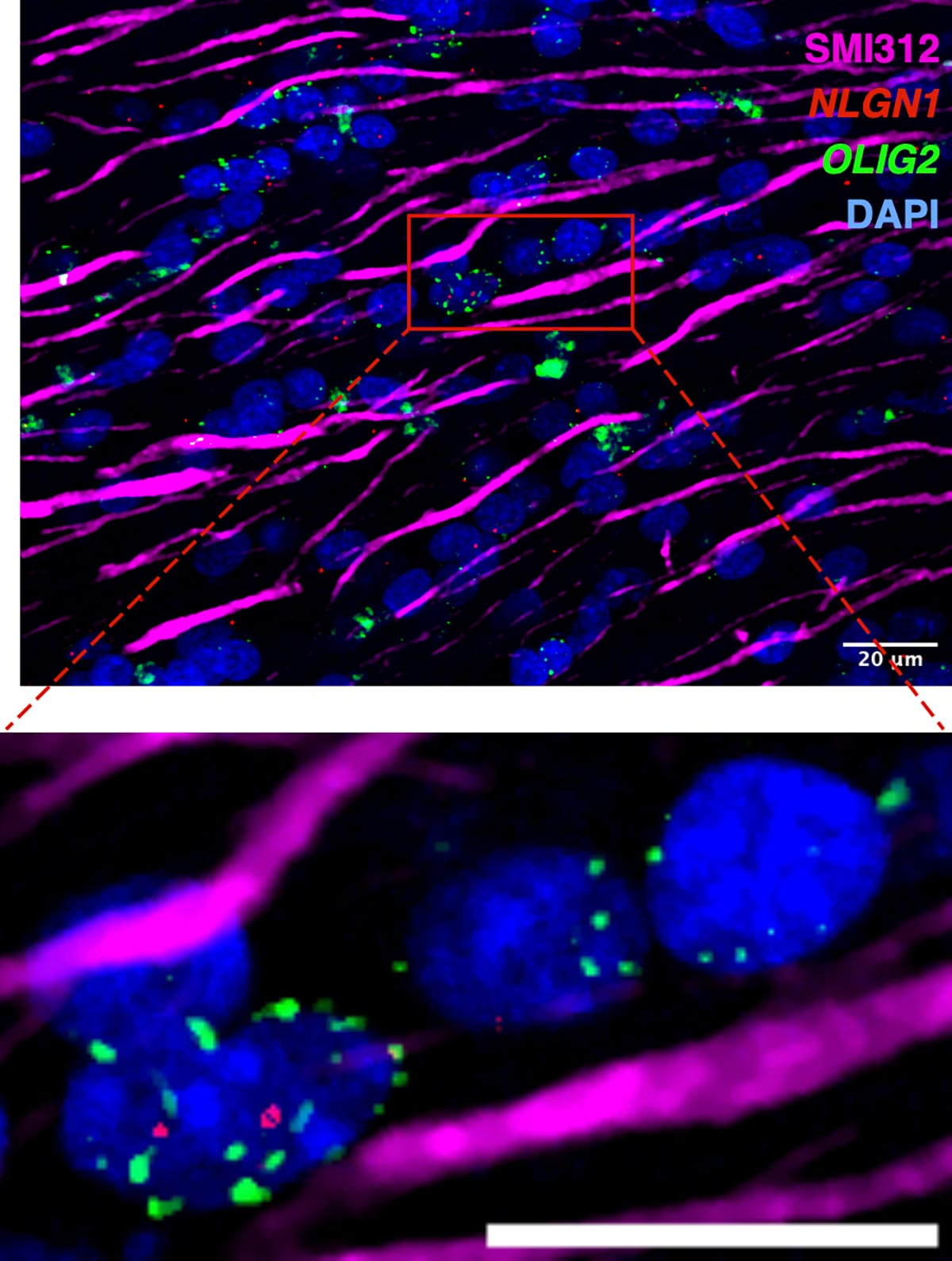
    Axonal nerve fibers (magenta) surrounded by supporting brain cells, whose nuclei are stained blue. Green puncta show OLIG2 mRNA, which identifies oligodendrocytes the brain cells that form the protective myelin sheath around nerves. Red puncta show NLGN1, a molecule that helps these oligodendrocytes connect to nerve fibers. Normally, aging reduces NLGN1 levels, disrupting myelin formation. However, researchers found that long-term calorie restriction helps maintain NLGN1 expression, potentially preserving healthy nerve insulation and communication. Credit: Boston University School of Medicine

    Long-term calorie restriction examined

    Researchers at Boston University Chobanian & Avedisian School of Medicine have now reported evidence that long-term calorie restriction may counter some of these age-related changes. In a study using an experimental model closely related to humans, the team found that reducing calorie intake by 30% for more than 20 years slowed biological signs of brain aging.

    Ana Vitantonio
    Ana Vitantonio. Credit: Boston University School of Medicine

    “While calorie restriction is a well-established intervention that can slow biological aging and may reduce age-related metabolic alterations in shorter-lived experimental models, this study provides rare, long-term evidence that calorie restriction may also protect against brain aging in more complex species,” says corresponding author Ana Vitantonio, a fifth-year PhD student in the department of pharmacology, physiology & biophysics.

    The project was launched in the 1980s in collaboration with the National Institute on Aging and tracked two groups throughout their natural lifespans. One group followed a typical, nutritionally balanced diet, while the other consistently consumed about 30% fewer calories.

    The initial aim was to determine whether sustained calorie restriction could extend lifespan. After the subjects died of natural causes, scientists conducted postmortem analyses of their brains to investigate how decades of different eating patterns influenced cellular aging.

    Inside the aging brain cell

    To understand what was happening inside aging brain cells, the team used single-nuclei RNA sequencing, a method that examines gene activity within individual cells. By comparing brain tissue from individuals on a standard diet with those on a calorie-restricted diet, the researchers were able to identify differences in gene expression and biological pathways associated with aging.

    Tara Moore
    Tara Moore, PhD. Credit: Boston University School of Medicine

    They found that brain cells from the calorie-restricted group showed stronger metabolic function and improved cellular performance. These cells displayed higher levels of myelin-related gene expression and greater activity in important metabolic pathways (glycolytic and fatty acid biosynthetic pathways) that support the production and maintenance of myelin.

    According to the researchers, these results suggest that long-term dietary habits can influence the course of brain aging at a molecular level. “This is important because these cellular alterations could have implications that are relevant to cognition and learning. In other words, dietary habits may influence brain health and eating fewer calories may slow some aspects of brain aging when implemented long term,” adds co-author Tara L. Moore, PhD, professor of anatomy & neurobiology.

    Reference: “Calorie Restriction Attenuates Transcriptional Aging Signatures in White Matter Oligodendrocytes and Immune Cells of the Monkey Brain” by Ana T. Vitantonio, Christina Dimovasili, Yuchen Liu, Bingtian Ye, Jou-Hsuan Roxie Lee, Molly Hartigan, Benjamin Bouchard, Madelyn Ray, Bryce Conner, Kelli L. Vaughan, Julie A. Mattison, Tara L. Moore, Chao Zhang and Douglas L. Rosene, 24 November 2025, Aging Cell.
    DOI: 10.1111/acel.70298

    This research was supported by the National Institutes of Health awards 1RF1AG062831-01, 2RF1AG043640-06, NIGMS 5T32GM008541-25, 1R21DK143406-01 and the NIA Intramural Research Program, NIH.

    Never miss a breakthrough: Join the SciTechDaily newsletter.
    Follow us on Google and Google News.

    Aging Boston University Brain Calorie Restriction Diet Metabolism
    Share. Facebook Twitter Pinterest LinkedIn Email Reddit

    Related Articles

    New Study Reveals Diet Can Turn Back the Clock on Brain Aging

    Scientists Identify Key Pathway for Brain Health Boost via Ketogenic Diet

    Turning Back Time: Study Links Key Nutrients to Slower Brain Aging

    The Isoleucine Paradox: Eat More, Weigh Less, Live Longer

    Why Do We Find It So Hard To Resist Treats Like Chocolate Bars? Scientists Discover Sweets Change Our Brain

    Scientists Identify Brain Aging “Sweet Spot”

    Scientists Discover That Eating Too Much During Development Permanently Alters the Brain

    A High Salt Low Potassium Diet Can Increase Your Risk of Cognitive Decline

    Fountain of Youth: Cutting Calories and Eating at the Right Time of Day Leads to a Longer Life

    1 Comment

    1. RobinC on March 5, 2026 9:29 am

      Who wants to be hungry for 20 years.

      Reply
    Leave A Reply Cancel Reply

    • Facebook
    • Twitter
    • Pinterest
    • YouTube

    Don't Miss a Discovery

    Subscribe for the Latest in Science & Tech!

    Trending News

    Scientists Finally Uncover How a “Forever Chemical” Causes Birth Defects

    Scientists Uncover the Earliest Brain Changes That May Predict Alzheimer’s Decades Before Symptoms

    Surprising New Study Challenges a Century-Old Theory of Habit Formation

    Scientists Turn Seawater Into Drinking Water Without Toxic Brine

    Vitamin D Drug Shows Surprising Promise Against One of the Deadliest Cancers

    NASA’s X-59 Sonic Boom Killer Is Ready for Its Biggest Test Yet

    The Best Exercise Combination for Longevity, According to a 30-Year Study

    Popular Weight-Loss Drug Found To Slow Biological Aging in Landmark Human Trial

    Follow SciTechDaily
    • Facebook
    • Twitter
    • YouTube
    • Pinterest
    • Newsletter
    • RSS
    SciTech News
    • Biology News
    • Chemistry News
    • Earth News
    • Health News
    • Physics News
    • Science News
    • Space News
    • Technology News
    Recent Posts
    • According to Scientists, This Simple Dietary Change Is Linked to Lower Depression Scores
    • Researchers Discover a Hidden Vitamin D Problem That Persists Year-Round
    • Scientists Are Building Electronics That Stretch Like Human Skin and Learn Like a Brain
    • Ancient Romans Were Obsessed With This Remarkable Herb – Then It Vanished Forever
    • AI Reveals Simple Ways To Make Your Meals Healthier and Cheaper
    Copyright © 1998 - 2026 SciTechDaily. All Rights Reserved.
    • Science News
    • About
    • Contact
    • Editorial Board
    • Privacy Policy
    • Terms of Use

    Type above and press Enter to search. Press Esc to cancel.