
Participants whose brains aged more slowly had a nutrient profile that was similar to that of the Mediterranean diet.
Scientists have been extensively researching the brain to promote healthier aging. Although there is considerable knowledge about risk factors that speed up brain aging, there is less understanding of how to prevent cognitive decline.
There is evidence that nutrition matters, and a novel study published on May 21 in the journal Nature Aging, from the University of Nebraska–Lincoln’s Center for Brain, Biology and Behavior and the University of Illinois at Urbana-Champaign (UIUC) further signals how specific nutrients may play a pivotal role in the healthy aging of the brain.
The team of scientists, led by Aron Barbey, director of the Center for Brain, Biology, and Behavior, with Jisheng Wu, a doctoral student at Nebraska, and Christopher Zwilling, research scientist at UIUC, performed the multimodal study — combining state-of-the-art innovations in neuroscience and nutritional science — and identified a specific nutrient profile in participants who performed better cognitively.
Study Design and Findings
The cross-sectional study enrolled 100 cognitively healthy participants, aged 65-75. These participants completed a questionnaire with demographic information, body measurements, and physical activity. Blood plasma was collected following a fasting period to analyze the nutrient biomarkers. Participants also underwent cognitive assessments and MRI scans. The efforts revealed two types of brain aging among the participants — accelerated and slower-than-expected. Those with slower brain aging had a distinct nutrient profile.
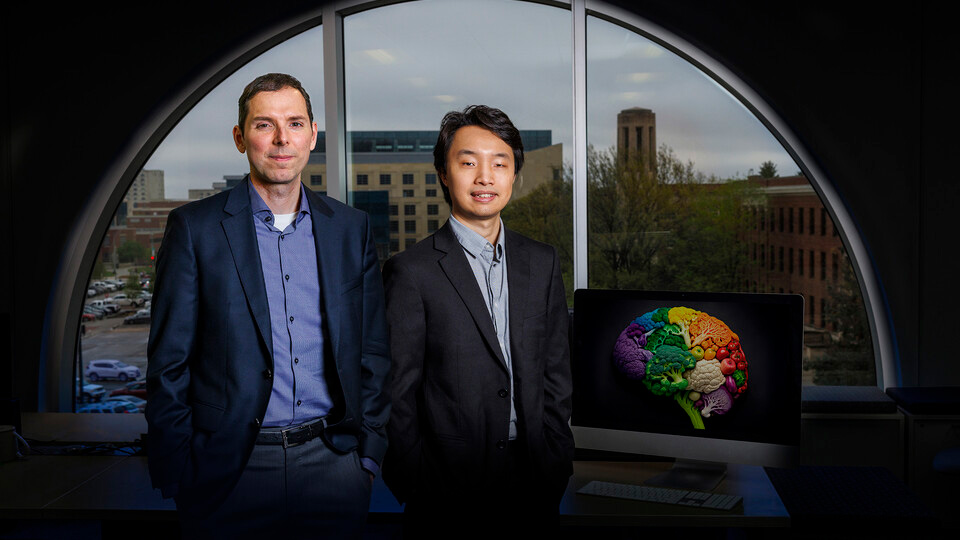
The beneficial nutrient blood biomarkers were a combination of fatty acids (vaccenic, gondoic, alpha-linolenic, eicosapentaenoic, eicosadienoic, and lignoceric acids); antioxidants and carotenoids including cis-lutein, trans-lutein, and zeaxanthin; two forms of vitamin E and choline. This profile is correlated with nutrients found in the Mediterranean diet, which research has previously associated with healthy brain aging.
“We investigated specific nutrient biomarkers, such as fatty acid profiles, known in nutritional science to potentially offer health benefits. This aligns with the extensive body of research in the field demonstrating the positive health effects of the Mediterranean Diet, which emphasizes foods rich in these beneficial nutrients,” Barbey, Mildred Francis Thompson Professor of Psychology, said. “The present study identifies particular nutrient biomarker patterns that are promising and have favorable associations with measures of cognitive performance and brain health.”

Barbey noted that previous research on nutrition and brain aging has mostly relied on food frequency questionnaires, which are dependent on participants’ own recall. This study is one of the first and the largest to combine brain imaging, blood biomarkers, and validated cognitive assessments.
“The unique aspect of our study lies in its comprehensive approach, integrating data on nutrition, cognitive function, and brain imaging,” Barbey said. “This allows us to build a more robust understanding of the relationship between these factors. We move beyond simply measuring cognitive performance with traditional neuropsychological tests. Instead, we simultaneously examine brain structure, function, and metabolism, demonstrating a direct link between these brain properties and cognitive abilities. Furthermore, we show that these brain properties are directly linked to diet and nutrition, as revealed by the patterns observed in nutrient biomarkers.”
Future Research and Implications
The researchers will continue to explore this nutrient profile as it relates to healthy brain aging. Barbey said it’s possible, in the future, that the findings will aid in developing therapies and interventions to promote brain health.
“An important next step involves conducting randomized controlled trials. In these trials, we will isolate specific nutrients with favorable associations with cognitive function and brain health, and administer them in the form of nutraceuticals,” Barbey said. “This will allow us to definitively assess whether increasing the levels of these specific nutrient profiles reliably leads to improvements in cognitive test performance and measures of brain structure, function, and metabolism.”
Barbey is also co-editing an upcoming special collection for the Journal of Nutrition, “Nutrition and the Brain — Exploring Pathways to Optimal Brain Health Through Nutrition,” which is currently inviting submissions for consideration, and articles will begin publishing next year.
“There’s immense scientific and medical interest in understanding the profound impact of nutrition on brain health,” Barbey said. “Recognizing this, the National Institutes of Health recently launched a ten-year strategic plan to significantly accelerate nutrition research. Our work directly aligns with this critical initiative, aiming to contribute valuable insights into how dietary patterns influence brain health and cognitive function.”
Reference: “Investigating nutrient biomarkers of healthy brain aging: a multimodal brain imaging study” by Christopher E. Zwilling, Jisheng Wu and Aron K. Barbey, 21 May 2024, npj Aging.
DOI: 10.1038/s41514-024-00150-8
The study was funded by Abbott Nutrition.
Never miss a breakthrough: Join the SciTechDaily newsletter.
Follow us on Google and Google News.
2 Comments
Great work. Now…just tell us what foods to eat. Mediterranean Diet?
Keep up the research great direction you’re going . Wishing you all success and positive vibes the earth possess. It can help a huge range of ages in this country and others. God Bless you. Thanks