
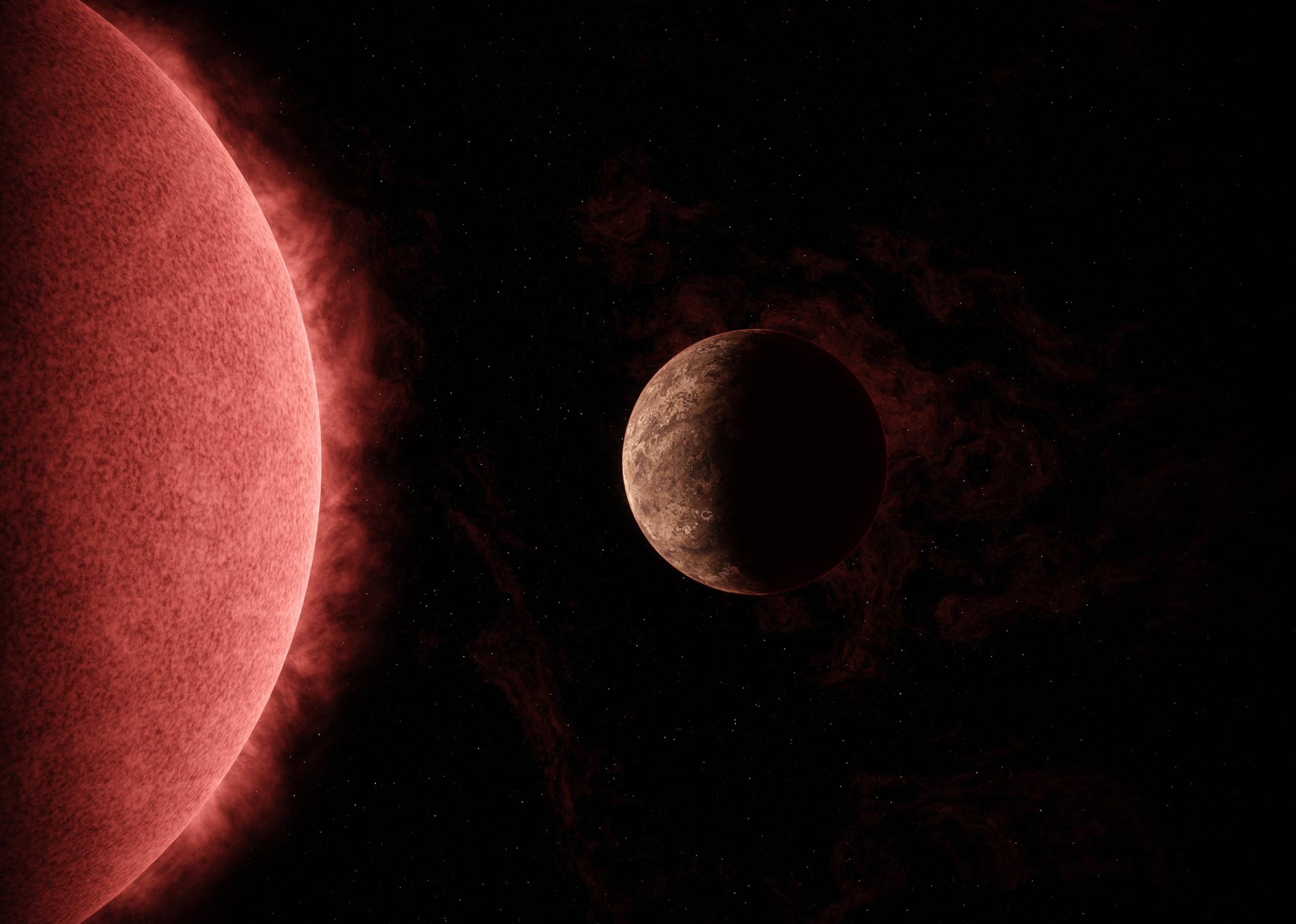
Astronomers have discovered an Earth-sized planet, SPECULOOS-3 b, orbiting an ultra-cool red dwarf star just 55 light years away. This tidally locked planet, which completes an orbit every 17 hours, was found by the international SPECULOOS project using a network of robotic telescopes.
A new, Earth-sized planet orbiting an ultra-cool red dwarf star, has been detected by an international team of astronomers – just 55 light years away.
The planet is only the second of its kind to be discovered around this type of star. Called SPECULOOS-3 b, it takes around 17 hours to complete an orbit of the star which is more than twice as cold as our sun, as well as ten times less massive and a hundred times less luminous.
Days and nights on SPECULOOS-3 b seem to be endless: the exoplanet is likely to be tidally locked, so the same side – the ‘dayside’ – always faces the star in a relationship similar to our moon and Earth.
The SPECULOOS Project
The discovery, published on May 15, 2024, in the journal Nature Astronomy, was made by the SPECULOOS project, which is led by the University of Liège, in Belgium, in collaboration with the Universities of Birmingham, Cambridge, Bern, and the Massachusetts Institute of Technology. SPECULOOS (Search for Planets EClipsing ULtra-cOOl Stars) was established to search for exoplanets orbiting ultra-cool dwarf stars using a network of robotic telescopes based around the world.
Challenges in Observing Ultra-cool Dwarf Stars
Ultra-cool dwarf stars are extremely common, making up around 70% of the stars in the Milky Way. But they are also very faint and scattered across the sky, so scientists have to observe data from telescopes over several weeks, monitoring each star individually to detect transiting planets.
“We designed SPECULOOS specifically to observe nearby ultracool dwarf stars in search of rocky planets that lend themselves well to detailed studies,” says Michaël Gillon, astronomer at the University of Liège and lead author on the paper. “In 2017, our SPECULOOS prototype using the TRAPPIST telescope discovered the famous TRAPPIST-1 system made up of seven Earth-sized planets, several of them potentially habitable. This was an excellent start!”
Global Collaboration and Observations
While most observations of this discovery were made by SPECULOOS telescopes in the Northern Hemisphere, the University of Birmingham researchers contributed some observations taken at the SPECULOOS South Observatory, located in the Atacama Desert in Chile.
Amaury Triaud, Professor of Exoplanetology at the University of Birmingham said: “The discovery of SPECULOOS-3 shows our worldwide network functions well and is ready to detect yet more rocky worlds orbiting very low mass stars While ultra-cool dwarf stars are cooler and smaller than our sun, their lifespan is over a hundred times longer – around 100 billion years – and they are expected to be the last stars still shining in the Universe.”
Potential for Life and Future Observations
This long life span, scientists believe, could offer opportunities for life on orbiting planets to develop.
Most astronomical data is automatically analyzed and planetary candidates are often first detected by algorithms before being reviewed by humans. However, in this case, this did not happen. Members of the SPECULOOS team had taken the habit of quickly glancing at the nightly data when they became available, and Dr. Georgina Dransfield, a former PhD student at the University of Birmingham and a current postdoctoral researcher in Birmingham noticed the planetary signal and alerted the whole collaboration.
She said: “The small size of ultra-cool dwarfs makes it easier to detect small planets. SPECULOOS-3b is special in that its stellar and planetary properties make it an optimal target for JWST, which is capable of getting information about the composition of the rocks that make its surface.”
Next steps for the project could include follow-up observations by the James Webb Space Telescope, which would deliver important insights into the planet’s surface mineralogy, and the potential for an atmosphere.
For more on this discovery:
- Astronomers Uncover Earth-Sized Exoplanet Just 55 Light-Years Away
- Astronomers Discover Nearby Earth-Sized Planet Without an Atmosphere
Reference: “Detection of an Earth-sized exoplanet orbiting the nearby ultracool dwarf star SPECULOOS-3” by Michaël Gillon, Peter P. Pedersen, Benjamin V. Rackham, Georgina Dransfield, Elsa Ducrot, Khalid Barkaoui, Artem Y. Burdanov, Urs Schroffenegger, Yilen Gómez Maqueo Chew, Susan M. Lederer, Roi Alonso, Adam J. Burgasser, Steve B. Howell, Norio Narita, Julien de Wit, Brice-Olivier Demory, Didier Queloz, Amaury H. M. J. Triaud, Laetitia Delrez, Emmanuël Jehin, Matthew J. Hooton, Lionel J. Garcia, Clàudia Jano Muñoz, Catriona A. Murray, Francisco J. Pozuelos, Daniel Sebastian, Mathilde Timmermans, Samantha J. Thompson, Sebastián Zúñiga-Fernández, Jesús Aceituno, Christian Aganze, Pedro J. Amado, Thomas Baycroft, Zouhair Benkhaldoun, David Berardo, Emeline Bolmont, Catherine A. Clark, Yasmin T. Davis, Fatemeh Davoudi, Zoë L. de Beurs, Jerome P. de Leon, Masahiro Ikoma, Kai Ikuta, Keisuke Isogai, Izuru Fukuda, Akihiko Fukui, Roman Gerasimov, Mourad Ghachoui, Maximilian N. Günther, Samantha Hasler, Yuya Hayashi, Kevin Heng, Renyu Hu, Taiki Kagetani, Yugo Kawai, Kiyoe Kawauchi, Daniel Kitzmann, Daniel D. B. Koll, Monika Lendl, John H. Livingston, Xintong Lyu, Erik A. Meier Valdés, Mayuko Mori, James J. McCormac, Felipe Murgas, Prajwal Niraula, Enric Pallé, Ilse Plauchu-Frayn, Rafael Rebolo, Laurence Sabin, Yannick Schackey, Nicole Schanche, Franck Selsis, Alfredo Sota, Manu Stalport, Matthew R. Standing, Keivan G. Stassun, Motohide Tamura, Yuka Terada, Christopher A. Theissen, Martin Turbet, Valérie Van Grootel, Roberto Varas, Noriharu Watanabe and Francis Zong Lang, 15 May 2024, Nature Astronomy.
DOI: 10.1038/s41550-024-02271-2
Never miss a breakthrough: Join the SciTechDaily newsletter.
Follow us on Google and Google News.