
Close Menu
    Facebook X (Twitter) Instagram
    SciTechDaily
    • Biology
    • Chemistry
    • Earth
    • Health
    • Physics
    • Science
    • Space
    • Technology
    Facebook X (Twitter) Pinterest YouTube RSS
    SciTechDaily
    Home»Science»Archaeologists Unearth Lost Camps of Chile’s Elephant Hunters
    Science

    Archaeologists Unearth Lost Camps of Chile’s Elephant Hunters

    By PLOSMay 27, 2024No Comments3 Mins Read
    Facebook Twitter Pinterest Telegram LinkedIn WhatsApp Email Reddit
    Share
    Facebook Twitter LinkedIn Pinterest Telegram Email Reddit
    New Late Pleistocene Settlement
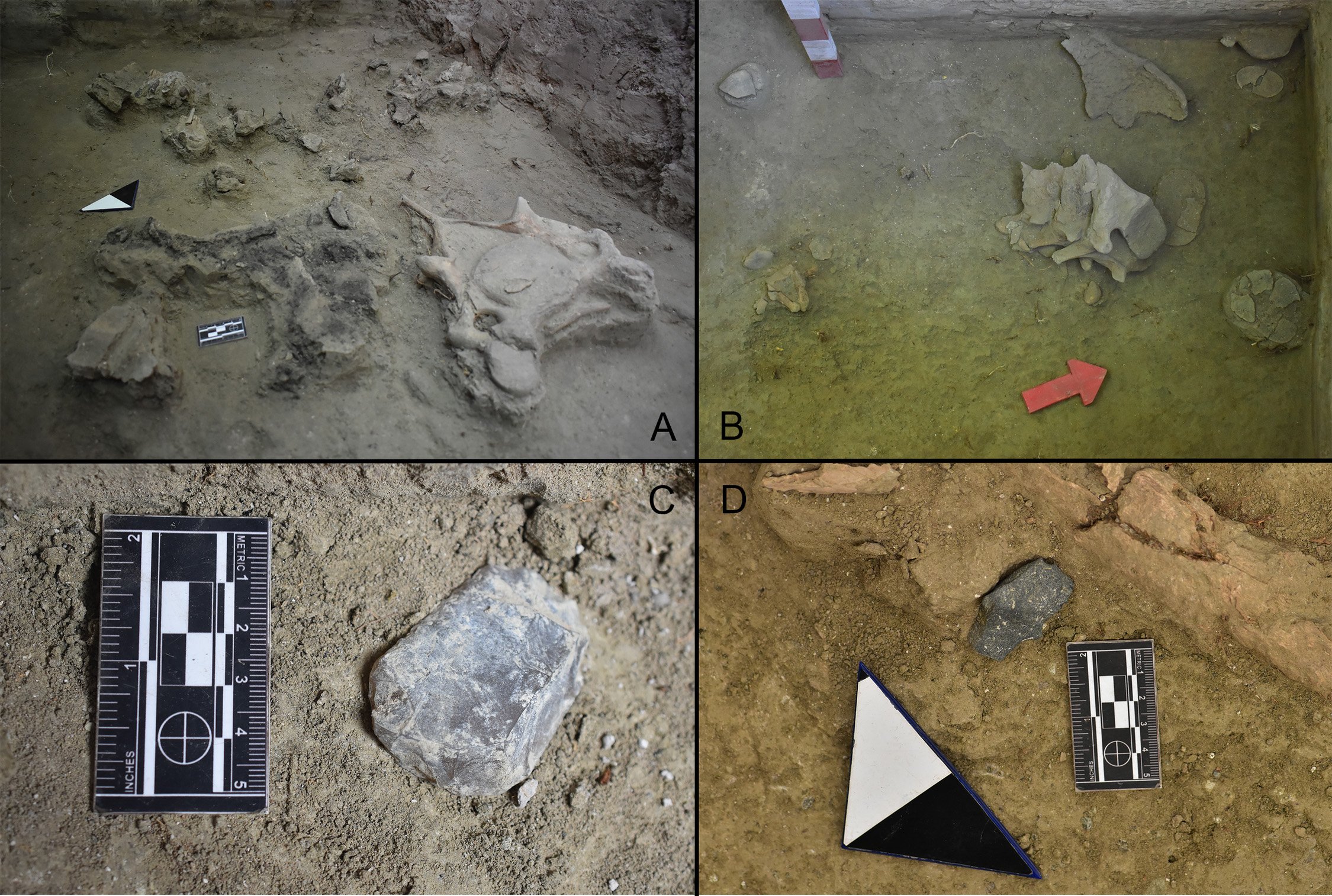
    Photographs from TT-3. A. Combustion feature spatially associated with gomphothere cervical vertebrae and skull fragments (excavation unit C5); B. Sacral and caudal vertebrae, vertebral discs, and unfused coxal portions (excavation unit F5). Note the distance between the first sacral vertebra and its vertebral disc; C. End scraper (TT3-U1-N18) in situ (excavation unit 1); D. Core debitage (TT3-G5-N18-12) in situ spatially associated with gomphothere remains (excavation unit G5). Credit: Labarca et al., 2024, PLOS ONE, CC-BY 4.0

    Temporary campsites indicate repeated visits by early hunter-gatherers.

    Thousands of years ago, early hunter-gatherers frequently visited Tagua Tagua Lake in Chile to hunt prehistoric elephants and utilize the area’s resources, according to a study recently published in the journal PLOS ONE by Rafael Labarca and colleagues from the Pontifical Catholic University of Chile.

    Multiple archaeological sites are known from the region of Tagua Tagua Lake in central Chile, representing some of the earliest known human settlements in the Americas. In this study, Labarca and colleagues report the recent discovery of a new site called Taguatagua 3, an ancient hunter-gatherer camp dating to the Late Pleistocene, between 12,440 and 12,550 years old.

    Subsistence Strategies and Seasonal Occupancy

    Notably, this site features the fossil remains of a gomphothere, an extinct relative of elephants. Signs of butchery on the bones, along with stone tools and other evidence, indicate that Taguatagua 3 represents a temporary camp established around the task of processing the large carcass. Other activities were also carried out during the camp’s brief period of use, including processing of other foods as indicated by additional charred remains of plants and small animals such as frogs and birds. Fossil cactus seeds and bird eggshells suggest that this camp was occupied specifically during the dry season.

    Numerous such sites of similar age are now known from this region, implying that Tagua Tagua Lake was a recurring hunting and scavenging ground for people during the Late Pleistocene due to abundant and predictable local resources. The researchers suggest that this area was a key location along the routes taken by mobile communities of the time and that temporary camps might have hosted regular meetings between these mobile bands. Further investigation of this rich archaeological region will continue to provide insights into the mobility and subsistence strategies of early humans in South America.

    The researchers add: “Taguatagua 3 helps us to understand better how the early humans adapted to fast-changing environments in central Chile during the late Pleistocene times.”

    Reference: “Taguatagua 3: A new late Pleistocene settlement in a highly suitable lacustrine habitat in central Chile (34°S)” by Rafael Labarca, Matías Frugone-Álvarez, Liz Vilches, José Francisco Blanco, Ángela Peñaloza, Carolina Godoy-Aguirre, Álvaro Lizama-Catalán, Cristóbal Oyarzo, Carlos Tornero, Erwin González-Guarda, Ayelen Delgado, Marcela Sepúlveda and Paula Soto-Huenchuman, 22 May 2024, PLOS ONE.
    DOI: 10.1371/journal.pone.0302465

    This research was funded by ANID-FONDECYT Grants 11170919, 11220930, 1230860, Fundación Palarq Grant 2020-2022, and the Ilustre Municipalidad de San Vicente. Additional support was provided by FONDEQUIP EQM150101 (SEM-EDX) and FONDEQUIP EQM150020 (Confocal microscopy/RAMAN/AFM spectroscopy).

    Never miss a breakthrough: Join the SciTechDaily newsletter.
    Follow us on Google and Google News.

    Archaeology Fossils PLOS
    Share. Facebook Twitter Pinterest LinkedIn Email Reddit

    Related Articles

    Forgotten Fossils: Mysterious Tusked Creature Unearthed in Rock Art

    Challenging Current Timelines: New Fossil Finds Suggest Early Humans in South America Over 20,000 Years Ago

    Mississippi’s Ostrich-Like Dinosaurs Among the World’s Largest, Tipping the Scales at Over 1,700 Pounds

    Surprising Diversity of Cretaceous Reptiles at Argentina Fossil Site – Revealed by Discovery of Ancient Teeth

    400,000 Year Old Fossil Helps Shed New Light on Human Evolution

    Extinct Animals From the Pleistocene Discovered in Mexico

    Exceptionally Preserved Brain Discovered Inside Waterlogged Pit

    Ash Preserved Fossils of Rangeomorphs Discovered in Newfoundland

    27-Foot Long Crocodylus Thorbjarnarsoni Roamed Kenya

    Leave A Reply Cancel Reply

    • Facebook
    • Twitter
    • Pinterest
    • YouTube

    Don't Miss a Discovery

    Subscribe for the Latest in Science & Tech!

    Trending News

    The Universe Is Expanding Too Fast and Scientists Can’t Explain Why

    “Like Liquid Metal”: Scientists Create Strange Shape-Shifting Material

    Early Warning Signals of Esophageal Cancer May Be Hiding in Plain Sight

    Common Blood Pressure Drug Shows Surprising Power Against Deadly Antibiotic-Resistant Superbug

    Scientists Uncover Dangerous Connection Between Serotonin and Heart Valve Disease

    Scientists Discover a “Protector” Protein That Could Help Reverse Hair Loss

    Bone-Strengthening Discovery Could Reverse Osteoporosis

    Scientists Uncover Hidden Trigger Behind Stem Cell Aging

    Follow SciTechDaily
    • Facebook
    • Twitter
    • YouTube
    • Pinterest
    • Newsletter
    • RSS
    SciTech News
    • Biology News
    • Chemistry News
    • Earth News
    • Health News
    • Physics News
    • Science News
    • Space News
    • Technology News
    Recent Posts
    • A Common Diabetes Drug May Hold the Key to Stopping HIV From Coming Back
    • Ancient “Syphilis-Like” Disease in Vietnam Challenges Key Scientific Assumptions
    • Drinking Alcohol To Cope in Your 20s Could Damage Your Brain for Life
    • Scientists Crack Alfalfa’s Chromosome Mystery After Decades of Debate
    • Ancient Ant-Plant Alliance Collapses As Predatory Wasps Move In
    Copyright © 1998 - 2026 SciTechDaily. All Rights Reserved.
    • Science News
    • About
    • Contact
    • Editorial Board
    • Privacy Policy
    • Terms of Use

    Type above and press Enter to search. Press Esc to cancel.