
Close Menu
    Facebook X (Twitter) Instagram
    SciTechDaily
    • Biology
    • Chemistry
    • Earth
    • Health
    • Physics
    • Science
    • Space
    • Technology
    Facebook X (Twitter) Pinterest YouTube RSS
    SciTechDaily
    Home»Earth»White and Black: Unveiling the Secrets of Saudi Arabia’s Volcanic Giants
    Earth

    White and Black: Unveiling the Secrets of Saudi Arabia’s Volcanic Giants

    By Emily Cassidy, NASA Earth ObservatoryMay 27, 20241 Comment3 Mins Read
    Facebook Twitter Pinterest Telegram LinkedIn WhatsApp Email Reddit
    Share
    Facebook Twitter LinkedIn Pinterest Telegram Email Reddit
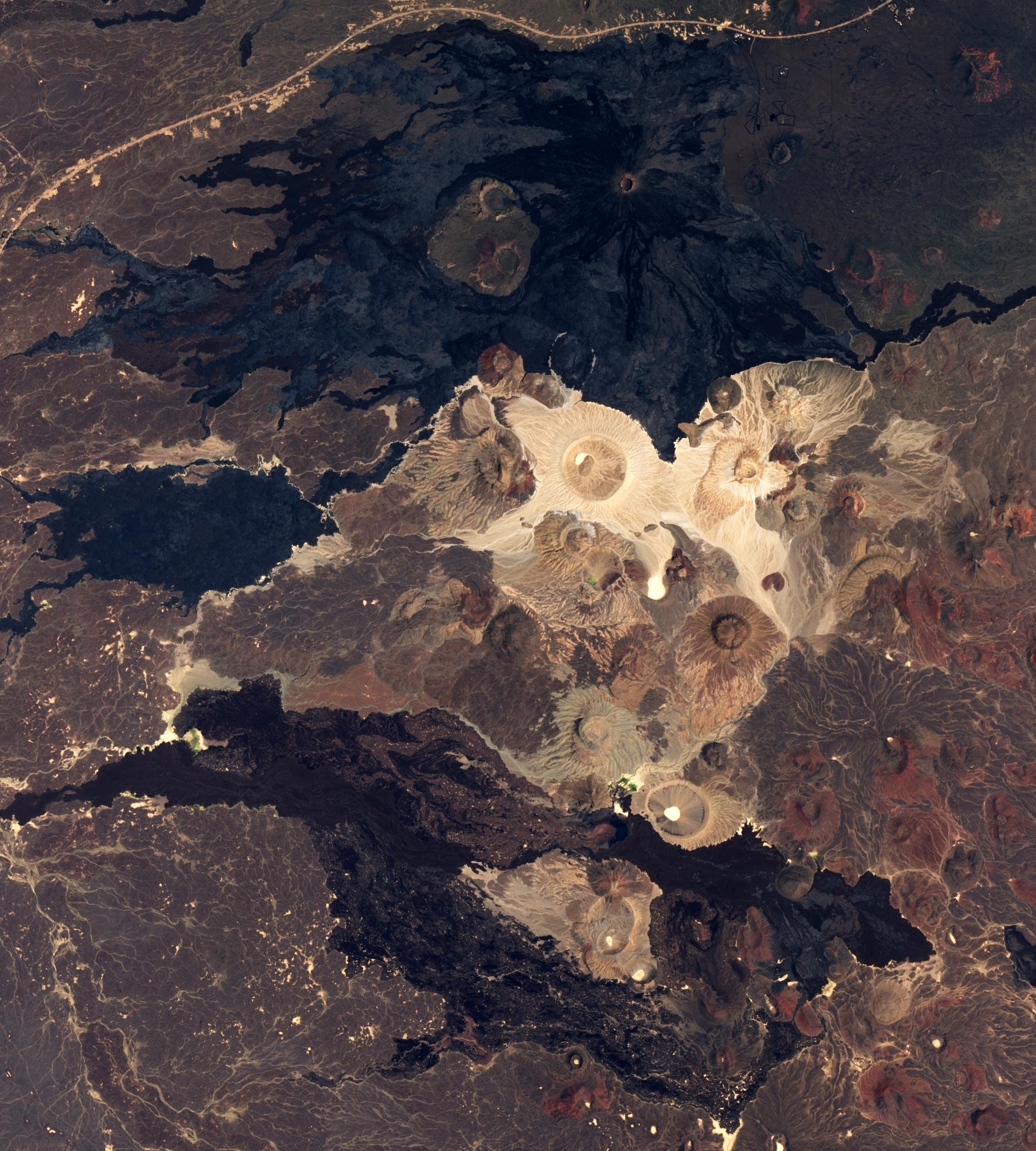
    Harrat Khaybar Volcanic Field Detail
    This satellite image, captured on April 25, 2024, by the Operational Land Imager-2 on Landsat 9, shows three of the youngest volcanic vents in Harrat Khaybar.

    Harrat Khaybar, a major volcanic field in Saudi Arabia, showcases a diverse range of volcanoes and eruptions, reflecting millions of years of geological activity. The contrasting colors of lava and ash reveal the geologic origins of Harrat Khaybar’s volcanic cones.

    While the Arabian Peninsula is known for its vast deserts of sand, the area also contains extensive fields of lava. At least 12 volcanic fields, known as harrats, are contained in the western half of the peninsula. One such field is the 14,000-square-kilometer (5,400-square-mile) Harrat Khaybar, one of the largest in Saudi Arabia.

    Geological Formation of Harrat Khaybar

    Harrat Khaybar was formed by eruptions over the past 5 million years along a 100-kilometer (60-mile) vent system that runs north-south. According to the Smithsonian’s Global Volcanism Program, the volcanic field is still active, and eight lava flows are less than 1,500 years old. The last known eruption was reported in Harrat Khaybar in the 7th century.

    Recent Volcanic Activity

    Three of the youngest volcanic vents in Harrat Khaybar can be seen in this image, acquired by the OLI-2 (Operational Land Imager-2) on Landsat 9. These volcanoes resulted from different eruptive styles: Jabal Qidr is a stratovolcano (or composite cone); Jabal Abyad is a felsic dome; and Jabal Bayda is a tuff cone.

    Harrat Khaybar Volcanic Field Annotated
    A wider view of the image above captured on April 25, 2024, by the Operational Land Imager-2 on Landsat 9

    Unique Features of Jabal Qidr, Jabal Abyad, and Jabal Bayda

    Jabal Qidr, in the northern part of the volcanic field, is built from several generations of dark, basaltic lava flows. Qidr has a 400-meter-diameter summit crater and exhibits the textbook cone shape of a stratovolcano. This is the only stratovolcano in the harrats of western Saudi Arabia.

    Jabal Abyad, in the center of the image, was formed from a more viscous, silica-rich lava classified as rhyolite. While Jabal Qidr exhibits the cone shape of a stratovolcano, Jabal Abyad is a lava dome—a rounded mass of thicker, more solidified lava flows. Abyad’s dome reaches over 2,090 meters above sea level, the highest elevation amongst all the surrounding harrats.

    To the west of Jabal Abyad is Jabal Bayda, a tuff cone volcano with a much larger summit crater measuring 1,400 meters in diameter. Tuff cones form from the interaction of rising magma with water. When heated rapidly by lava, water turns to steam and expands violently, fragmenting the lava into plumes of very fine grains of ash.

    Volcanic Colors and Naming

    Abyad and bayda are the masculine and feminine words for “white” in Arabic. The lighter color of these mountains comes from the ash of comenditic lavas that are rich with silica. The white and beige colors stand out against the darker basaltic lava of Qidr.

    NASA Earth Observatory images by Lauren Dauphin, using Landsat data from the U.S. Geological Survey.

    Never miss a breakthrough: Join the SciTechDaily newsletter.
    Follow us on Google and Google News.

    Geography Geology NASA NASA Earth Observatory Volcano
    Share. Facebook Twitter Pinterest LinkedIn Email Reddit

    Related Articles

    Island Obliterated: Dramatic Changes at Hunga Tonga-Hunga Ha’apai

    Movie Mars on Earth: Wadi Rum as a Stand-In for the Red Planet

    Ol Doinyo Lengai: The Symmetric “Mountain of God” in Tanzania Is Part of the East African Rift System

    From Russia With Questions: Distinctive Striping Pattern in Siberia Puzzles Researchers

    Gold Mining in Russia’s Central Aldan Ore District Seen From Space

    Socked in Stratovolcano: Astronaut on ISS Captures Incredible View of Uninhabited Atlasov Island

    Kilauea’s Lava Lake Returns – Hawaii’s Most Active Volcano Is Erupting Again

    Newberry Volcano Photographed by Astronaut Onboard the International Space Station

    Sea of Galilee Seen From Space – Source of Religious Inspiration and Intrigue

    1 Comment

    1. Clyde Spencer on May 29, 2024 2:04 pm

      Being composed of basalt, I would expect Jabal Qidr to be a shield volcano such as is found in the Hawaiian Islands. Stratovolcanoes are more commonly composed of andesite, diorite, or other rocks varying in composition over time, which are intermediate in composition between mafic and acidic. It appears that the lighter-colored felsic (acidic) rocks overlie the dark basalts (mafic), making them younger. It is common for the composition of mafic magmas to become acidic over time. I don’t have personal experience with the rocks found in this harrat; however, I suspect that Ms. Cassidy is mistaken in her nomenclature.

      Reply
    Leave A Reply Cancel Reply

    • Facebook
    • Twitter
    • Pinterest
    • YouTube

    Don't Miss a Discovery

    Subscribe for the Latest in Science & Tech!

    Trending News

    Scientists May Have Found the Key to Jupiter and Saturn’s Moon Mystery

    Scientists Uncover Brain Changes That Link Pain to Depression

    Saunas May Do More Than Raise Body Temperature – They Activate Your Immune System

    Exercise in a Pill? Metformin Shows Surprising Effects in Cancer Patients

    Hidden Oceans of Magma Could Be Protecting Alien Life

    New Study Challenges Alzheimer’s Theories: It’s Not Just About Plaques

    Artificial Sweeteners May Harm Future Generations, Study Suggests

    Splashdown! NASA Artemis II Returns From Record-Breaking Moon Mission

    Follow SciTechDaily
    • Facebook
    • Twitter
    • YouTube
    • Pinterest
    • Newsletter
    • RSS
    SciTech News
    • Biology News
    • Chemistry News
    • Earth News
    • Health News
    • Physics News
    • Science News
    • Space News
    • Technology News
    Recent Posts
    • Breakthrough Drug Delays Rheumatoid Arthritis for Years After Treatment Ends
    • This Small Change to Your Exercise Routine Could Be the Secret to Living Longer
    • Physicists Discover a Strange New Kind of One-Dimensional Particle
    • Scientists Discover Unexpected Climate Benefit Hidden in Forest Soils
    • The Grand Canyon’s “Swiss Cheese” Rocks Hold a Critical Secret
    Copyright © 1998 - 2026 SciTechDaily. All Rights Reserved.
    • Science News
    • About
    • Contact
    • Editorial Board
    • Privacy Policy
    • Terms of Use

    Type above and press Enter to search. Press Esc to cancel.