
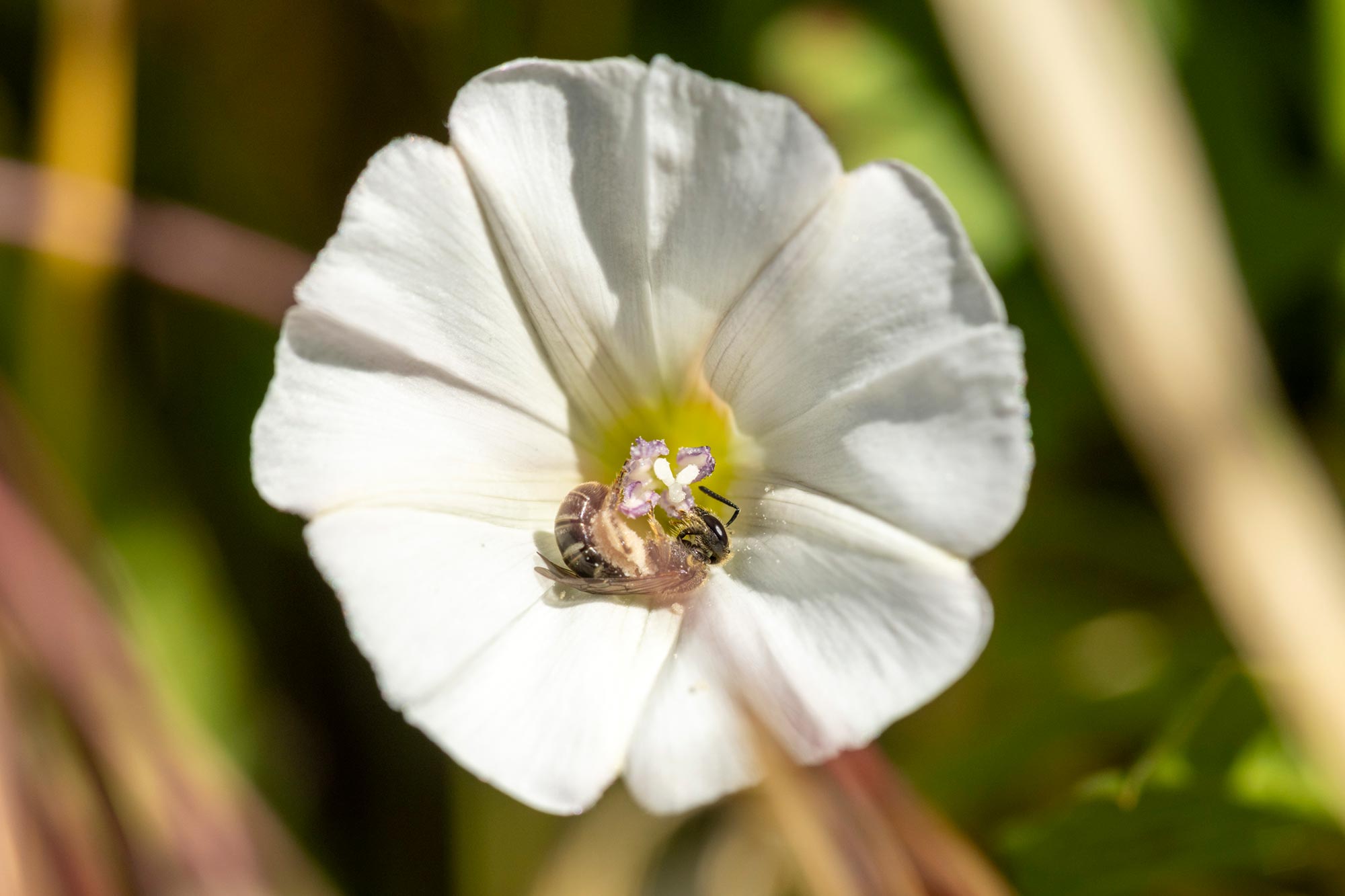
A study suggests that severe pollinator losses may have sharply slowed plant adaptation.
A morning glory facing a warmer climate may benefit from blooming earlier. But if pollinators are becoming harder to attract, producing larger flowers may matter more. New research suggests that these competing pressures have become linked in a way that sharply limits how quickly the plant can adapt.
University of Michigan researchers observed a 96% decline in the estimated rate of adaptation among wild morning glory populations over nine years. The shift could also matter to farmers because morning glory is a common agricultural weed, although the study does not show whether slower adaptation will make it easier or more difficult to manage.
Pollinators may be steering plant evolution
The researchers found that natural selection strongly favored larger flowers, which are more attractive to pollinators. At the same time, responding to climate change may require plants to flower earlier. Because flower size and flowering time became connected, evolution in one trait could restrict change in the other.
“Because pollinator pressure strongly favors larger flowers, that linkage may limit how efficiently the population can respond to other selective pressures. Whether that ultimately makes the weed more or less of a problem for farmers is hard to predict—and that unpredictability is itself part of the story,” said Regina Baucom, a professor in the U-M Department of Ecology and Evolutionary Biology.
The result was not caused by a lack of genetic diversity. The newer morning glory populations still contained enough variation that they would normally be expected to adapt. Instead, the connection between traits appeared to be directing evolutionary change toward larger flowers, potentially reducing the plants’ ability to adjust flowering time as the climate shifts.
“The plant isn’t running out of evolutionary fuel—it’s increasingly locked into a trajectory that favors pollinator attraction, potentially at the expense of climate adaptation,” Baucom said.
Wild plants are adapting slower than expected
Recent doctoral graduate Sasha Bishop led the research with Baucom and University of Toronto researcher John Stinchcombe. Their goal was to understand how morning glories are responding to several forms of human-caused environmental change at once.
Rising temperatures are only one part of that pressure. Development has replaced previously undisturbed habitat, while pesticides, herbicides, and other widespread agricultural practices have contributed to steep pollinator declines. Plants must therefore respond simultaneously to a changing climate and to changes in the animals they depend on for reproduction.
The study, published in Evolution Letters, also addresses a wider puzzle in evolutionary biology. Theory suggests that organisms with enough genetic variation should be capable of adapting rapidly as their surroundings change. Yet many wild plant populations are declining rather than keeping pace.
“Instead of evolving, there are all these wild populations that are dying off, declining or going through genetic bottlenecks,” Bishop said. “So we’re looking at a situation in which there’s a lag in what we’re seeing in the adaptive rate in wild populations compared to what we think might be theoretically possible in terms of rapid evolution.”
Nine years revealed a growing constraint
To investigate what was slowing adaptation, the researchers compared morning glory seeds collected from wild populations nine years apart. They grew plants from both sets under controlled conditions so that differences between them could be evaluated directly.
The researchers measured traits that could be shaped by climate or pollinator pressure. These included the date when each plant produced its first flower, overall flowering time, flower size, nectar sugar, and the distance between the anthers, which produce pollen, and the stigma, which receives it.
Looking at each trait separately would not reveal whether changes in one were restricting changes in another. To capture those relationships, the researchers calculated adaptation using a statistic called R.
This measure estimates how a population is expected to adapt after accounting for connections among its traits. It allowed Bishop and her colleagues to determine whether one characteristic could “constrain” another, meaning that change in one trait could influence whether and how the other changed.
Linked traits sharply reduced adaptation
When traits vary together, researchers describe them as covariants. In the morning glories, flower size and flowering time became increasingly linked during the nine-year interval.
That connection had a large effect on the plants’ predicted ability to adapt. In the original population, the estimated rate of adaptation was about 76% of what would have been expected if the traits were not linked. Nine years later, it had fallen to about 9% of that expectation.
The comparison indicates that the plants retained genetic variation, but their traits had become organized in a way that sharply narrowed the evolutionary paths available to them. Selection favoring larger flowers may therefore interfere with the shift toward earlier flowering that could help plants respond to changing temperature and rainfall.
“There are quite literally thousands of studies showing that flowering phenology is a really important adaptive path when it comes to climate change, particularly temperature changes and precipitation changes, both of which happened in these wild populations in the locations where they were collected from,” Bishop said. “The implication in my mind is that pollinator decline, or the lack of pollination and selective drive to attract pollinators, is making these plants potentially less able to adapt to climatic shifts.”
Reference: “A resurrection experiment reveals reduced adaptive potential in a common agricultural weed” by Sasha G D Bishop, John R Stinchcombe and Regina S Baucom, 7 July 2026, Evolution Letters.
DOI: 10.1093/evlett/qrag026
Funding: University of Michigan, Dr. Nancy William Walls Award for Field Research, and the NSERC Discovery Grant.
Never miss a breakthrough: Join the SciTechDaily newsletter.
Follow us on Google and Google News.
1 Comment
Try pesticides