
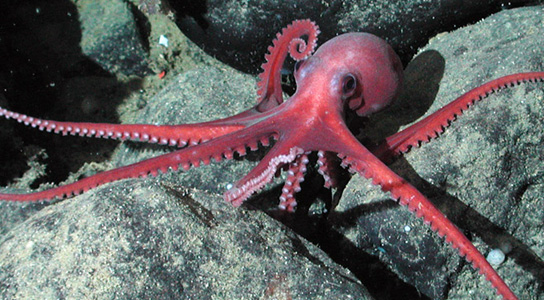
Octopuses have found a novel way of beating the frigid temperatures of the Antarctic waters by using RNA editing to customize crucial nervous system proteins, allowing them to work at low temperatures. A new paper in Science is the first to reveal that RNA editing, not just changes to genes, can lead to adaptations.
Low temperatures will hamper certain proteins in the nervous system, meaning that it will have problem sending signals. When a nerve cell fires, protein channels open or close in its membrane, allowing ions to come in or go out. Once it returns to normal, the ion channels let potassium ions out. Extremely cold temperatures can delay the closing of the channels, hindering a neuron’s ability to fire again. Scientists have hypothesized that some species living in extremely frigid climates have modified their potassium channels so that they work better in the cold.
 Molecular neurophysiologist Joshua Rosenthal from the University of Puerto Rico Medical Sciences Campus in San Juan, accompanied by his graduate student Sandra Garrett, has figured out how this adaptation has occurred. They initially thought that they’d see changes at the gene-level, implying that the expected potassium channel gens from these cold-living species would have evolved to become more efficient in low temperatures.
They tested their hypothesis by comparing an octopus species living in the Antarctic seas to another one living in a Puerto Rican coral reef. They found that the potassium channel genes in the two species were almost identical. Then, they injected the genes into frog egg cells, which manufactured each protein and installed it into their plasma membranes. This allowed the researchers to measure the electrical activity of each species’ potassium channel.
They discovered that the potassium channels functioned in the same way. They turned over to the RNA editing hypothesis. RNA editing allows changing proteins coded by genes. During the RNA editing, which can alter the sequence of amino acids, and thus change the proteins’ function, the Antarctic octopus edits its RNA at 9 sites that change the amino acid sequence of the potassium channel. The change more than doubles the channel’s closing speed, allowing for a better adaptation to the cold waters. The colder the environment, the more likely that the species will make RNA edits to the channels.
Reference: “RNA Editing Underlies Temperature Adaptation in K+ Channels from Polar Octopuses” by Sandra Garrett and Joshua J. C. Rosenthal, 5 January 2012, Science.
DOI: 10.1126/science.1212795
Never miss a breakthrough: Join the SciTechDaily newsletter.
Follow us on Google and Google News.
1 Comment
How is the RNA edited?